
Oncology CRO services – Syngeneic Mouse Models
Syngeneic mouse models represent one of the first steps needed to determine the efficacy of your novel immunotherapies in an in vivo model with functional immune system
InnoSer’s Syngeneic Mouse Model Services
Syngeneic mouse models are established from immortalized murine cancer cells originating from inbred mouse strains that are implanted and grown in genetically identical strains. Avoiding the need to use immunocompromised mice, this approach allows you to study your novel immunotherapy’s efficacy in a mouse model that combines tumor microenvironment interactions with a fully functional immune system.
Therefore, experts at InnoSer recommend the use of syngeneic rodent models (mice or rats) as a first step to evaluate the efficacy of your novel immunotherapy approaches (vaccines, mRNA-based therapeutics, immune checkpoint inhibitors, antibody-drug conjugates, (stem) cell therapy such as CAR-T cell therapy, NK cell therapy, etc., as well as classical anti-tumoral compounds (chemotherapy, radiotherapy). Accordingly, syngeneic mouse models represent an easy-to-use, relatively inexpensive mouse model with short study timelines (2-4 weeks), offering reproducible immune response results. However, for more advanced studies, InnoSer’s experts recommend working with humanized mouse models.
✓ Available as subcutaneous or orthotopic models (fluorescently labeled rodent cell lines or followed-up via ultrasound).
✓ マウスおよびラットの細胞株 が利用可能です。
✓ Complementary immuno-oncology in vitro assays and PK/PD profiling services.

Developing new, safe, and efficacious anticancer therapies is an extremely intricate process. As a preclinical oncology contract research organization (CRO), InnoSer partners with you to help you navigate the complexities of this research area.
Scientists at InnoSer collaborate with you to develop the most optimal study design to help answer your research questions most cost-effectively. With flexible and fast study start times you can perform your research at an accelerated pace. By outsourcing your preclinical oncology studies to InnoSer, you gain access to our in vitro and in vivo oncology drug development portfolio.
研究に最適なツールを手に入れよう。
当社の腫瘍学プラットフォームを探索・比較し、研究ニーズに最適なモデルを特定してください。

Syngeneic Mouse Models Sample Data

Tumor growth curve data from the 4T1 (breast cancer cell line) syngeneic mouse model.
Following initial cell culturing, murine breast cancer cells (4T1 mouse breast cell line) were injected orthotopically (directly into the mammary fat pad) of BALB/C mice. This mouse model is available at InnoSer both as an (A) subcutaneous (4T1) whereby tumor growth is followed via calipers and (B) orthotopic mouse model (4T1-luc) whereby tumor growth is followed via bioluminescent imaging. The model is validated with standard-of-care treatments doxorubicin and gemcitabine.

Tumor growth curve data from the PanO2 (pancreatic cancer cell line) syngeneic mouse model.
Following initial cell culturing, murine pancreatic cancer cells (PanO2 cell line) were injected subcutaneously into the left flank of C57BL/6 mice. Model is validated with standard-of-care treatment gemcitabine (tested at different concentrations).

Tumor growth curve data from the MC38 (colorectal carcinoma) syngeneic mouse model.
Following initial cell culturing, murine colorectal carcinoma cells (MC38 cell line) were injected into the left flank of C57BL/6 mice. The MC38 colorectal carcinoma syngeneic mouse model is available at InnoSer both as (A) subcutaneous and (B) orthotopic model. The model is validated with checkpoint inhibitor anti-PD-1.

Tumor growth curve data from the Renca (renal cell carcinoma) syngeneic mouse model.
Following initial cell culturing, murine renal cell carcinoma cells (Renca cell line) were injected into the left flank of C57BL/6 mice. The renal cell carcinoma Renca syngeneic mouse model is available at InnoSer both as a (A) subcutaneous model and orthotopic (B-C) model. The model is validated with standard-of-care treatment Doxorubicin (different dosages tested). Compared to healthy kidneys (B), kidneys of mice injected with Renca cells (C) lead to increase in total kidney volume and development of lesions which can be longitudinally imaged and quantified.
Key Syngeneic Mouse Models Readouts
あなたの研究を支える人々

セリーヌ・エレンス博士、免疫学研究 ディレクター
当社の免疫腫瘍学研究責任者セリーヌ・エレンス率いる専門家チームが、適切なツールの選択と最適な試験設計の構築を支援します。当該分野への深い理解に基づき、リード化合物の前臨床試験を厳選することで、貴社の医薬品開発を加速するソリューションを提供します。

ヤニック・ファントン博士、最高科学責任者
イノサーの最高科学責任者として、ヤニックはイノサーにおける全ての顧客調査を担当し、科学的・技術的な調整業務を統括している。
腫瘍学理事会メンバー

エスター・ヴォルフス教授博士
イノサーの科学諮問委員会のメンバーであるウルフス博士は、幹細胞治療の第一人者である。現在ハッセルト大学の教授を務める エスターは、 抗がん治療における幹細胞の利用と、シャルコー・マリー・トゥース病1A型の研究モデルとしての幹細胞活用に取り組んでいる。

医学博士、博士(医学)マリエ・スリンガーランド
イノサーの科学諮問委員会のメンバーであるライデン大学医療センターのスリンガーランド博士は、消化器癌および頭頸部癌における臨床試験、特に腫瘍内免疫パラメータに焦点を当てている。
よくあるご質問
How can I use in vivo imaging for orthotopic models in my research?
- Bioluminescence imaging (BLI): Ideal for tracking labeled tumor cells in real-time.
- Ultrasound imaging: A non-invasive option for quantifying tumor size in non-labeled models (e.g., RENCA renal carcinoma).
What is the advantage of tracking tumor growth using bioluminesence imaging?
- Non-invasive and longitudinal tracking: Monitor tumor growth over time without sacrificing animals, reducing variability and animal numbers.
- High sensitivity: Allows early detection of small tumors that may not be visible with other methods.
- BLI is especially suitable for orthotopic models where tumors are located in internal sites that are difficult to measure manually.
How can tumor growth be tracked in non-fluorescently labelled orthotopic syngeneic mouse models?
- Other imaging modalities: Ultrasound imaging is a common alternative for internal tumors (e.g., RENCA renal cell carcinoma).
- Manual measurement: Tumors can be manually measured post-sacrifice at pre-determined time points, but this requires increased animal numbers and imposes higher study costs.
- These considerations further highlight the advantages of incorporating in vivo imaging to improve data quality and reduce study expenses.
Do you have a list of available cell lines for syngeneic applications at InnoSer?
- Pan02 cell line of pancreatic ductal adenocarcinoma)
- RENCA cell line of renal cell carcinoma)
- B16F10 cell line of melanoma
- MC38 cell line of colorectal carcinoma.
View the list of syngeneic mouse models available at InnoSer here.
I don't see my cell line of interest in your syngeneic mouse model list, can InnoSer validate new models on request?
What examples of PD-1 responsive tumor models does InnoSer offer?
- Hepa1-6 (liver carcinoma)
- CT-26 (colon carcinoma)
- MBT-2 (bladder carcinoma)
- MC38 (colon adenocarcinoma)
その他の関連する腫瘍学研究モデルを発見する


研究に最適なツールを手に入れよう。
当社の腫瘍学プラットフォームを探索・比較し、研究ニーズに最適なモデルを特定してください。
好奇心を持ち続けよう:さらに探求できる記事
前臨床腫瘍学のための個別化リンパ腫CDXマウスモデル
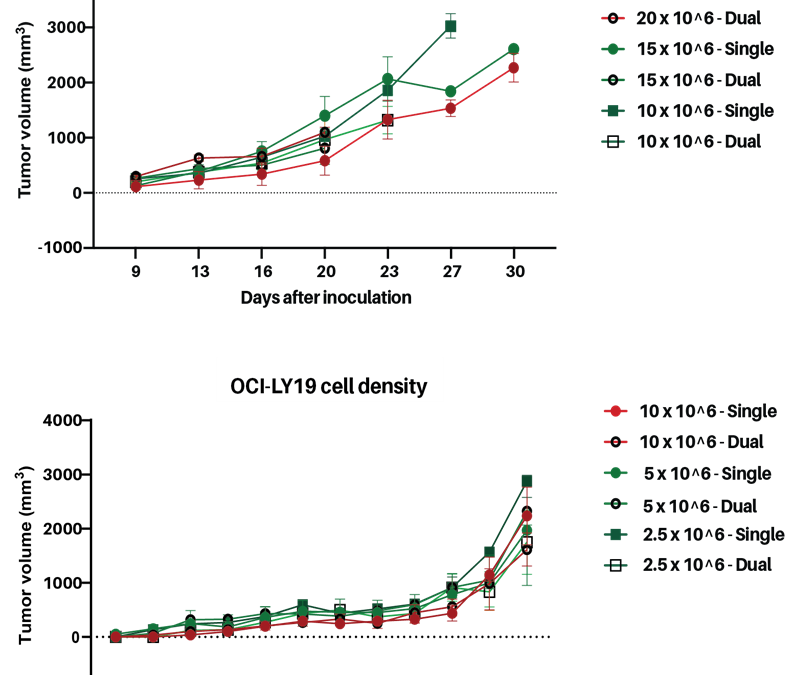
最近の研究において、我々は、OCI-Ly19(びまん性大細胞型B細胞リンパ腫、DLBCL)およびREC-1(マントル細胞リンパ腫)の細胞株から作製された、2つの新しいヒトリンパ腫細胞株由来異種移植(CDX)モデルを確立し、その妥当性を検証した。これらのモデルは、戦略的な...

免疫腫瘍学研究におけるマルチプレックスサイトカインおよび免疫細胞プロファイリング
メソスケール・ディスカバリー(MSD)プラットフォームは、高感度かつ多重のサイトカインプロファイリング分析システムであり、ごく微量のサンプル(わずか1μL)から複数の標的サイトカイン、ケモカイン、抗体、成長因子を同時に定量することが可能です。これにより...

膵臓癌患者由来異種移植モデル
先月11月は膵臓がん啓発月間でした。これは最も攻撃的で致死率の高いがん種の一つがもたらす課題に焦点を当てる時期です。膵臓がんは欧州で診断される全がんの約3%を占め、膵臓...

InnoSerの主要なin vitro腫瘍学サービスを探る:PD-1/PD-L1遮断アッセイ
腫瘍学における免疫チェックポイント阻害剤の創薬近年、免疫チェックポイント阻害は免疫腫瘍学における画期的な治療戦略として台頭している。プログラム細胞死1受容体(PD-1)とそのリガンドであるプログラム細胞死リガンド1(PD-L1)...
AAALAC認定
InnoSerはAAALAC認証を取得し、責任ある動物ケアと利用への取り組みを実証しています。AAALAC Internationalは、自主的な認証および評価プログラムを通じて科学における動物の適切な扱いを推進する非営利組織です。InnoSerのオランダおよびベルギー施設は、それぞれ2016年および2020年よりAAALAC認証を取得しています。AAALAC認証プログラムの詳細はこちらをご覧ください。

動物福祉
3R原則は、政策や規制の変更から新技術・手法の開発と普及に至るまで、あらゆる分野に影響を及ぼします。このためInnoSerは、これらのプロセスに対する継続的な取り組みと監視を実施しています。当社が実践する手順は、動物実験の代替・削減・改善を最大限に実現し、研究および医薬品開発におけるこれらの原則への取り組みを促進します。
info@innoserlaboratories.com