
Oncology CRO services – Syngeneic Mouse Models
Syngeneic mouse models represent one of the first steps needed to determine the efficacy of your novel immunotherapies in an in vivo model with functional immune system
InnoSer’s Syngeneic Mouse Model Services
Syngeneic mouse models are established from immortalized murine cancer cells originating from inbred mouse strains that are implanted and grown in genetically identical strains. Avoiding the need to use immunocompromised mice, this approach allows you to study your novel immunotherapy’s efficacy in a mouse model that combines tumor microenvironment interactions with a fully functional immune system.
Therefore, experts at InnoSer recommend the use of syngeneic rodent models (mice or rats) as a first step to evaluate the efficacy of your novel immunotherapy approaches (vaccines, mRNA-based therapeutics, immune checkpoint inhibitors, antibody-drug conjugates, (stem) cell therapy such as CAR-T cell therapy, NK cell therapy, etc., as well as classical anti-tumoral compounds (chemotherapy, radiotherapy). Accordingly, syngeneic mouse models represent an easy-to-use, relatively inexpensive mouse model with short study timelines (2-4 weeks), offering reproducible immune response results. However, for more advanced studies, InnoSer’s experts recommend working with humanized mouse models.
✓ Available as subcutaneous or orthotopic models (fluorescently labeled rodent cell lines or followed-up via ultrasound).
✓ Des lignées cellulaires murines et de rat sont disponibles.
✓ Complementary immuno-oncology in vitro assays and PK/PD profiling services.

Developing new, safe, and efficacious anticancer therapies is an extremely intricate process. As a preclinical oncology contract research organization (CRO), InnoSer partners with you to help you navigate the complexities of this research area.
Scientists at InnoSer collaborate with you to develop the most optimal study design to help answer your research questions most cost-effectively. With flexible and fast study start times you can perform your research at an accelerated pace. By outsourcing your preclinical oncology studies to InnoSer, you gain access to our in vitro and in vivo oncology drug development portfolio.
Accédez aux outils adaptés à vos recherches.
Découvrez et comparez nos plateformes d'oncologie afin d'identifier le modèle le mieux adapté aux besoins de votre étude.

Syngeneic Mouse Models Sample Data

Tumor growth curve data from the 4T1 (breast cancer cell line) syngeneic mouse model.
Following initial cell culturing, murine breast cancer cells (4T1 mouse breast cell line) were injected orthotopically (directly into the mammary fat pad) of BALB/C mice. This mouse model is available at InnoSer both as an (A) subcutaneous (4T1) whereby tumor growth is followed via calipers and (B) orthotopic mouse model (4T1-luc) whereby tumor growth is followed via bioluminescent imaging. The model is validated with standard-of-care treatments doxorubicin and gemcitabine.

Tumor growth curve data from the PanO2 (pancreatic cancer cell line) syngeneic mouse model.
Following initial cell culturing, murine pancreatic cancer cells (PanO2 cell line) were injected subcutaneously into the left flank of C57BL/6 mice. Model is validated with standard-of-care treatment gemcitabine (tested at different concentrations).

Tumor growth curve data from the MC38 (colorectal carcinoma) syngeneic mouse model.
Following initial cell culturing, murine colorectal carcinoma cells (MC38 cell line) were injected into the left flank of C57BL/6 mice. The MC38 colorectal carcinoma syngeneic mouse model is available at InnoSer both as (A) subcutaneous and (B) orthotopic model. The model is validated with checkpoint inhibitor anti-PD-1.

Tumor growth curve data from the Renca (renal cell carcinoma) syngeneic mouse model.
Following initial cell culturing, murine renal cell carcinoma cells (Renca cell line) were injected into the left flank of C57BL/6 mice. The renal cell carcinoma Renca syngeneic mouse model is available at InnoSer both as a (A) subcutaneous model and orthotopic (B-C) model. The model is validated with standard-of-care treatment Doxorubicin (different dosages tested). Compared to healthy kidneys (B), kidneys of mice injected with Renca cells (C) lead to increase in total kidney volume and development of lesions which can be longitudinally imaged and quantified.
Key Syngeneic Mouse Models Readouts
Les personnes qui travaillent sur vos recherches

Céline Erens, docteure en immunologie, étude Directrice
Une équipe d'experts dirigée par notre directrice d'études en immuno-oncologie, Céline Erens, vous aide à choisir les outils adaptés et à mettre en place des protocoles d'étude optimaux. La gestion des essais précliniques de vos composés phares, fondée sur une connaissance approfondie du domaine, est la clé pour accélérer le développement de vos médicaments.

Yanick Fanton, docteur, directeur scientifique
En tant que directeur scientifique chez InnoSer, Yanick est responsable de toutes les études menées pour le compte des clients de l'entreprise et assure la coordination scientifique et technique.
Membres du comité d'oncologie

Prof. Dr Esther Wolfs
Membre du Conseil consultatif scientifique d’InnoSer, le Dr Wolfs est une chercheuse de premier plan dans le domaine de la thérapie par cellules souches. Actuellement professeure à l’université de Hasselt, Ester utilise les cellules souches dans le cadre de traitements anticancéreux et comme modèle pour étudier la maladie de Charcot-Marie-Tooth de type 1A.

Marije Slingerland, docteur en médecine et titulaire d'un doctorat en sciences
Membre du comité consultatif scientifique d’InnoSer, le Dr Slingerland, du Centre médical universitaire de Leyde, se consacre aux essais cliniques sur les cancers gastro-intestinaux et les cancers de la tête et du cou, en particulier aux paramètres immunitaires intratumoraux.
Foire aux questions
How can I use in vivo imaging for orthotopic models in my research?
- Bioluminescence imaging (BLI): Ideal for tracking labeled tumor cells in real-time.
- Ultrasound imaging: A non-invasive option for quantifying tumor size in non-labeled models (e.g., RENCA renal carcinoma).
What is the advantage of tracking tumor growth using bioluminesence imaging?
- Non-invasive and longitudinal tracking: Monitor tumor growth over time without sacrificing animals, reducing variability and animal numbers.
- High sensitivity: Allows early detection of small tumors that may not be visible with other methods.
- BLI is especially suitable for orthotopic models where tumors are located in internal sites that are difficult to measure manually.
How can tumor growth be tracked in non-fluorescently labelled orthotopic syngeneic mouse models?
- Other imaging modalities: Ultrasound imaging is a common alternative for internal tumors (e.g., RENCA renal cell carcinoma).
- Manual measurement: Tumors can be manually measured post-sacrifice at pre-determined time points, but this requires increased animal numbers and imposes higher study costs.
- These considerations further highlight the advantages of incorporating in vivo imaging to improve data quality and reduce study expenses.
Do you have a list of available cell lines for syngeneic applications at InnoSer?
- Pan02 cell line of pancreatic ductal adenocarcinoma)
- RENCA cell line of renal cell carcinoma)
- B16F10 cell line of melanoma
- MC38 cell line of colorectal carcinoma.
View the list of syngeneic mouse models available at InnoSer here.
I don't see my cell line of interest in your syngeneic mouse model list, can InnoSer validate new models on request?
What examples of PD-1 responsive tumor models does InnoSer offer?
- Hepa1-6 (liver carcinoma)
- CT-26 (colon carcinoma)
- MBT-2 (bladder carcinoma)
- MC38 (colon adenocarcinoma)
Découvrez d'autres modèles de recherche en oncologie connexes


Accédez aux outils adaptés à vos recherches.
Découvrez et comparez nos plateformes d'oncologie afin d'identifier le modèle le mieux adapté aux besoins de votre étude.
Restez curieux : d'autres articles à découvrir
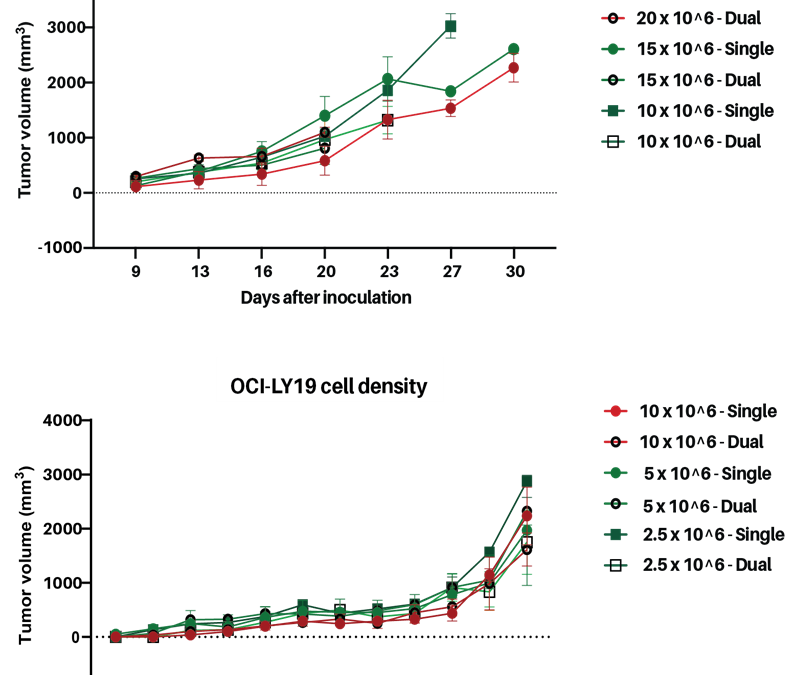
Modèles murins CDX personnalisés de lymphome pour la recherche préclinique en oncologie
Dans le cadre d’études récentes, nous avons mis au point et validé deux nouveaux modèles de xénogreffes dérivées de lignées cellulaires de lymphomes humains (CDX), issus des lignées cellulaires OCI-Ly19 (lymphome diffus à grandes cellules B, DLBCL) et REC-1 (lymphome à cellules du manteau). Ces modèles ont été développés dans le cadre d’une stratégie...

Profilage multiplexe des cytokines et des cellules immunitaires dans la recherche en immuno-oncologie
La plateforme Meso-Scale Discovery (MSD) est un système d'analyse de profilage multiplexe des cytokines à haute sensibilité, qui vous permet de quantifier simultanément plusieurs cytokines, chimiokines, anticorps et facteurs de croissance cibles à partir de volumes d'échantillons infimes (à partir de 1 µL). En...

Modèles PDX du cancer du pancréas
Le mois dernier, novembre, était le Mois de la sensibilisation au cancer du pancréas ; l'occasion de mettre l'accent sur les défis posés par l'un des types de cancer les plus agressifs et les plus mortels. Le cancer du pancréas représente environ 3 % de l'ensemble des cancers diagnostiqués en Europe, avec le cancer du pancréas...

Découverte des principaux services d'oncologie in vitro d'InnoSer : test de blocage PD-1/PD-L1
Le blocage des points de contrôle immunitaires dans la recherche sur les médicaments oncologiques Ces dernières années, le blocage des points de contrôle immunitaires s'est imposé comme une stratégie thérapeutique révolutionnaire en immuno-oncologie. Le récepteur de la mort cellulaire programmée 1 (PD-1) et son ligand, le ligand de la mort cellulaire programmée 1 (PD-L1)...
Accréditation AAALAC
InnoSer a obtenu l'accréditation AAALAC, ce qui témoigne de notre engagement en faveur d'une prise en charge et d'une utilisation responsables des animaux. AAALAC International est une organisation à but non lucratif qui promeut le traitement sans cruauté des animaux dans le domaine scientifique par le biais de programmes volontaires d'accréditation et d'évaluation. Les sites d'InnoSer aux Pays-Bas et en Belgique sont accrédités par l'AAALAC depuis 2016 et 2020, respectivement. Pour en savoir plus sur le programme d'accréditation de l'AAALAC, cliquez ici.

Bien-être animal
Les « 3R » ont une incidence sur tous les domaines, depuis les changements politiques et réglementaires jusqu’au développement et à l’adoption de nouvelles technologies et approches. C’est pourquoi InnoSer s’engage en permanence à suivre ces processus. Les mesures que nous mettons en œuvre optimisent notre capacité à remplacer, réduire et perfectionner l’utilisation des animaux et facilitent notre engagement envers ces principes dans le cadre de la recherche et du développement de médicaments.
info@innoserlaboratories.com
Liens rapides