
Delayed-type hypersensitivity (DTH) Mouse Model
The Delayed-type hypersensitivity (DTH) Mouse Model helps you quickly assess the efficacy of immunomodulatory or immunosuppressive compounds
DTH Mouse Model Key Characteristics
Delayed-type hypersensitivity (DTH) reactions, also known as type IV hypersensitivity reactions, are local inflammatory reactions mediated by cell-associated antigens involving CD4+ or CD8+ T-cell activation. During the afferent phase of DTH, mice are typically immunized by subcutaneous injection with a specific hapten or antigen emulsified with an adjuvant. The efferent phase is typically initiated 5-12 days after sensitization, via antigen challenge by subcutaneous footpad or intradermal ear injection.
The delayed-type hypersensitivity (DTH) mouse model represents a relatively quick and useful approach for evaluating the efficacy of potential immunomodulatory or immunosuppressive compounds to modulate the cellular immune response, primarily Th1 and Th17 type responses. By challenging the cell-mediated immune response, you can obtain valuable information such as whether your lead immunomodulatory compound can reduce DTH in mice. Hypersensitivity reactions can be categorized based on the delivery of the antigen through subcutaneous injection, topical administration or via the gut.
✓ DTH can be evaluated in wild-type (i.e., C57BL6) or humanized mice carrying human transgenes.
✓ DTH can be induced by antigen injection (OXA, KLH), skin absorption (DNFβ) following topical administration, or via the gut (DSS-induced colitis).
✓ Complementary in vitro immuno-assays, histopathology analyses, and PK/PD profiling services.

Developing new, safe, and efficacious therapies is an extremely intricate process. As a preclinical immunology contract research organization (CRO), InnoSer partners with you to help you navigate the complexities of this research area.
InnoSerの協働的アプローチを活用し、最適な試験デザインを開発してください。柔軟かつ迅速な試験開始により、研究を加速的に進めることが可能です。前臨床腫瘍学試験をInnoSerに委託することで、当社のin vitroおよびin vivo免疫学薬物開発ポートフォリオへのアクセスが可能となります。
DTH Mouse Model Sample Data

The delayed-type hypersensitivity (DTH) mouse model represents a relatively quick and useful approach for evaluating the efficacy of potential immunomodulatory or immunosuppressive compounds.
On day 0, mice were sensitized by a subcutaneous injection with KLH/CFA/IFA emulsion in the tail base. Six days later, following baseline measurements, mice were challenged with a KLH injection into one ear and PBS injection into the other ear as a within-subject control. Treatment with an anti-inflammatory drug (Rapidexon) was used as a positive control for KLH hypersensitivity.
We observed clear increases in ear thickness on the days after KLH challenge compared to baseline (day 6). Moreover, ear thickness of PBS control ears and KLH-injected ears of Rapidexon-treated animals showed reduced swelling throughout the whole study duration, confirming the suitability of this assay. Data is shown as mean±SEM.

The delayed-type hypersensitivity (DTH) mouse model represents a relatively quick and useful approach for evaluating the efficacy of potential immunomodulatory or immunosuppressive compounds.
Mice were sensitized with 0.5% DNFB on abdominal skin on day 0 and elicited on both ears with 0.5% DNFB on day 5. Ear thickness was measured daily from day 5 to day 10. The graph shows that treatment with Rapidexon (green) significantly reduced ear thickness compared to the PBS control (red), indicating the anti-inflammatory efficacy of Rapidexon in this contact dermatitis model. Data are presented as mean ± SEM.

The delayed-type hypersensitivity (DTH) mouse model represents a relatively quick and useful approach for evaluating the efficacy of potential immunomodulatory or immunosuppressive compounds.
All efficacy studies can be complemented with histopathology readouts with in-house expert pathologist evaluation. As an example, the H&E-stained digitalized whole-slide images below show (A) infiltration of immune cells consisting of mainly lymphocyte in the dermis. (B) Non-inflamed dermis.
DTH Mouse Model Readouts
あなたの研究を支える人々

セリーヌ・エレンス博士、免疫学研究 ディレクター
当社の免疫学研究責任者が率いる専門家チーム セリーヌ・エレンス博士が率いる専門家チームが、 セリーヌ・エレンス博士が率いる専門チームが、お客様と協力し、 最適な 研究設計を確立するお手伝いをいたします。分野への深い理解をもって貴社のリード化合物の前臨床試験をキュレーションすることは、貴社の医薬品開発を加速させるための解決策です。

ヤニック・ファントン博士、最高科学責任者
イノサーの最高科学責任者として、ヤニックはイノサーにおける全ての顧客調査を担当し、科学的・技術的な調整業務を統括している。
よくあるご質問
What is the DTH model of inflammation?
The DTH model of inflammation is a well-established in vivo model used to study cell-mediated immune responses associated with Th1 reactivity. In the DTH mouse model, T-cell-mediated immune responses are triggered, leading to local inflammation at the site of antigen injection.
The DTH reaction is divided into the afferent and efferent phases. During the afferent phase of this model, mice are typically immunized by subcutaneous injection with a specific hapten or antigen in its chemically reactive state and emulsified with an adjuvant. The efferent phase is typically initiated 5-12 days after sensitization, whereby the previously sensitized mice are challenged by either subcutaneous footpad injection or intradermal ear injection. In addition, when studying contact dermatitis, these challenges will occur via topical administration. The DTH response is then evaluated 24 h post-challenge.
At InnoSer, this model is commonly used to study the efficacy of anti-inflammatory and immunomodulatory compounds in the setting of autoimmune conditions, allergic reactions, and chronic inflammation. At InnoSer, we offer DTH model evaluations in wild-type (e.g., C57BL/6) and humanized mice carrying human transgenes. Depending on your specific research objective, DTH can be induced through:
- Antigen injection (such as OXA or KLH)
- Skin absorption (e.g., DNFβ through topical administration)
- Gut-mediated induction (using the DSS-induced colitis IBD mouse model)
What is DTH immune response?
- Investigate the efficacy of compounds in autoimmune diseases like contact dermatitis
- Test efficacy of anti-inflammatory and immunomodulatory therapies
- Evaluate vaccine responses and allergic conditions
Contact InnoSer to explore how our DTH model can support your immunology research.
Which strains of mice are preferred to study the DTH model?
At InnoSer, commonly used strains for DTH studies include:
- C57BL/6: One of the most widely used strains, particularly for studies involving T-cell-mediated immune responses. It is ideal for autoimmune disease models and inflammatory disorders.
- BALB/c: This strain is commonly used for testing allergic responses and Th2-driven immune responses, making it suitable for evaluating hypersensitivity reactions.
- Humanized DTH mouse models carrying human transgenes can also be used to study DTH responses, providing enhanced translational value for your research.
How do you follow up the DTH response?
At InnoSer, following up on the DTH response involves several key methods to assess the immune reaction and inflammatory response over time:
- Localized ear swelling measurement: The most common method is to measure the size of the inflammatory lesion or swelling at the site of antigen injection (i.e., the ears in case of skin injections). This is usually done at 24, 48, and 72 hours post-exposure to evaluate the intensity of the immune response.
- Blood and/or serum collection: At InnoSer, we frequently perform immune cell profiling via flow cytometry and cytokine profiling (e.g., IFN-γ, TNF-α, and IL-1β)
- Histopathological Analysis: Tissue samples from the site of inflammation are assessed by an in-house veterinary pathologist to assess the presence and type of immune cells (e.g., T cells, macrophages) involved in the response and thus determine the efficacy of your compound.
Choose which readouts are the most suitable for your research together with our expert study team.
What are the typical positive controls to use in this model?
Using appropriate positive controls is essential to validate the immune response in the DTH mouse model, assess the efficacy of your new therapeutic compounds, and most importantly, to benchmark the therapeutic profile of your compounds against existing treatments. At InnoSer, common positive controls can include:
- Anti-inflammatory drugs: Rapidexon (or other corticosteroids) can be used as a positive control to demonstrate the ability of an anti-inflammatory drug to reduce inflammation and modulate the DTH response, helping you benchmark the efficacy of your novel compound.
- Phosphate-buffered saline (PBS) is injected into the ear as a negative control to ensure the response is due to the antigen and not other factors. It also serves as an internal control for the injected volume, allowing you to compare the inflammation in the ear caused by the antigen versus the PBS injection.
Including both positive and negative controls in your study ensures reliable data, allowing for the accurate interpretation of the DTH response and the efficacy of your novel therapeutic candidates. Reach out to our team to confirm the inclusion of the most appropriate positive and negative controls for your study.
その他の関連する免疫学マウスモデルを発見する


好奇心を持ち続けよう:さらに探求できる記事
前臨床腫瘍学のための個別化リンパ腫CDXマウスモデル
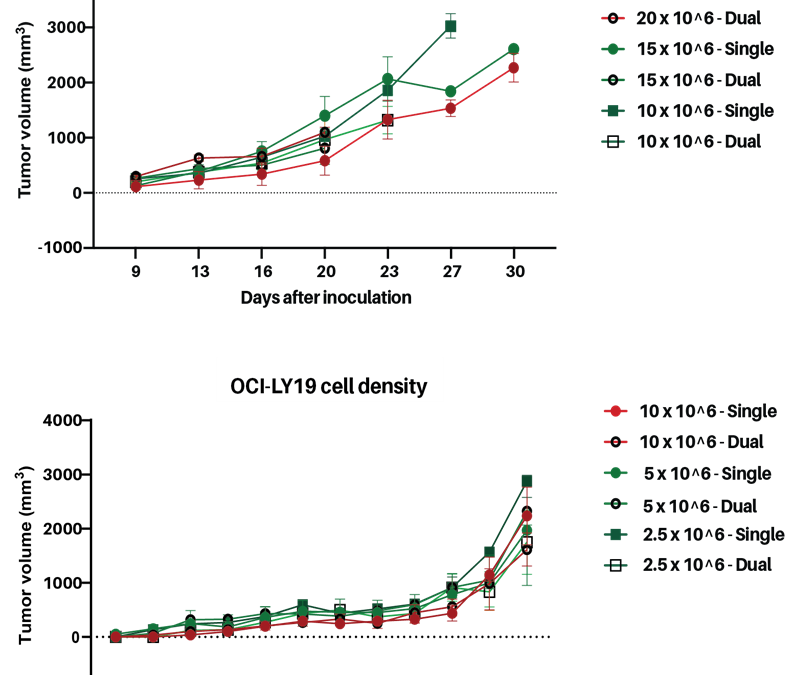
最近の研究において、我々は、OCI-Ly19(びまん性大細胞型B細胞リンパ腫、DLBCL)およびREC-1(マントル細胞リンパ腫)の細胞株から作製された、2つの新しいヒトリンパ腫細胞株由来異種移植(CDX)モデルを確立し、その妥当性を検証した。これらのモデルは、戦略的な...

免疫腫瘍学研究におけるマルチプレックスサイトカインおよび免疫細胞プロファイリング
メソスケール・ディスカバリー(MSD)プラットフォームは、高感度かつ多重のサイトカインプロファイリング分析システムであり、ごく微量のサンプル(わずか1μL)から複数の標的サイトカイン、ケモカイン、抗体、成長因子を同時に定量することが可能です。これにより...

膵臓癌患者由来異種移植モデル
先月11月は膵臓がん啓発月間でした。これは最も攻撃的で致死率の高いがん種の一つがもたらす課題に焦点を当てる時期です。膵臓がんは欧州で診断される全がんの約3%を占め、膵臓...

InnoSerの主要なin vitro腫瘍学サービスを探る:PD-1/PD-L1遮断アッセイ
腫瘍学における免疫チェックポイント阻害剤の創薬近年、免疫チェックポイント阻害は免疫腫瘍学における画期的な治療戦略として台頭している。プログラム細胞死1受容体(PD-1)とそのリガンドであるプログラム細胞死リガンド1(PD-L1)...
AAALAC認定
InnoSerはAAALAC認証を取得し、責任ある動物ケアと利用への取り組みを実証しています。AAALAC Internationalは、自主的な認証および評価プログラムを通じて科学における動物の適切な扱いを推進する非営利組織です。InnoSerのオランダおよびベルギー施設は、それぞれ2016年および2020年よりAAALAC認証を取得しています。AAALAC認証プログラムの詳細はこちらをご覧ください。

動物福祉
3R原則は、政策や規制の変更から新技術・手法の開発と普及に至るまで、あらゆる分野に影響を及ぼします。このためInnoSerは、これらのプロセスに対する継続的な取り組みと監視を実施しています。当社が実践する手順は、動物実験の代替・削減・改善を最大限に実現し、研究および医薬品開発におけるこれらの原則への取り組みを促進します。
info@innoserlaboratories.com