
Oncology CRO services – Patient-derived Xenograft (PDX) Mouse Models
Recapitulate the tumor and patient heterogeneity and response to treatment using patient-derived xenograft (PDX) mouse models
InnoSer’s Patient-derived Xenograft (PDX) Mouse Models Services
Patient-derived xenograft (PDX) mouse models are established from resected tumor samples obtained from oncologic patients that are implanted and grown in immunodeficient mice. However, to fully recapitulate the intricacies between the immune system and the tumor microenvironment, humanized mouse models are recommended instead of immunodeficient mice. Patient-derived xenograft (PDX) mouse models represent the most clinically relevant and predictive tool in your drug development journey, recapitulating the tumor and patient heterogeneity, gene expression, and response to treatment.
Therefore, experts from InnoSer’s immuno-oncology team recommend the use of PDX mouse models whenever you have carried out initial in vivo studies using cell line-derived (CDX) mouse models and wish to obtain more clinically relevant results. Accordingly, patient-derived xenografts are suitable for evaluating a range of therapies ranging from immunotherapy, antibody, antibody-drug conjugate, and gene therapies to small molecules (cytotoxic drugs). PDX models provide you with a highly predictive in vivo model for therapeutic efficacy evaluation.
Compared to other preclinical in vivo models, patient-derived xenograft models represent more robust models, requiring longer study timelines and the inclusion of different patient samples to capture your compound’s efficacy on patient heterogeneity.
✓ Well-characterised parental samples (histopathology, hot spot analyses, mutational burden, treatment history, response to treatment).
✓ Complementary organoid high-throughput phenotyping screening services
✓ On-request PDX expansion services.

Developing new, safe, and efficacious anticancer therapies is an extremely intricate process. As a preclinical oncology contract research organization (CRO), InnoSer partners with you to help you navigate the complexities of this research area.
Scientists at InnoSer collaborate with you to develop the most optimal study design to help answer your research questions most cost-effectively. With flexible and fast study start times you can perform your research at an accelerated pace. By outsourcing your preclinical oncology studies to InnoSer, you gain access to our in vitro and in vivo oncology drug development portfolio.
研究に最適なツールを手に入れよう。
当社の腫瘍学プラットフォームを探索・比較し、研究ニーズに最適なモデルを特定してください。

Patient-derived Xenograft (PDX) Mouse Models Sample Data

Example tumor growth of PDAC PDX from InnoSer’s Biobank. Tumor growth curves of InnoSer’s PDX of pancreatic ductal adenocarcinoma sample sc. implanted into female SCID mice.
Example tumor growth of PDAC PDX from InnoSer’s Biobank. Tumor growth curves of InnoSer’s PDX of pancreatic ductal adenocarcinoma (PDAC; V-INNO-016) sample sc. implanted into female SCID mice. This model offers a compelling genetic profile with KRAS (KRAS mutations are present in over 90% of PDAC cases) and JAK2 mutations. For a detailed overview, reach out to our team and obtain the full tumor sample profile including patient information, parental genomics and DNA HotSpot mutations, histopathology, and RNAseq data here.

Histopathology images from a PDX sample of mucinous pancreatic adenocarcinoma, stained for the cancer marker MUC5AC.

Histopathology images from a PDX sample of non-keratinizing squamous lung carcinoma showing p63 expression.
Key Patient-derived Xenograft (PDX) Mouse Models Readouts
あなたの研究を支える人々

セリーヌ・エレンス博士、免疫学研究 ディレクター
当社の免疫腫瘍学研究責任者セリーヌ・エレンス率いる専門家チームが、適切なツールの選択と最適な試験設計の構築を支援します。当該分野への深い理解に基づき、リード化合物の前臨床試験を厳選することで、貴社の医薬品開発を加速するソリューションを提供します。

ヤニック・ファントン博士、最高科学責任者
イノサーの最高科学責任者として、ヤニックはイノサーにおける全ての顧客調査を担当し、科学的・技術的な調整業務を統括している。
腫瘍学理事会メンバー

エスター・ヴォルフス教授博士
イノサーの科学諮問委員会のメンバーであるウルフス博士は、幹細胞治療の第一人者である。現在ハッセルト大学の教授を務める エスターは、 抗がん治療における幹細胞の利用と、シャルコー・マリー・トゥース病1A型の研究モデルとしての幹細胞活用に取り組んでいる。

医学博士、博士(医学)マリエ・スリンガーランド
イノサーの科学諮問委員会のメンバーであるライデン大学医療センターのスリンガーランド博士は、消化器癌および頭頸部癌における臨床試験、特に腫瘍内免疫パラメータに焦点を当てている。
よくあるご質問
What is the difference between PDX and CDX mouse models?
Cell line-derived xenograft (CDX) mouse models are established by injecting immunodeficient or humanized mice with immortalised human cancer cell lines in contrast to patient-derived xenograft (PDX) models which are established by injecting the primary tumor material into mice. While CDX mouse models are useful for high-throughput and cost-effective preclinical studies, they lack the tumor heterogeneity of primary tumor, which are preserved in PDX mouse models. Preserving both the tumor and stromal cell heterogeneity, PDX mouse models are better suited for studying tumor biology and treatment responses that closely reflect patient tumors.
Choose the most appropriate model for your research in consultation with our study experts.
Are patient derived xenograft (PDX) mouse models accurate representations of primary tumors?
What is the most suitable mouse and genetic backgrounds for PDX studies?
- Nude mice: The immunocompromised nude mice represent the ideal recipient mouse strain due to no rejection responses. The absence of fur in nude mice may also additionally make it easier to identify subcutaneous tumors.
- NSG (NOD scid gamma) mice: The highly immunodeficient NSG mice are suitable for engraftment of human tumors as well as the establishment of human immunity following hematopoietic stem cell transplantation.
- BRGSF mice: Compared to nude and NSG mice, BRGSF mice represent the most defective immunodeficient strain, suitable for xenografting of human tumors or transplantation of the human immune system.
When should I use humanized mice for PDX applications?
その他の関連する腫瘍学研究モデルを発見する


研究に最適なツールを手に入れよう。
当社の腫瘍学プラットフォームを探索・比較し、研究ニーズに最適なモデルを特定してください。
好奇心を持ち続けよう:さらに探求できる記事
前臨床腫瘍学のための個別化リンパ腫CDXマウスモデル
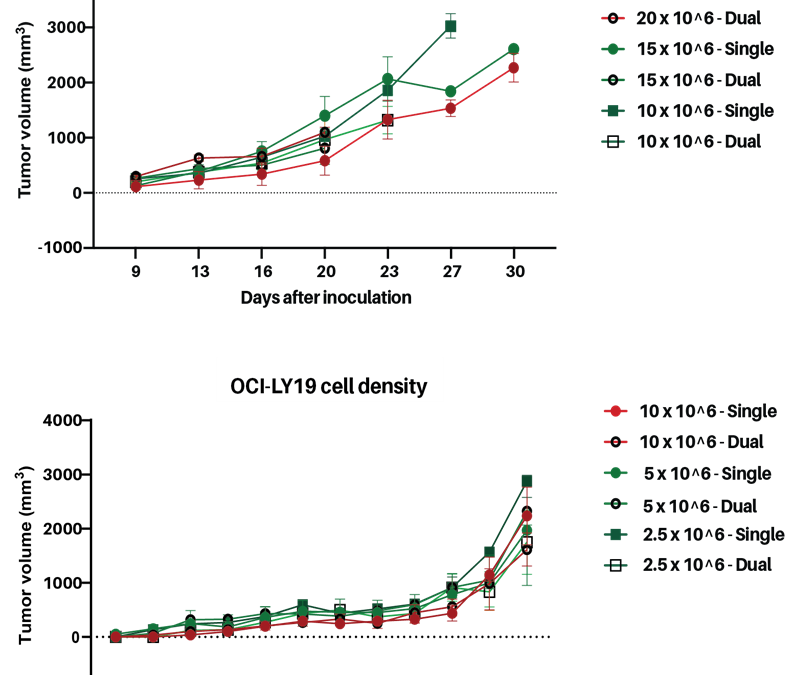
最近の研究において、我々は、OCI-Ly19(びまん性大細胞型B細胞リンパ腫、DLBCL)およびREC-1(マントル細胞リンパ腫)の細胞株から作製された、2つの新しいヒトリンパ腫細胞株由来異種移植(CDX)モデルを確立し、その妥当性を検証した。これらのモデルは、戦略的な...

免疫腫瘍学研究におけるマルチプレックスサイトカインおよび免疫細胞プロファイリング
メソスケール・ディスカバリー(MSD)プラットフォームは、高感度かつ多重のサイトカインプロファイリング分析システムであり、ごく微量のサンプル(わずか1μL)から複数の標的サイトカイン、ケモカイン、抗体、成長因子を同時に定量することが可能です。これにより...
膵臓癌患者由来異種移植モデル
先月11月は膵臓がん啓発月間でした。これは最も攻撃的で致死率の高いがん種の一つがもたらす課題に焦点を当てる時期です。膵臓がんは欧州で診断される全がんの約3%を占め、膵臓...

InnoSerの主要なin vitro腫瘍学サービスを探る:PD-1/PD-L1遮断アッセイ
腫瘍学における免疫チェックポイント阻害剤の創薬近年、免疫チェックポイント阻害は免疫腫瘍学における画期的な治療戦略として台頭している。プログラム細胞死1受容体(PD-1)とそのリガンドであるプログラム細胞死リガンド1(PD-L1)...
AAALAC認定
InnoSerはAAALAC認証を取得し、責任ある動物ケアと利用への取り組みを実証しています。AAALAC Internationalは、自主的な認証および評価プログラムを通じて科学における動物の適切な扱いを推進する非営利組織です。InnoSerのオランダおよびベルギー施設は、それぞれ2016年および2020年よりAAALAC認証を取得しています。AAALAC認証プログラムの詳細はこちらをご覧ください。

動物福祉
3R原則は、政策や規制の変更から新技術・手法の開発と普及に至るまで、あらゆる分野に影響を及ぼします。このためInnoSerは、これらのプロセスに対する継続的な取り組みと監視を実施しています。当社が実践する手順は、動物実験の代替・削減・改善を最大限に実現し、研究および医薬品開発におけるこれらの原則への取り組みを促進します。
info@innoserlaboratories.com