
Oncology CRO services – Syngeneic Mouse Models
Syngeneic mouse models represent one of the first steps needed to determine the efficacy of your novel immunotherapies in an in vivo model with functional immune system
InnoSer’s Syngeneic Mouse Model Services
Syngeneic mouse models are established from immortalized murine cancer cells originating from inbred mouse strains that are implanted and grown in genetically identical strains. Avoiding the need to use immunocompromised mice, this approach allows you to study your novel immunotherapy’s efficacy in a mouse model that combines tumor microenvironment interactions with a fully functional immune system.
Therefore, experts at InnoSer recommend the use of syngeneic rodent models (mice or rats) as a first step to evaluate the efficacy of your novel immunotherapy approaches (vaccines, mRNA-based therapeutics, immune checkpoint inhibitors, antibody-drug conjugates, (stem) cell therapy such as CAR-T cell therapy, NK cell therapy, etc., as well as classical anti-tumoral compounds (chemotherapy, radiotherapy). Accordingly, syngeneic mouse models represent an easy-to-use, relatively inexpensive mouse model with short study timelines (2-4 weeks), offering reproducible immune response results. However, for more advanced studies, InnoSer’s experts recommend working with humanized mouse models.
✓ Available as subcutaneous or orthotopic models (fluorescently labeled rodent cell lines or followed-up via ultrasound).
✓ Es stehen sowohl Maus- als auch Rattenzelllinien sind verfügbar.
✓ Complementary immuno-oncology in vitro assays and PK/PD profiling services.

Developing new, safe, and efficacious anticancer therapies is an extremely intricate process. As a preclinical oncology contract research organization (CRO), InnoSer partners with you to help you navigate the complexities of this research area.
Scientists at InnoSer collaborate with you to develop the most optimal study design to help answer your research questions most cost-effectively. With flexible and fast study start times you can perform your research at an accelerated pace. By outsourcing your preclinical oncology studies to InnoSer, you gain access to our in vitro and in vivo oncology drug development portfolio.
Entdecken Sie die richtigen Werkzeuge für Ihre Forschung.
Entdecken und vergleichen Sie unsere Onkologie-Plattformen, um das ideale Modell für Ihre Studienanforderungen zu finden.

Syngeneic Mouse Models Sample Data

Tumor growth curve data from the 4T1 (breast cancer cell line) syngeneic mouse model.
Following initial cell culturing, murine breast cancer cells (4T1 mouse breast cell line) were injected orthotopically (directly into the mammary fat pad) of BALB/C mice. This mouse model is available at InnoSer both as an (A) subcutaneous (4T1) whereby tumor growth is followed via calipers and (B) orthotopic mouse model (4T1-luc) whereby tumor growth is followed via bioluminescent imaging. The model is validated with standard-of-care treatments doxorubicin and gemcitabine.

Tumor growth curve data from the PanO2 (pancreatic cancer cell line) syngeneic mouse model.
Following initial cell culturing, murine pancreatic cancer cells (PanO2 cell line) were injected subcutaneously into the left flank of C57BL/6 mice. Model is validated with standard-of-care treatment gemcitabine (tested at different concentrations).

Tumor growth curve data from the MC38 (colorectal carcinoma) syngeneic mouse model.
Following initial cell culturing, murine colorectal carcinoma cells (MC38 cell line) were injected into the left flank of C57BL/6 mice. The MC38 colorectal carcinoma syngeneic mouse model is available at InnoSer both as (A) subcutaneous and (B) orthotopic model. The model is validated with checkpoint inhibitor anti-PD-1.

Tumor growth curve data from the Renca (renal cell carcinoma) syngeneic mouse model.
Following initial cell culturing, murine renal cell carcinoma cells (Renca cell line) were injected into the left flank of C57BL/6 mice. The renal cell carcinoma Renca syngeneic mouse model is available at InnoSer both as a (A) subcutaneous model and orthotopic (B-C) model. The model is validated with standard-of-care treatment Doxorubicin (different dosages tested). Compared to healthy kidneys (B), kidneys of mice injected with Renca cells (C) lead to increase in total kidney volume and development of lesions which can be longitudinally imaged and quantified.
Key Syngeneic Mouse Models Readouts
Die Menschen hinter Ihrer Forschung

Dr. Céline Erens, Studie zur Immunologie Leiterin
Ein Expertenteam unter der Leitung unserer Studienleiterin für Immunonkologie, Céline Erens, unterstützt Sie bei der Auswahl der richtigen Instrumente und der Ausarbeitung optimaler Studiendesigns. Die Begleitung der präklinischen Prüfung Ihrer Leitverbindungen auf der Grundlage fundierter Fachkenntnisse ist der Schlüssel zur Beschleunigung Ihrer Arzneimittelentwicklung.

Dr. Yanick Fanton, wissenschaftlicher Leiter
Als Chief Science Officer bei InnoSer ist Yanick für alle Kundenstudien bei InnoSer verantwortlich und kümmert sich um die wissenschaftliche und technische Koordination.
Mitglieder des Onkologie-Beirats

Prof. Dr. Esther Wolfs
Dr. Wolfs, Mitglied des wissenschaftlichen Beirats von InnoSer, ist eine führende Forscherin auf dem Gebiet der Stammzelltherapie. Derzeit ist sie Professorin an der Universität Hasselt und nutzt Stammzellen in der Krebstherapie sowie als Modell zur Erforschung der Charcot-Marie-Tooth-Krankheit Typ 1A.

Dr. med., Dr. phil. Marije Slingerland
Als Mitglied des wissenschaftlichen Beirats von InnoSer konzentriert sich Dr. Slingerland vom Medizinischen Zentrum der Universität Leiden auf klinische Studien zu Magen-Darm-Krebs und Kopf-Hals-Krebs, insbesondere auf intratumorale Immunparameter.
Häufig gestellte Fragen
How can I use in vivo imaging for orthotopic models in my research?
- Bioluminescence imaging (BLI): Ideal for tracking labeled tumor cells in real-time.
- Ultrasound imaging: A non-invasive option for quantifying tumor size in non-labeled models (e.g., RENCA renal carcinoma).
What is the advantage of tracking tumor growth using bioluminesence imaging?
- Non-invasive and longitudinal tracking: Monitor tumor growth over time without sacrificing animals, reducing variability and animal numbers.
- High sensitivity: Allows early detection of small tumors that may not be visible with other methods.
- BLI is especially suitable for orthotopic models where tumors are located in internal sites that are difficult to measure manually.
How can tumor growth be tracked in non-fluorescently labelled orthotopic syngeneic mouse models?
- Other imaging modalities: Ultrasound imaging is a common alternative for internal tumors (e.g., RENCA renal cell carcinoma).
- Manual measurement: Tumors can be manually measured post-sacrifice at pre-determined time points, but this requires increased animal numbers and imposes higher study costs.
- These considerations further highlight the advantages of incorporating in vivo imaging to improve data quality and reduce study expenses.
Do you have a list of available cell lines for syngeneic applications at InnoSer?
- Pan02 cell line of pancreatic ductal adenocarcinoma)
- RENCA cell line of renal cell carcinoma)
- B16F10 cell line of melanoma
- MC38 cell line of colorectal carcinoma.
View the list of syngeneic mouse models available at InnoSer here.
I don't see my cell line of interest in your syngeneic mouse model list, can InnoSer validate new models on request?
What examples of PD-1 responsive tumor models does InnoSer offer?
- Hepa1-6 (liver carcinoma)
- CT-26 (colon carcinoma)
- MBT-2 (bladder carcinoma)
- MC38 (colon adenocarcinoma)
Entdecken Sie weitere verwandte Forschungsmodelle im Bereich der Onkologie


Entdecken Sie die richtigen Werkzeuge für Ihre Forschung.
Entdecken und vergleichen Sie unsere Onkologie-Plattformen, um das ideale Modell für Ihre Studienanforderungen zu finden.
Bleiben Sie neugierig: Weitere Artikel zum Entdecken
Individuell angepasste CDX-Mausmodelle für Lymphome in der präklinischen Onkologie
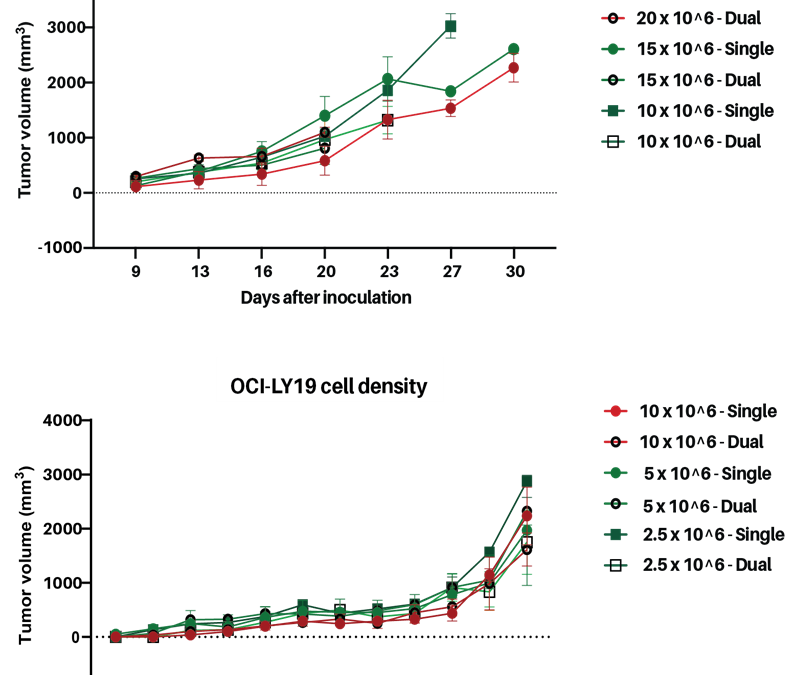
In aktuellen Studien haben wir zwei neue Xenotransplantatmodelle (CDX-Modelle) etabliert und validiert, die aus den Zelllinien OCI-Ly19 (diffuses großzelliges B-Zell-Lymphom, DLBCL) und REC-1 (Mantelzell-Lymphom) gewonnen wurden. Diese Modelle wurden im Rahmen einer strategischen...

Multiplex-Profiling von Zytokinen und Immunzellen in der immunonkologischen Forschung
Die Meso-Scale Discovery (MSD)-Plattform ist ein hochempfindliches Multiplex-Analysesystem zur Erstellung von Zytokinprofilen, mit dem Sie mehrere Zielzytokine, Chemokine, Antikörper und Wachstumsfaktoren aus winzigen Probenvolumina (bereits ab 1 µl) gleichzeitig quantifizieren können. Durch...

PDX-Modelle für Bauchspeicheldrüsenkrebs
Der vergangene Monat, der November, war der Monat der Aufklärung über Bauchspeicheldrüsenkrebs – eine Zeit, in der die Herausforderungen im Zusammenhang mit einer der aggressivsten und tödlichsten Krebsarten im Mittelpunkt stehen. Bauchspeicheldrüsenkrebs macht etwa 3 % aller in Europa diagnostizierten Krebserkrankungen aus, wobei Bauchspeicheldrüsenkrebs...

Einblick in die wichtigsten In-vitro-Dienstleistungen von InnoSer im Bereich der Onkologie: PD-1/PD-L1-Blockade-Assay
Immun-Checkpoint-Blockade in der onkologischen Wirkstoffforschung In den letzten Jahren hat sich die Immun-Checkpoint-Blockade als bahnbrechende therapeutische Strategie in der Immunonkologie etabliert. Der Programmierte-Zelltod-1-Rezeptor (PD-1) und sein Ligand, der Programmierte-Zelltod-Ligand 1 (PD-L1)...
AAALAC-Akkreditierung
InnoSer hat die AAALAC-Akkreditierung erhalten und damit sein Engagement für einen verantwortungsvollen Umgang mit Tieren unter Beweis gestellt. AAALAC International ist eine gemeinnützige Organisation, die sich durch freiwillige Akkreditierungs- und Bewertungsprogramme für den artgerechten Umgang mit Tieren in der Wissenschaft einsetzt. Die Einrichtungen von InnoSer in den Niederlanden und Belgien sind seit 2016 bzw. 2020 AAALAC-akkreditiert. Weitere Informationen zum AAALAC-Akkreditierungsprogramm finden Sie hier.

Tierschutz
Die 3Rs wirken sich auf alle Bereiche aus, von politischen und regulatorischen Veränderungen bis hin zur Entwicklung und Einführung neuer Technologien und Ansätze. Aus diesem Grund engagiert sich InnoSer kontinuierlich für diese Prozesse und überwacht sie. Die von uns umgesetzten Maßnahmen maximieren unsere Fähigkeit, den Einsatz von Tieren zu ersetzen, zu reduzieren und zu verfeinern, und unterstützen unser Bekenntnis zu diesen Grundsätzen in der Forschung und der Arzneimittelentwicklung.
info@innoserlaboratories.com