
Oncology CRO services – Patient-derived Xenograft (PDX) Mouse Models
Recapitulate the tumor and patient heterogeneity and response to treatment using patient-derived xenograft (PDX) mouse models
InnoSer’s Patient-derived Xenograft (PDX) Mouse Models Services
Patient-derived xenograft (PDX) mouse models are established from resected tumor samples obtained from oncologic patients that are implanted and grown in immunodeficient mice. However, to fully recapitulate the intricacies between the immune system and the tumor microenvironment, humanized mouse models are recommended instead of immunodeficient mice. Patient-derived xenograft (PDX) mouse models represent the most clinically relevant and predictive tool in your drug development journey, recapitulating the tumor and patient heterogeneity, gene expression, and response to treatment.
Therefore, experts from InnoSer’s immuno-oncology team recommend the use of PDX mouse models whenever you have carried out initial in vivo studies using cell line-derived (CDX) mouse models and wish to obtain more clinically relevant results. Accordingly, patient-derived xenografts are suitable for evaluating a range of therapies ranging from immunotherapy, antibody, antibody-drug conjugate, and gene therapies to small molecules (cytotoxic drugs). PDX models provide you with a highly predictive in vivo model for therapeutic efficacy evaluation.
Compared to other preclinical in vivo models, patient-derived xenograft models represent more robust models, requiring longer study timelines and the inclusion of different patient samples to capture your compound’s efficacy on patient heterogeneity.
✓ Well-characterised parental samples (histopathology, hot spot analyses, mutational burden, treatment history, response to treatment).
✓ Complementary organoid high-throughput phenotyping screening services
✓ On-request PDX expansion services.

Developing new, safe, and efficacious anticancer therapies is an extremely intricate process. As a preclinical oncology contract research organization (CRO), InnoSer partners with you to help you navigate the complexities of this research area.
Scientists at InnoSer collaborate with you to develop the most optimal study design to help answer your research questions most cost-effectively. With flexible and fast study start times you can perform your research at an accelerated pace. By outsourcing your preclinical oncology studies to InnoSer, you gain access to our in vitro and in vivo oncology drug development portfolio.
Accédez aux outils adaptés à vos recherches.
Découvrez et comparez nos plateformes d'oncologie afin d'identifier le modèle le mieux adapté aux besoins de votre étude.

Patient-derived Xenograft (PDX) Mouse Models Sample Data

Example tumor growth of PDAC PDX from InnoSer’s Biobank. Tumor growth curves of InnoSer’s PDX of pancreatic ductal adenocarcinoma sample sc. implanted into female SCID mice.
Example tumor growth of PDAC PDX from InnoSer’s Biobank. Tumor growth curves of InnoSer’s PDX of pancreatic ductal adenocarcinoma (PDAC; V-INNO-016) sample sc. implanted into female SCID mice. This model offers a compelling genetic profile with KRAS (KRAS mutations are present in over 90% of PDAC cases) and JAK2 mutations. For a detailed overview, reach out to our team and obtain the full tumor sample profile including patient information, parental genomics and DNA HotSpot mutations, histopathology, and RNAseq data here.

Histopathology images from a PDX sample of mucinous pancreatic adenocarcinoma, stained for the cancer marker MUC5AC.

Histopathology images from a PDX sample of non-keratinizing squamous lung carcinoma showing p63 expression.
Key Patient-derived Xenograft (PDX) Mouse Models Readouts
Les personnes qui travaillent sur vos recherches

Céline Erens, docteure en immunologie, étude Directrice
Une équipe d'experts dirigée par notre directrice d'études en immuno-oncologie, Céline Erens, vous aide à choisir les outils adaptés et à mettre en place des protocoles d'étude optimaux. La gestion des essais précliniques de vos composés phares, fondée sur une connaissance approfondie du domaine, est la clé pour accélérer le développement de vos médicaments.

Yanick Fanton, docteur, directeur scientifique
En tant que directeur scientifique chez InnoSer, Yanick est responsable de toutes les études menées pour le compte des clients de l'entreprise et assure la coordination scientifique et technique.
Membres du comité d'oncologie

Prof. Dr Esther Wolfs
Membre du Conseil consultatif scientifique d’InnoSer, le Dr Wolfs est une chercheuse de premier plan dans le domaine de la thérapie par cellules souches. Actuellement professeure à l’université de Hasselt, Ester utilise les cellules souches dans le cadre de traitements anticancéreux et comme modèle pour étudier la maladie de Charcot-Marie-Tooth de type 1A.

Marije Slingerland, docteur en médecine et titulaire d'un doctorat en sciences
Membre du comité consultatif scientifique d’InnoSer, le Dr Slingerland, du Centre médical universitaire de Leyde, se consacre aux essais cliniques sur les cancers gastro-intestinaux et les cancers de la tête et du cou, en particulier aux paramètres immunitaires intratumoraux.
Foire aux questions
What is the difference between PDX and CDX mouse models?
Cell line-derived xenograft (CDX) mouse models are established by injecting immunodeficient or humanized mice with immortalised human cancer cell lines in contrast to patient-derived xenograft (PDX) models which are established by injecting the primary tumor material into mice. While CDX mouse models are useful for high-throughput and cost-effective preclinical studies, they lack the tumor heterogeneity of primary tumor, which are preserved in PDX mouse models. Preserving both the tumor and stromal cell heterogeneity, PDX mouse models are better suited for studying tumor biology and treatment responses that closely reflect patient tumors.
Choose the most appropriate model for your research in consultation with our study experts.
Are patient derived xenograft (PDX) mouse models accurate representations of primary tumors?
What is the most suitable mouse and genetic backgrounds for PDX studies?
- Nude mice: The immunocompromised nude mice represent the ideal recipient mouse strain due to no rejection responses. The absence of fur in nude mice may also additionally make it easier to identify subcutaneous tumors.
- NSG (NOD scid gamma) mice: The highly immunodeficient NSG mice are suitable for engraftment of human tumors as well as the establishment of human immunity following hematopoietic stem cell transplantation.
- BRGSF mice: Compared to nude and NSG mice, BRGSF mice represent the most defective immunodeficient strain, suitable for xenografting of human tumors or transplantation of the human immune system.
When should I use humanized mice for PDX applications?
Découvrez d'autres modèles de recherche en oncologie connexes


Accédez aux outils adaptés à vos recherches.
Découvrez et comparez nos plateformes d'oncologie afin d'identifier le modèle le mieux adapté aux besoins de votre étude.
Restez curieux : d'autres articles à découvrir
Modèles murins CDX personnalisés de lymphome pour la recherche préclinique en oncologie
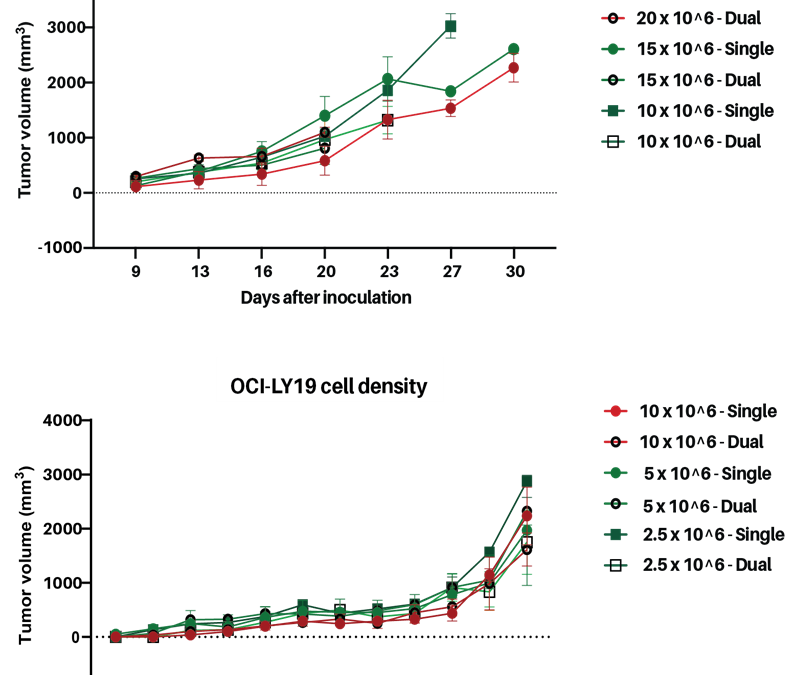
Dans le cadre d’études récentes, nous avons mis au point et validé deux nouveaux modèles de xénogreffes dérivées de lignées cellulaires de lymphomes humains (CDX), issus des lignées cellulaires OCI-Ly19 (lymphome diffus à grandes cellules B, DLBCL) et REC-1 (lymphome à cellules du manteau). Ces modèles ont été développés dans le cadre d’une stratégie...

Profilage multiplexe des cytokines et des cellules immunitaires dans la recherche en immuno-oncologie
La plateforme Meso-Scale Discovery (MSD) est un système d'analyse de profilage multiplexe des cytokines à haute sensibilité, qui vous permet de quantifier simultanément plusieurs cytokines, chimiokines, anticorps et facteurs de croissance cibles à partir de volumes d'échantillons infimes (à partir de 1 µL). En...
Modèles PDX du cancer du pancréas
Le mois dernier, novembre, était le Mois de la sensibilisation au cancer du pancréas ; l'occasion de mettre l'accent sur les défis posés par l'un des types de cancer les plus agressifs et les plus mortels. Le cancer du pancréas représente environ 3 % de l'ensemble des cancers diagnostiqués en Europe, avec le cancer du pancréas...

Découverte des principaux services d'oncologie in vitro d'InnoSer : test de blocage PD-1/PD-L1
Le blocage des points de contrôle immunitaires dans la recherche sur les médicaments oncologiques Ces dernières années, le blocage des points de contrôle immunitaires s'est imposé comme une stratégie thérapeutique révolutionnaire en immuno-oncologie. Le récepteur de la mort cellulaire programmée 1 (PD-1) et son ligand, le ligand de la mort cellulaire programmée 1 (PD-L1)...
Accréditation AAALAC
InnoSer a obtenu l'accréditation AAALAC, ce qui témoigne de notre engagement en faveur d'une prise en charge et d'une utilisation responsables des animaux. AAALAC International est une organisation à but non lucratif qui promeut le traitement sans cruauté des animaux dans le domaine scientifique par le biais de programmes volontaires d'accréditation et d'évaluation. Les sites d'InnoSer aux Pays-Bas et en Belgique sont accrédités par l'AAALAC depuis 2016 et 2020, respectivement. Pour en savoir plus sur le programme d'accréditation de l'AAALAC, cliquez ici.

Bien-être animal
Les « 3R » ont une incidence sur tous les domaines, depuis les changements politiques et réglementaires jusqu’au développement et à l’adoption de nouvelles technologies et approches. C’est pourquoi InnoSer s’engage en permanence à suivre ces processus. Les mesures que nous mettons en œuvre optimisent notre capacité à remplacer, réduire et perfectionner l’utilisation des animaux et facilitent notre engagement envers ces principes dans le cadre de la recherche et du développement de médicaments.
info@innoserlaboratories.com
Liens rapides