In this month’s newsletter, we invite you to explore how InnoSer’s longitudinal total kidney volume (TKV) assessment via non-invasive ultrasound imaging in our ADPKD mouse model provides a clinically aligned structural readout that directly supports decision-making in preclinical drug development.
Total kidney volume (TKV): an FDA- and EMA-qualified biomarker for ADPKD clinical trials
Total kidney volume (TKV) is an FDA- and EMA-qualified imaging biomarker in ADPKD clinical trials, where it is used as a prognostic enrichment tool and a likely surrogate endpoint for disease progression.
Together with estimated glomerular filtration rate (eGFR), TKV forms the structural–functional framework that underpins patient stratification and accelerated approval pathways in ADPKD drug development, increasing the need for preclinical models that generate structurally anchored translational datasets rather than isolated terminal readouts.
InnoSer’s ADPKD platform includes longitudinal kidney volume assessment via ultrasound as a standard in-life readout, strengthening the translational narrative of your compound’s development package from lead optimisation through to IND-enabling studies.
Kidney volume assessed via ultrasound captures progressive renal enlargement longitudinally in the P18 ADPKD mouse model
The P18 mouse model, established by conditional knock-out of Pkd1 at postnatal day 18 (PND18–20), is one of InnoSer’s most widely used ADPKD models for preclinical efficacy testing, offering a robust and progressive disease phenotype over an in vivo phase of approximately 20 weeks. Kidney volume corrected for body weight (KV/BW), assessed longitudinally via ultrasound imaging, captures progressive renal enlargement throughout the study duration (Figure 1).
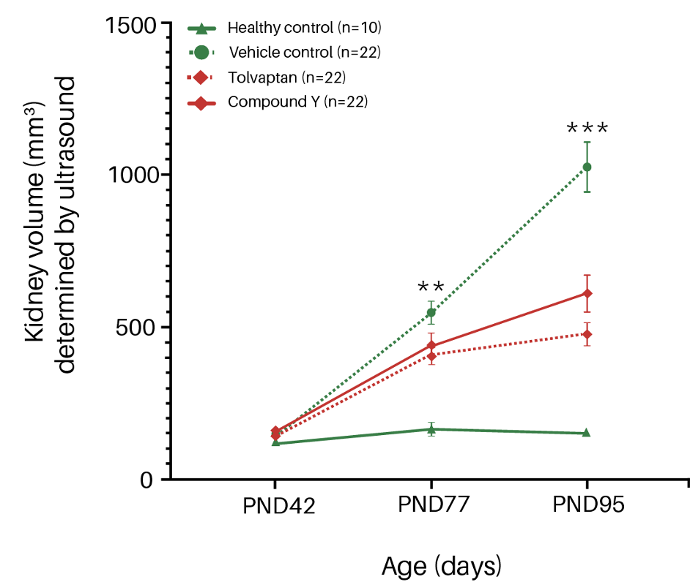
FIGURE 1. Longitudinal kidney volume assessment via ultrasound reveals progressive renal enlargement in the P18 ADPKD mouse model. Right kidney volume is significantly lower in the 0,1% Tolvaptan (used as positive control) and compound Y (test compound) groups compared to the vehicle control group (Mean ± SEM; one-way ANOVA; **P<0.01, ***P<0.001).
Kidney volume correlates with histological cyst burden in the ADPKD mouse model
Longitudinal kidney volume assessment in the P18 ADPKD mouse model correlates with terminal cystic index measurements, supporting its relevance as a non-invasive surrogate marker of structural disease progression (Figure 3). As cyst formation and expansion drive progressive renal enlargement in ADPKD, increased kidney volume closely reflects underlying cyst burden within the renal parenchyma.

FIGURE 2. Kidney volume positively correlates with cystic index in the P18 ADPKD mouse model. Kidney volume assessment around PND95 is associated with histologically quantified cyst burden (cystic index), supporting ultrasound-derived kidney volume as a translational in-life phase intermediate readout of disease progression in preclinical ADPKD studies.
In the ADPKD mouse model, kidney volume is associated with declining renal function markers
While the correlation between kidney volume and functional renal readouts such as glomerular filtration rate (GFR) and blood urea nitrogen (BUN) in the P18 ADPKD mouse model is moderate (Figure 3, and 4), the observed inverse trend remains biologically relevant. Similar to the human course of ADPKD, structural disease progression and functional renal decline do not always progress in parallel, particularly during earlier stages of disease where compensatory renal mechanisms can partially preserve filtration capacity and kidney function, despite ongoing cyst expansion and kidney enlargement.
In efficacy preclinical setting, longitudinal ultrasound-based kidney volume assessment therefore provides highly valuable complementary information to functional endpoints such as transdermal GFR and terminal BUN measurements, enabling integrated evaluation of both structural cystic progression and renal function decline throughout an efficacy study.

FIGURE 3. Kidney volume shows an inverse, moderate trend with glomerular filtration rate in the P18 ADPKD mouse model. Assessed around PND95. While structural and functional disease progression are not fully coupled during all disease stages, progressive renal enlargement is associated with declining renal function.

FIGURE 4. Relationship between kidney volume and blood urea nitrogen (BUN) in the P18 ADPKD mouse model. Assessed around PND95. While structural and functional disease progression are not fully coupled during all stages of ADPKD progression, increased kidney volume generally associates with worsening renal impairment markers.
Interested in integrating TKV into your ADPKD program? Our nephrology study directors support tailored study design, including model selection, longitudinal imaging strategies, and endpoint alignment with clinical development plans. We help ensure your preclinical package is structured around the same decision-making framework used in clinical trials.
Drug development can be an iterative and long process, whereby InnoSer can be your dedicated partner, offering fast turnaround times with back-to-back experiments to help you optimize your lead compounds. Curious to learn more about InnoSer’s capabilities within the drug development space?
Ready to elevate your preclinical research?Let’s work together to ensure your novel therapies achieve optimal clinical outcomes.