
Blood-brain-barrier (BBB) disruption – Ultrasound-mediated BBB drug delivery (SonoCloud®)
Advance your targeted CNS therapeutics development with SonoCloud®, a clinically validated approach for ultrasound-mediated BBB drug delivery
Ultrasound-mediated BBB disruption (SonoCloud®)
Ultrasound-mediated blood-brain barrier (BBB) disruption using low-intensity pulsed ultrasound (LIPU) with intravenous microbubbles is a novel technique for enhancing drug delivery to the brain, studied in both preclinical (Sabbagh et al., 2021; Ahmed et al., 2023; Arrieta et al, 2024) and clinical settings across oncology (Carpentier et al., 2024; Kim et al., 2024) and more recently neurodegenerative diseases (Epelbaum et al., 2022; Rezai et al., 2024; Canney et al., 2025). Traditionally, the delivery of large biologics, nucleic acid-based therapeutics as well as hydrophilic small molecules to the brain is hindered by the highly selective, semi-permeable BBB, composed of brain endothelial cells, astrocytic end-feet and pericytes. Without specialized carriers or more invasive delivery methods (i.e., direct intrathecal or intracerebroventricular injections), these new therapeutic modalities cannot efficiently cross the BBB, in turn greatly limiting the efficacy of many CNS-targeting drugs.
To overcome these challenges, InnoSer and Carthera, the developer of the SonoCloud® ultrasound technology, are partnering to bring this clinically validated approach into the preclinical space, enabling you to explore and optimize new strategies for targeted neurodegenerative disease therapies.
✓ Evaluate the synergy between SonoCloud® and your CNS-targeted therapeutics
✓ Leverage a clinically validated platform, developed by Carthera and backed by numerous publications and active clinical trials across oncology and neurodegenerative diseases
✓ Seamlessly translate your preclinical proof-of-concept studies to the clinic using the same underlying SonoCloud® technology

Take advantage of InnoSer’s expertise, flexibility, and collaborative approach for your research. We support you in identifying new drug candidates, characterizing their pharmacological properties, and conducting rigorous safety and efficacy studies with state-of-the-art behavioral, bioanalytical, and histopathological readouts.
Explore how SonoCloud® enhances brain uptake of therapeutics through parenchymal trapping post-BBB disruption
SonoCloud® enables efficient delivery of therapeutics across the BBB in preclinical models, using the same technology validated in clinical trials.
Anesthetized mice are placed on the LIPU preclinical platform, which consists of an ultrasound transducer housed in a cylinder surrounded by degassed water to ensure optimal acoustic coupling. Therapeutic compound is administered intravenously before, during, or after microbubble injection via the IV route (tail vein/ retro-orbital injection). Under the field of LIPU, the microbubbles oscillate within the cerebral blood vessels, temporarily loosening tight junctions and increasing therapeutic infusion into the parenchyma.
This reversible BBB opening lasts 1–2 hours, allowing small molecules, antibodies, antisense oligonucleotides (ASOs), and viral vectors to reach the brain efficiently. After the window closes, tight junctions reseal, restoring BBB integrity.
Let’s discuss how integrating SonoCloud® can strengthen your therapeutics’ potential and support a seamless transition from nonclinical development to clinical usage.
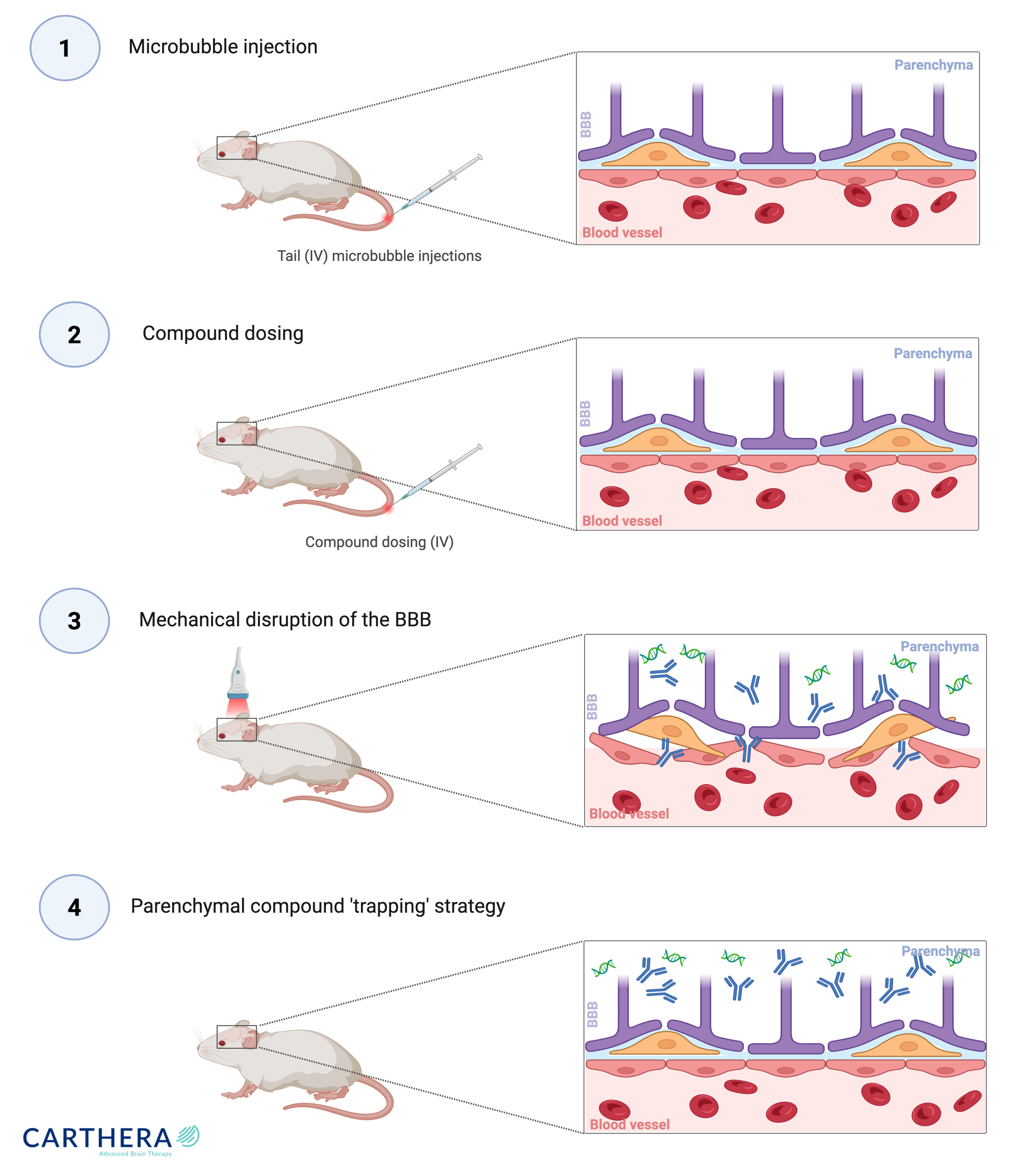
Examples of SonoCloud® ultrasound-mediated BBB drug delivery
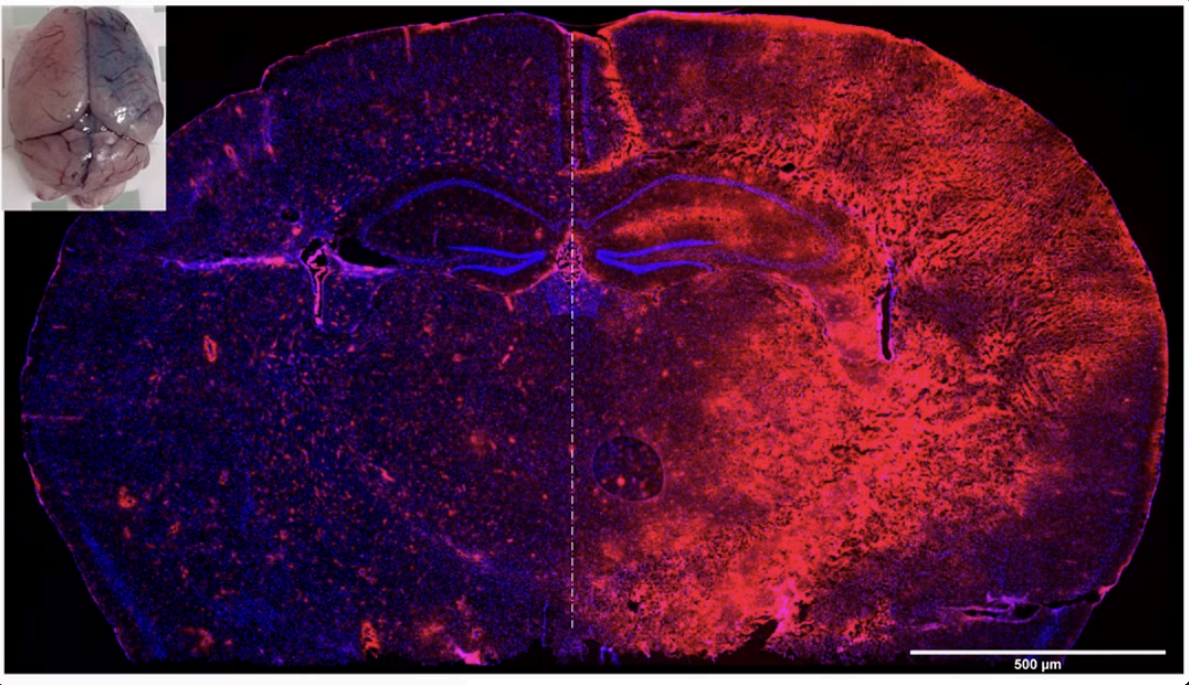
Example image highlighting blood-brain barrier opening following sonication of low-intensity pulsed ultrasound (LIPU) and intravenously administered microbubbles (MB) in mouse brain
Evans blue staining was enhanced in the brain hemisphere compared to the control hemisphere, visually and by fluorescence (Evans Blue shown in red, and nuclei, DAPI, shown in blue). Evans blue is a dye that binds to albumin (60 kDa molecular complex) and does not cross the BBB under normal circumstances; therefore, the presence of Evans blue dye in post-mortem rodent brains following sonication indicates the successful opening of the BBB.
Figure shared with permission from original paper Ahmed et al., 2023.

Example data highlighting the application of low-intensity pulsed ultrasound (LIPU) and intravenously administered microbubbles (MB)-mediated delivery of Nivolumab as a treatment strategy in glioma
Non-tumor bearing mice were injected with human anti PD-1, Nivolumab, followed by LIPU/MB and fluorescein IV injections for visualization of areas of BBB disruption (shown as areas of fluorescent green in the above images). Compared to controls that received Nivolumab and fluorescein without LIPU/MB, mice receiving Nivolumab and LIPU-MB had increased concentrations of human aPD-1 despite similar aPD-1 plasma concentrations over time.
Figure published with permission from the original paper Arrieta et al., 2024
| Feature | Relevance |
| Clinically validated | Used clinical trials in Alzheimer’s (Epelbaum et al., 2022) glioblastoma patients (Carpentier et al., 2024) and brain metastases |
| Demonstrated relevance in neurodegenerative disease research | Reported safe BBB opening and improved brain drug delivery across Alzheimer’s disease (Epelbaum et al., 2022, Canney et al., 2025), and preclinical Tauopathy (Geraudie et al., 2023); some studies show reduced pathology even without therapeutics (Shen et al, 2020; Karakatsani et al, 2023; Liu et al., 2024) |
| Increased brain concentration of multiple therapy types | Reported improved brain concentrations of small molecules (up to 4x fold), antibodies (up to 4x fold) and emerging modalities (LNPs, RNA, AAVs, oligonucleotides) |
| Preclinical to clinical platform | Leverage the same SonoCloud® LIPU technology from rodents to patients, enabling seamless translation of CNS drug delivery strategies from preclinical studies to clinical applications |
Unlock new possibilities in CNS research by overcoming delivery barriers with SonoCloud® ultrasound technology
Many promising CNS compounds fail because they can’t cross the blood-brain barrier (BBB). Temporarily and safely opening the BBB, leveraging Carthera’s ultrasound drug delivery platform, SonoCloud ®, enables you to efficiently deliver your therapeutic of choice across the brain parenchyma. This non-invasive approach helps you unlock new possibilities for your early-stage therapeutics without the need for complex formulation changes.
Partner with us to explore how SonoCloud®-enabled studies can strengthen your preclinical program and accelerate the translation to clinical development.
Key readouts
Additional analyses
Biomarker analyses and/or post-mortem analyses
- Assessment of the degree of BBB opening (Evans blue staining)
- Compound biodistribution and target engagement (IHC)
- Biomarker assessment in CSF, plasma (e.g., NfL, soluble and insoluble Aβ species, Tau)
- Evaluation of pathology via IHC (e.g., astrocytosis, microgliosis, Tau phosphorylation, soluble and insoluble Aβ species)
The People Behind Your Research

Carthera
Developer of SonoCloud®

Thomas Vogels, PhD
Study Director Neurology
Frequently Asked Questions
Is the SonoCloud® ultrasound-mediated BBB drug delivery platform already implemented and validated for preclinical use at InnoSer?
Yes, InnoSer has implemented the SonoCloud® system in-house for use in preclinical studies, offering you with a validated, end-to-end platform for ultrasound-mediated BBB drug delivery. Our workflows support all stages of preclinical compound evaluation, including:
- PK/PD profiling of your compounds
- Assessment of BBB opening
- Target engagement studies
- Proof of concept and/or efficacy studies, including behavioural and biomarker assays of choice in multiple neurodegenerative disease models
SonoCloud® can be combined with various readouts, enabling you to evaluate the synergy between your CNS-targeted therapeutics and ultrasound-mediated delivery. This integrated approach ensures robust, reproducible, and translatable preclinical data to support your clinical development.
Contact our team to obtain a customized readout package for your therapeutic program.
How can I assess successful BBB opening using the Sono Cloud ultrasound drug delivery system?
In preclinical studies, successful BBB opening can be verified various established approaches (e.g., dyes such as Evans blue, imaging contrast agents, biomarkers such as S100β biomarker). Most commonly used approach to assess the successful BBB opening in preclinical studies performed at InnoSer is by utilizing Evans blue staining. Evans blue is a dye that binds to albumin (60 kDa molecular complex) and does not cross the BBB under normal circumstances, therefore, the presence of Evans blue dye in post-mortem rodent brains following sonication indicates the successful opening of the BBB.
Moreover, this technique is also commonly utilized in literature, with animal studies consistently showing enhanced Evans blue staining in sonicated murine brain hemispheres compared to control hemispheres (Ahmed et al., 2023; Sabbagh et al., 2021; Géraudie et al., 2023), in turn confirming the reproducibility and efficiency of BBB disruption by LIPU.
How long does the BBB remain open after SonoCloud® ultrasound, and when are compounds administered to maximize BBB exposure?
SonoCloud® opens the BBB safely and reversibly for a few hours. In rodents, permeability increases within minutes and begins to close within ~30 minutes and can remain partially open for up to 2 hours. In preclinical studies, compound dosing (typically via IV) is usually performed before microbubble injection and sonication to maximize the delivery of the compound across the brain parenchyma.
Preclinical studies have shown that for large molecules/therapeutics, the BBB begins closing immediately after sonication, with a theoretical half-closure time of less than 1 hour for molecules larger than 5 nm (Marty et al., 2012).
In clinical studies, BBB opening with SonoCloud® has been demonstrated to occur immediately after ultrasound activation, with gadolinium-enhanced MRI showing a rapid increase in permeability that gradually declines over several hours (see Figure 3 in a study performed by Carpentier et al., 2024).
Can the SonoCloud® ultrasound-mediated BBB drug delivery platform be used to deliver antibodies, ASOs, or viral vectors to the brain in preclinical mouse models?
A wide range of molecules from small molecules to larger biologics such as antibodies, antisense oligonucleotides, viral vectors, and lipid nanoparticles can be delivered to the brain using ultrasound-mediated BBB drug delivery.
SonoCloud® has been shown to enhance delivery of a wide range of molecules, from small drugs (~1 kDa) to large biologics (~150 kDa). Preclinical data demonstrate up to 4-fold concentrations of small molecule therapeutics in murine brains (Arrieta et al., 2024), up to 4-fold concentrations for antibodies with single treatment (Sabbah et al, 2021; Arrieta et al, 2024), and up to 7-fold with antibodies with double treatment (Sabbah et al, 2021). Ongoing studies are exploring the enhanced brain delivery of advanced modalities such as antisense oligonucleotides (ASOs), adeno-associated viral vectors (AAVs), and lipid nanoparticles (LNPs).
Do I need to change the formulation of my drug to use SonoCloud® for BBB delivery?
No, you do not need to change the formulation of your drug prior to delivering your compound via ultrasound. This is the advantage of choosing to work with ultrasound-mediated BBB delivery system, as this works by temporarily opening the BBB, meaning that compounds do not require formulation or chemical modification. This makes it applicable across many therapeutic modalities. However, the resultant fold-increase in your compounds’ concentration in the brain is still dependent on the chemistry and physical properties of your compound.
Does the preclinical SonoCloud® system for BBB opening differ from the clinical version used in patients?
In preclinical studies, SonoCloud® uses an externally applied ultrasound system adapted for rodents, allowing BBB opening through the skin and skull without the need for surgical implantation (as further explained in Figure 1 in a study performed by Sabbagh and colleagues, 2021). Briefly, the low-intensity pulsed ultrasound (LIPU) platform used in preclinical rodent studies consists of an ultrasound transducer placed in a small cylinder surrounded by a compartment of degassed water to ensure acoustic coupling. Anesthetized mice are placed on the platform in contact with the degassed water and stabilized, allowing for motionless sonication to the CNS. Microbubbles are injected through the tail vein prior to start of sonication. In preclinical studies, compound dosing (via IV) is usually performed before microbubble injection and sonication to maximize the delivery of the compound across the brain parenchyma. For technical details of the preclinical set-up, see Figure 1 of Sabbagh et al., 2021.
In contrast, the clinical system for patients requires a surgical implantation of a small implant in the skull (SonoCloud®-9, used for e.g., in study by Carpentier et al., 2024). The SonoCloud-9 is an implantable device containing nine ultrasound emitters that are powered by a transdermal needle used to connect the device at each activation to an external generator. During activation, patients receive an intravenous injection of microbubbles, and the device delivers pulsed ultrasound to transiently and reversibly open the BBB. Compound dosing is performed either immediately before or after sonication. For further technical details, see Figure 6 of Carpentier et al., 2024.
However, both the preclinical SonoCloud LIPU and SonoCloud-9 systems use the same underlying LIPU technology combined with intravenously injected microbubbles, ensuring translational relevance from animal models to human applications. Therefore, data generated in preclinical studies with SonoCloud® can help inform dosing strategies and optimize therapeutic delivery in future clinical trials.
Discover Relevant Disease Models for Ultrasound-mediated BBB Disruption


Explore InnoSer’s Latest Research
Neurodevelopmental disorder mouse models at InnoSer — TSC, Rett & STXBP1
in this month's update, we invite you to explore recent developments in rare neurodevelopmental disorders associated with epilepsy and seizure phenotypes. We highlight emerging therapeutic approaches, discuss the importance of selecting translationally relevant...

Plasma NfL, p-tau217, or Aβ42/40: Which Alzheimer’s disease biomarkers should you include in your preclinical efficacy study?
A practical guide to preclinical Alzheimer’s disease biomarkers panel selection when you’re considering outsourcing to a specialist neurology CRO Biomarkers have transformed Alzheimer's disease clinical trials, enabling diagnosis confirmation for trial eligibility,...

Transgenic Amyloid, Tau, Seeding, or combined Amyloid/Tau pathology mouse models — which is the right one for your drug development program?
A practical guide to model selection when outsourcing your Alzheimer's disease efficacy study to a specialist neurology CRO Choosing the right Alzheimer's disease mouse model is one of the most consequential early decisions in a preclinical drug development program....

Morris Water Maze, Rotarod and beyond: How do you build a comprehensive behavioral test battery when outsourcing your preclinical Alzheimer’s disease efficacy study?
A practical introduction to behavioural test battery selection when outsourcing your Alzheimer's disease efficacy study to a specialist neurology CRO When outsourcing a preclinical Alzheimer's disease efficacy study, behavioral endpoint selection is one of the most...
AAALAC Accreditation
InnoSer has earned the AAALAC accreditation, demonstrating our commitment to responsible animal care and use. AAALAC International is a nonprofit organization that promotes the humane treatment of animals in science through voluntary accreditation and assessment programs. InnoSer’s facilities in the Netherlands and Belgium have been AAALAC-accredited since 2016 and 2020, respectively. Read more about the AAALAC accreditation programme here.

Animal Welfare
The 3Rs impact everything from policy and regulatory change to the development and uptake of new technologies and approaches. This is why InnoSer has ongoing commitment and monitoring of these processes. The steps we practice maximize our ability to replace, reduce and refine animal involvement and facilitate our commitment to these principles when it comes to research and drug development.
info@innoserlaboratories.com