
Double transgenic combined Amyloid and Tau mouse model – APP[V717I]xTau[P301S] mouse model
E多標的治療薬の評価を InnoSerの 複合 APPxTau 疾患 モデル
Characteristics of the combined APP[V717I]xTau[P301S] mouse model
The double transgenic APP[V717I]xTau[P301S] mouse model leverages two well-established transgenic mouse models of amyloid (APP[V717I] mouse model) and tau (Tau[P301S] mouse model) pathology. The double transgenic mice express human APP[V7I7I] with the London mutation and human Tau[P301S] (4R/2N) under control of the neuron-specific Thy-1 promoter, resulting in the combined and progressive development of β-amyloid and tau pathology within the same animal.
The APP[V717I]xTau[P301S] mouse model develops significant spatial learning and memory impairments in the Morris water maze from approximately 6.5 months of age, reflecting functional consequences of combined amyloid and Tau pathology. At later stages (around 9 months of age), the double transgenic mice also exhibit progressive motor deficits, including impaired rotarod performance and clasping behavior, indicative of advancing neurodegenerative processes.
Building on the robust amyloid phenotype of the APP[V717I] model and the aggressive Tau pathology of InnoSer’s Tau[P301S] model, the APPxTau[P301S] mouse provides a highly translational platform for comprehensive preclinical efficacy studies in Alzheimer’s disease.
✓ Double transgenic APPxTau show robust amyloid-β plaques and tau pathology across cortex, hippocampus and subiculum from an age of 8 months
✓ Amyloid-β plaques and tau pathology in the APP[V717I]xTau[P301S] mouse model is associated with robust neuroinflammation phenotype (astrocytosis, microgliosis) in cortex and subiculum at 9 months of age
✓ The double transgenic mice show cognitive impairment in Morris Water Maze paradigm from an age of 6.5 months
✓ APPxTau mice show progressive motoric impairment from an age of 9 months

Take advantage of InnoSer’s expertise, flexibility, and collaborative approach for your research. We support you in identifying new drug candidates, characterizing their pharmacological properties, and conducting rigorous safety and efficacy studies with state-of-the-art behavioral, bioanalytical, and histopathological readouts.
Example data featuring the APP[V717I]xTau[P301S] mouse model of Alzheimer’s disease

Progressive accumulation of plaque deposition (LOC), hyperphosphorylated Tau (AT100 = pThr212/pSer214 Tau), astrocytosis (GFAP) and microgliosis (CD45) in the cortex as measured by IHC
Data shown as mean ± SEM, n = 8, no data for WT at 11.2 months. Statistics: One-Way ANOVA, Tukey’s multiple comparison.

Preliminary data suggest Aβ accelerates the onset of and aggravates hTau pathology in APP[V717I]xTAU[P301S] transgenic mice
At 13 to 14 months of age hyperphosphorylation of Tau (AT8 staining) is significantly increased in APP[V717I] x Tau[P301S] transgenic mice compared to heterozygous Tau[P301S] mice, suggesting an interplay between APP / Ab and Tau. The onset of Tau hyperphosphorylation (at 8 months of age) seems accelerated as well.
The figure shows a quantification of AT8 (pTau S202/T205) positive neurons using IHC in the cortex. Similar patterns are detected in other brain regions with other pTau epitopes (AT100 in CA1 of the hippocampus and the cortex).
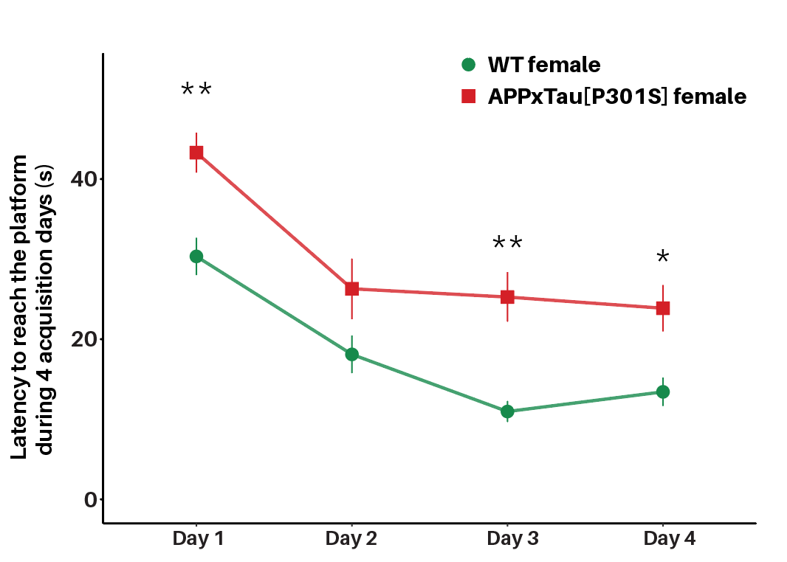
APP[V717I]xTau[P301S] mice show a learning deficit during MWM acquisition at 33 weeks of age.
Compared with WT littermates, APP[V717I] xTau[P301S] females show a significantly increased latency to reach the platform across the 4-day acquisition phase.
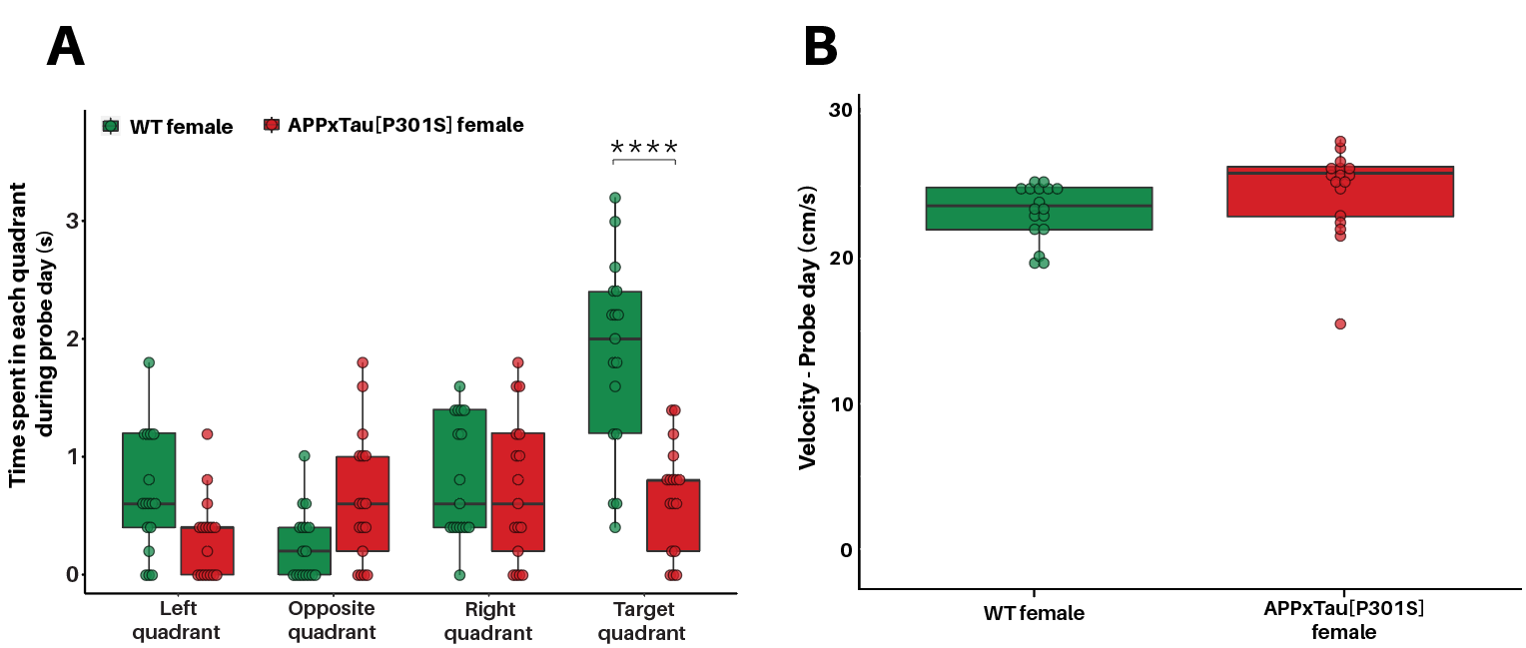
APP[V717I]xTau[P301S] mice show impaired spatial memory in the MWM probe trial, independent of motor function.
(A) APP[V717I]xTau[P301S] mice spend less time in the target quadrant than WT controls, while WT mice show a clear preference for the target quadrant over the other three. (B) Swimming velocity during the probe trial is comparable between genotypes, supporting that the spatial memory deficit shown in panel A reflects a genuine cognitive impairment rather than a sensorimotor confound.
あなたのアルツハイマー病研究はここから始まります。
当社の専門的に厳選したマウスモデル比較情報をご活用いただき、データに基づいた迅速な意思決定を実現してください。各種マウスモデルにおける検証データセットを掲載した研究スケジュール例、推奨される測定項目、およびサンプルデータをご覧ください。

Key readouts in the combined APP[V717I]xTau[P301S] mouse model
Original literature describing the combined Amyloid and Tau mouse model
- Terwel et al., 2008. Amyloid activates GSK-3beta to aggravate neuronal tauopathy in bigenic mice. DOI: 10.2353/ajpath.2008.070904
- Chong et al., 2011. Synaptic dysfunction in hippocampus of transgenic mouse models of Alzheimer’s disease: A Multi-electrode array study. DOI: 10.1016/j.nbd.2011.07.006
Preclinical Alzheimer’s disease Research with InnoSer

Validated Alzheimer’s disease mouse models
Choosing the right Alzheimer’s disease mouse model determines which pathological endpoints are measurable, which behavioral and biomarker readouts are appropriate, and how your data will be interpreted in a clinical context. Leverage our transgenic amyloid, tau, combined amyloid/tau, and tau seeding models. Read more >>

Translationally relevant Alzheimer’s disease biomarkers
Biomarkers are now central to Alzheimer’s disease clinical trials; generating translationally relevant preclinical readouts has never been more critical. Learn how you can implement clinically relevant biomarkers in one of our validated Alzheimer’s disease models, from plasma Aβ42/40 and/or CSF pan-Tau to the neurodegeneration marker, NfL. Read more >>

Functional behavioral endpoints
Behavioral and functional endpoints are how you demonstrate that your compound is reaching and rescuing cells in the brain regions relevant to Alzheimer’s disease. Assess cognitive and motor functions that have been validated across our Alzheimer’s disease models using CognitionWall™, Morris Water Maze, Rotarod, CatWalk, and ex vivo LTP. Read more >>
あなたの研究を支える人々

ソフィー・カーマンス博士
主任神経科学研究員

トーマス・フォーゲルス博士
主任神経科学研究員
よくあるご質問
Does the APPxTau[P301S] display both amyloid and tau pathology, and why is it relevant in terms of Alzheimer’s disease modelling?
Yes, InnoSer’s internal characterisation datasets show that the double transgenic APP[V717I]xTau[P301S] mouse model develops extracellular amyloid beta plaques (amyloid plaque load detected as LOC+ diffuse areas) and tau pathology (hyperphosphorylated tau detected by AT100+ regions) across the cortex and subiculum from 9 to 13 months of age, at which robust pathology is observed.
Importantly, our internal datasets show that Tau pathology in the combined model is moderately increased (see the dataset here) compared to the heterozygous Tau[P301S] model, suggesting that amyloid pathology aggravates Tau hyperphosphorylation and accelerates its progression.
Alzheimer’s disease is pathologically defined by the presence of both amyloid plaques and neurofibrillary tangles. While traditionally used transgenic Alzheimer’s disease mouse models, such as APP[V717I] or APPxPS1, display robust amyloid plaque deposition throughout the brain, they lack the associated plaque-driven tau pathology that is also central to the pathological development and progression of Alzheimer’s disease. Conversely, Tau[P301S] mice develop aggressive Tau pathology, but the P301S mutation in MAPT is linked to frontotemporal dementia (FTD), limiting the model’s standalone translational relevance for Alzheimer’s disease.
Because tau pathology remains largely absent in amyloid-only mouse models, incorporation of mutant human tau is required to recapitulate the dual hallmark pathology of Alzheimer’s disease in vivo.
Reach out to our scientific team to confirm this model’s suitability for your research.
Is the tau pathology observed in InnoSer’s double APPxTau transgenic mouse model driven by amyloid beta plaques?
InnoSer’s internal preliminary data suggest Aβ accelerates the onset of and aggravates tau pathology in the double transgenic APP[V717I]xTau[P301S] mice.
At 13 to 14 months of age, we observe significant increase in hyperhosphorylated tau (AT8 staining) in APP[V717I] x Tau[P301S] transgenic mice compared to heterozygous Tau[P301S] mice, suggesting an interplay between APP / Ab and Tau. The onset of Tau hyperphosphorylation (at 8 months of age) seems accelerated as well.
Quantification of AT8-positive neurons by immunohistochemistry in the cortex demonstrates this increase, with similar patterns observed in other brain regions and additional phospho-tau epitopes (e.g., AT100 in hippocampal CA1 and cortex).
These findings are consistent with literature suggesting that Aβ oligomers accelerate Tau pathology and cognitive impairment (Selkoe and Hardy, 2016; Spires-Jones and Hyman, 2014; Webster et al., 2014), supporting an amyloid-driven enhancement of Tau pathology.
What motor phenotypes are observed in the APP[V717I]xTau[P301S] model?
APP[V717I]xTau[P301S] mice develop progressive motor impairments starting around at 9 months of age, as evidenced by a clasping phenotype and impaired performance during the rotarod task. The clasping phenotype during the motor suspension test is commonly interpreted as a sign of neurodegenerative progression and corticospinal dysfunction.
These motor endpoints provide additional functional readouts of disease severity and can serve as sensitive measures of therapeutic efficacy at later stages.
Reach out to us to obtain the full mouse model phenotyping datasets.
Does the APP[V717I]xTau[P301S] model display cognitive deficits?
Yes, the combined model expressing mutant APP and Tau develops significant impairments in spatial learning and memory, including deficits in the Morris water maze from approximately 6.5 months of age.
The cognitive decline correlates with progressive accumulation of phosphorylated Tau and amyloid pathology, supporting the functional relevance of dual pathology.
However, as with all rodent models, mice do not recapitulate the full complexity of human cognition, social behavior, or clinical symptomatology. The model should therefore be interpreted as a mechanistic and translational efficacy platform rather than a complete replication of human Alzheimer’s disease.
Reach out to us to obtain the full mouse model phenotyping datasets.
Is InnoSer’s double transgenic APP[V717I]xTau[P301S] mouse model readily available for preclinical efficacy studies?
Yes, as an expert preclinical neurodegeneration CRO, InnoSer maintains access to established breeding cohorts of the double transgenic APP[V717I]xTau[P301S] mouse model, enabling rapid study initiation depending on the required animal age and genotype.
Our proactive colony planning ensures that your preclinical efficacy studies can be launched with minimal lead time.
InnoSerが提供するアルツハイマー病モデルの種類

アミロイド(APP/AB)トランスジェニックマウスモデル
InnoSerは、アルツハイマー病(AD)のプラーク病理を再現する複数の異なるトランスジェニックアミロイドモデルを用いた前臨床研究サービスを提供しています。

トランスジェニックタウマウスモデル
InnoSerは、複数の異なるトランスジェニックタウモデルを用いた独自の研究サービスを提供しており、これらはアルツハイマー病(AD)のタウ神経原線維変化病理を再現します。

タウタンパク質の導入および拡散を伴うマウスモデル
InnoSerはAD脳抽出物注入モデルを採用し、タウ病理の播種と拡散を再現するトランスレーショナルモデルによる独自の非臨床サービスを提供します。

インビトロ神経学アッセイ
リード候補化合物をスクリーニングするには InnoSerの in vitro神経学アッセイを用いてリード候補化合物をスクリーニングし、確信を持って前臨床段階のin vivo研究へ進める
InnoSer社の利用可能なアルツハイマー病マウスモデル

PS19トランスジェニックマウスモデル
前臨床研究で最も広く用いられているマウスモデルの1つを活用し、タウ病変を標的とする化合物の有効性を評価してください
![APP[V717I]マウスモデル](https://www.innoserlaboratories.com/wp-content/uploads/2026/05/APPV717I-mouse-model.png)
APP[V717I]マウスモデル

Tau[P301S]マウスモデル
再現性が高く、進行性のタウ病理を示すInnoSer独自のTau[P301S]マウスモデルを活用し、迅速かつ意思決定主導型の非臨床有効性試験を実施する
![APP[V717I] × PS1[A246E] マウスモデル](https://www.innoserlaboratories.com/wp-content/uploads/2026/05/APPV717I-x-PS1A246E-mouse-model.png)
APP[V717I] × PS1[A246E] マウスモデル
早期発症型アミロイドーシスを呈するトランスジェニックAPPxPS1アルツハイマー病モデルを用いて、アミロイドβの蓄積、神経炎症、および認知機能障害を標的とする治療法の有効性を検証する
![Tau[P301L]マウスモデル](https://www.innoserlaboratories.com/wp-content/uploads/2026/05/TauP301L-Mouse-Model.png)
Tau[P301L]マウスモデル
進行性で、病理学的特徴が十分に解明されているInnoSer社のTau[P301L]マウスモデルを活用し、メカニズム主導型の非臨床有効性試験を実施する

トランスジェニックAPP×PS1 ARTE10マウスモデル
ARTE10マウスモデルに見られる広範なアミロイドβ病変を活用し、確固たる前臨床有効性試験を実施することで、アミロイド低減治療プログラムを推進する
![APP[V717I] × Tau[P301S] マウスモデル、欧州神経学分野のCRO専門家](https://www.innoserlaboratories.com/wp-content/uploads/2026/05/APPV717I-x-TauP301S-mouse-model.png)
APP[V717I] × Tau[P301S] マウスモデル
E多標的治療薬の評価を InnoSerの 複合 APPxTau 疾患 モデル
InnoSerの最新研究を発見する

Neurodevelopmental disorder mouse models at InnoSer — TSC, Rett & STXBP1
in this month's update, we invite you to explore recent developments in rare neurodevelopmental disorders associated with epilepsy and seizure phenotypes. We highlight emerging therapeutic approaches, discuss the importance of selecting translationally relevant...

Plasma NfL, p-tau217, or Aβ42/40: Which Alzheimer’s disease biomarkers should you include in your preclinical efficacy study?
A practical guide to preclinical Alzheimer’s disease biomarkers panel selection when you’re considering outsourcing to a specialist neurology CRO Biomarkers have transformed Alzheimer's disease clinical trials, enabling diagnosis confirmation for trial eligibility,...

Transgenic Amyloid, Tau, Seeding, or combined Amyloid/Tau pathology mouse models — which is the right one for your drug development program?
A practical guide to model selection when outsourcing your Alzheimer's disease efficacy study to a specialist neurology CRO Choosing the right Alzheimer's disease mouse model is one of the most consequential early decisions in a preclinical drug development program....

Morris Water Maze, Rotarod and beyond: How do you build a comprehensive behavioral test battery when outsourcing your preclinical Alzheimer’s disease efficacy study?
A practical introduction to behavioural test battery selection when outsourcing your Alzheimer's disease efficacy study to a specialist neurology CRO When outsourcing a preclinical Alzheimer's disease efficacy study, behavioral endpoint selection is one of the most...
AAALAC認定
InnoSerはAAALAC認証を取得し、責任ある動物ケアと利用への取り組みを実証しています。AAALAC Internationalは、自主的な認証および評価プログラムを通じて科学における動物の適切な扱いを推進する非営利組織です。InnoSerのオランダおよびベルギー施設は、それぞれ2016年および2020年よりAAALAC認証を取得しています。AAALAC認証プログラムの詳細はこちらをご覧ください。

動物福祉
3R原則は、政策や規制の変更から新技術・手法の開発と普及に至るまで、あらゆる分野に影響を及ぼします。このためInnoSerは、これらのプロセスに対する継続的な取り組みと監視を実施しています。当社が実践する手順は、動物実験の代替・削減・改善を最大限に実現し、研究および医薬品開発におけるこれらの原則への取り組みを促進します。
info@innoserlaboratories.com