
Double transgenic combined Amyloid and Tau mouse model – APP[V717I]xTau[P301S] mouse model
EBewertung von Multi-Target-Therapeutika bei InnoSer’s kombinierten APPxTau Krankheitsmodell Modell
Characteristics of the combined APP[V717I]xTau[P301S] mouse model
The double transgenic APP[V717I]xTau[P301S] mouse model leverages two well-established transgenic mouse models of amyloid (APP[V717I] mouse model) and tau (Tau[P301S] mouse model) pathology. The double transgenic mice express human APP[V7I7I] with the London mutation and human Tau[P301S] (4R/2N) under control of the neuron-specific Thy-1 promoter, resulting in the combined and progressive development of β-amyloid and tau pathology within the same animal.
The APP[V717I]xTau[P301S] mouse model develops significant spatial learning and memory impairments in the Morris water maze from approximately 6.5 months of age, reflecting functional consequences of combined amyloid and Tau pathology. At later stages (around 9 months of age), the double transgenic mice also exhibit progressive motor deficits, including impaired rotarod performance and clasping behavior, indicative of advancing neurodegenerative processes.
Building on the robust amyloid phenotype of the APP[V717I] model and the aggressive Tau pathology of InnoSer’s Tau[P301S] model, the APPxTau[P301S] mouse provides a highly translational platform for comprehensive preclinical efficacy studies in Alzheimer’s disease.
✓ Double transgenic APPxTau show robust amyloid-β plaques and tau pathology across cortex, hippocampus and subiculum from an age of 8 months
✓ Amyloid-β plaques and tau pathology in the APP[V717I]xTau[P301S] mouse model is associated with robust neuroinflammation phenotype (astrocytosis, microgliosis) in cortex and subiculum at 9 months of age
✓ The double transgenic mice show cognitive impairment in Morris Water Maze paradigm from an age of 6.5 months
✓ APPxTau mice show progressive motoric impairment from an age of 9 months

Take advantage of InnoSer’s expertise, flexibility, and collaborative approach for your research. We support you in identifying new drug candidates, characterizing their pharmacological properties, and conducting rigorous safety and efficacy studies with state-of-the-art behavioral, bioanalytical, and histopathological readouts.
Example data featuring the APP[V717I]xTau[P301S] mouse model of Alzheimer’s disease

Progressive accumulation of plaque deposition (LOC), hyperphosphorylated Tau (AT100 = pThr212/pSer214 Tau), astrocytosis (GFAP) and microgliosis (CD45) in the cortex as measured by IHC
Data shown as mean ± SEM, n = 8, no data for WT at 11.2 months. Statistics: One-Way ANOVA, Tukey’s multiple comparison.

Preliminary data suggest Aβ accelerates the onset of and aggravates hTau pathology in APP[V717I]xTAU[P301S] transgenic mice
At 13 to 14 months of age hyperphosphorylation of Tau (AT8 staining) is significantly increased in APP[V717I] x Tau[P301S] transgenic mice compared to heterozygous Tau[P301S] mice, suggesting an interplay between APP / Ab and Tau. The onset of Tau hyperphosphorylation (at 8 months of age) seems accelerated as well.
The figure shows a quantification of AT8 (pTau S202/T205) positive neurons using IHC in the cortex. Similar patterns are detected in other brain regions with other pTau epitopes (AT100 in CA1 of the hippocampus and the cortex).
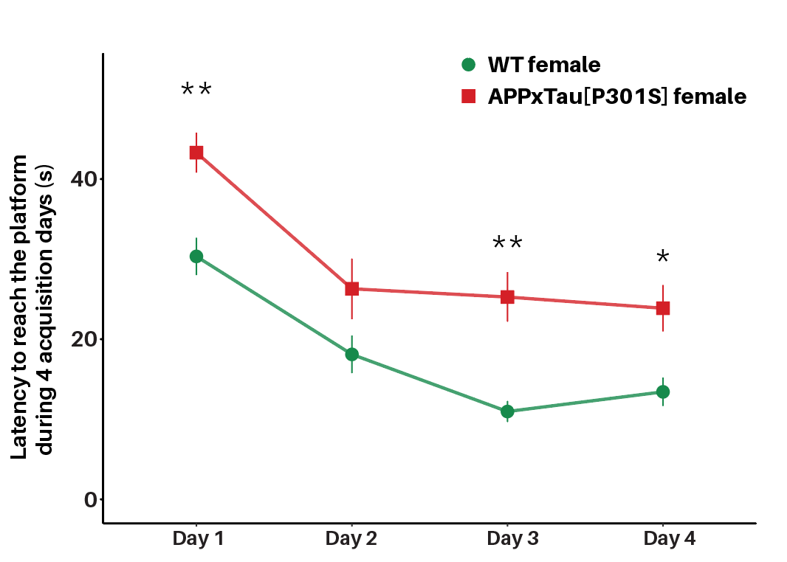
APP[V717I]xTau[P301S] mice show a learning deficit during MWM acquisition at 33 weeks of age.
Compared with WT littermates, APP[V717I] xTau[P301S] females show a significantly increased latency to reach the platform across the 4-day acquisition phase.
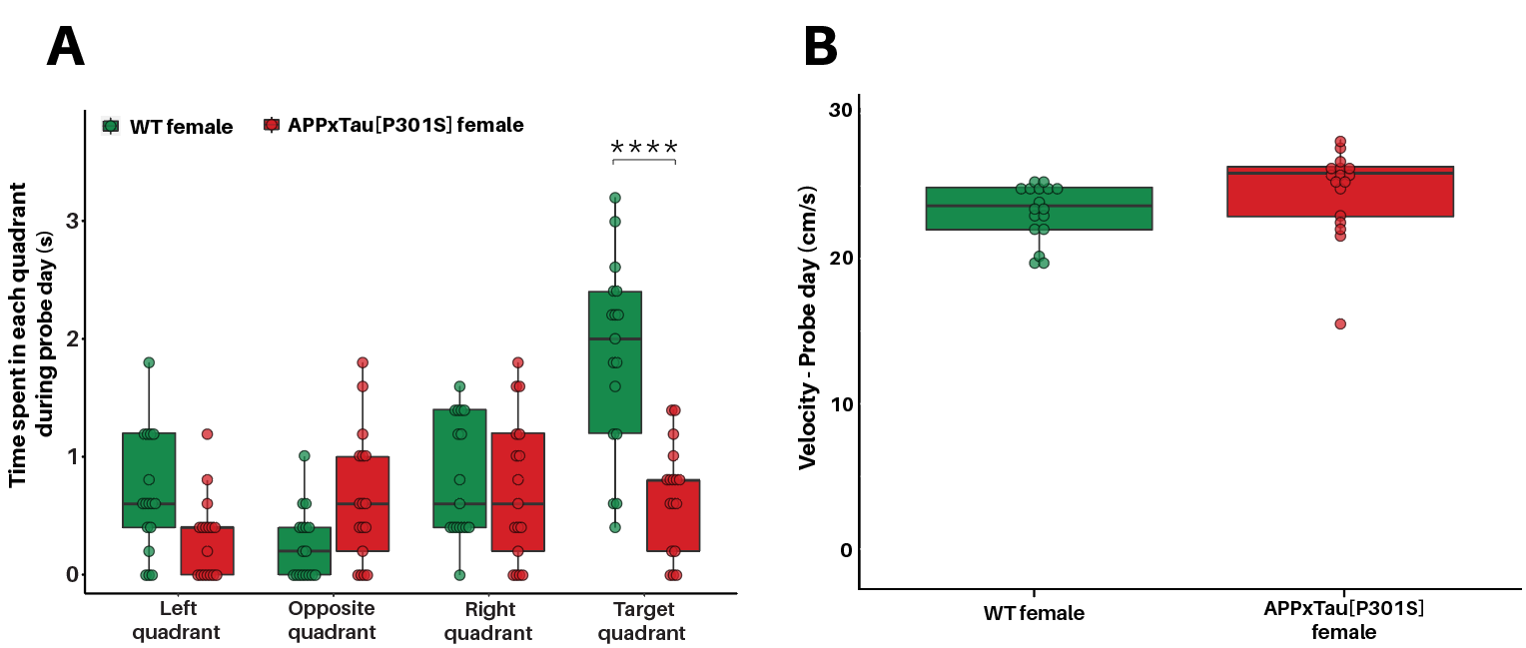
APP[V717I]xTau[P301S] mice show impaired spatial memory in the MWM probe trial, independent of motor function.
(A) APP[V717I]xTau[P301S] mice spend less time in the target quadrant than WT controls, while WT mice show a clear preference for the target quadrant over the other three. (B) Swimming velocity during the probe trial is comparable between genotypes, supporting that the spatial memory deficit shown in panel A reflects a genuine cognitive impairment rather than a sensorimotor confound.
Ihre Alzheimer-Forschung beginnt hier.
Entdecken Sie unseren fachkundig zusammengestellten Vergleich der verfügbaren Mausmodelle, um schnellere, datengestützte Entscheidungen zu treffen. Sehen Sie sich einen Beispiel-Zeitplan für die Studie, empfohlene Messparameter sowie Beispieldaten mit Validierungsdatensätzen für die verschiedenen Mausmodelle an.

Key readouts in the combined APP[V717I]xTau[P301S] mouse model
Original literature describing the combined Amyloid and Tau mouse model
- Terwel et al., 2008. Amyloid activates GSK-3beta to aggravate neuronal tauopathy in bigenic mice. DOI: 10.2353/ajpath.2008.070904
- Chong et al., 2011. Synaptic dysfunction in hippocampus of transgenic mouse models of Alzheimer’s disease: A Multi-electrode array study. DOI: 10.1016/j.nbd.2011.07.006
Preclinical Alzheimer’s disease Research with InnoSer

Validated Alzheimer’s disease mouse models
Choosing the right Alzheimer’s disease mouse model determines which pathological endpoints are measurable, which behavioral and biomarker readouts are appropriate, and how your data will be interpreted in a clinical context. Leverage our transgenic amyloid, tau, combined amyloid/tau, and tau seeding models. Read more >>

Translationally relevant Alzheimer’s disease biomarkers
Biomarkers are now central to Alzheimer’s disease clinical trials; generating translationally relevant preclinical readouts has never been more critical. Learn how you can implement clinically relevant biomarkers in one of our validated Alzheimer’s disease models, from plasma Aβ42/40 and/or CSF pan-Tau to the neurodegeneration marker, NfL. Read more >>

Functional behavioral endpoints
Behavioral and functional endpoints are how you demonstrate that your compound is reaching and rescuing cells in the brain regions relevant to Alzheimer’s disease. Assess cognitive and motor functions that have been validated across our Alzheimer’s disease models using CognitionWall™, Morris Water Maze, Rotarod, CatWalk, and ex vivo LTP. Read more >>
Die Menschen hinter Ihrer Forschung

Dr. Sofie Carmans
Leitender Wissenschaftler im Bereich Neurologie

Dr. Thomas Vogels
Leitender Wissenschaftler im Bereich Neurologie
Häufig gestellte Fragen
Does the APPxTau[P301S] display both amyloid and tau pathology, and why is it relevant in terms of Alzheimer’s disease modelling?
Yes, InnoSer’s internal characterisation datasets show that the double transgenic APP[V717I]xTau[P301S] mouse model develops extracellular amyloid beta plaques (amyloid plaque load detected as LOC+ diffuse areas) and tau pathology (hyperphosphorylated tau detected by AT100+ regions) across the cortex and subiculum from 9 to 13 months of age, at which robust pathology is observed.
Importantly, our internal datasets show that Tau pathology in the combined model is moderately increased (see the dataset here) compared to the heterozygous Tau[P301S] model, suggesting that amyloid pathology aggravates Tau hyperphosphorylation and accelerates its progression.
Alzheimer’s disease is pathologically defined by the presence of both amyloid plaques and neurofibrillary tangles. While traditionally used transgenic Alzheimer’s disease mouse models, such as APP[V717I] or APPxPS1, display robust amyloid plaque deposition throughout the brain, they lack the associated plaque-driven tau pathology that is also central to the pathological development and progression of Alzheimer’s disease. Conversely, Tau[P301S] mice develop aggressive Tau pathology, but the P301S mutation in MAPT is linked to frontotemporal dementia (FTD), limiting the model’s standalone translational relevance for Alzheimer’s disease.
Because tau pathology remains largely absent in amyloid-only mouse models, incorporation of mutant human tau is required to recapitulate the dual hallmark pathology of Alzheimer’s disease in vivo.
Reach out to our scientific team to confirm this model’s suitability for your research.
Is the tau pathology observed in InnoSer’s double APPxTau transgenic mouse model driven by amyloid beta plaques?
InnoSer’s internal preliminary data suggest Aβ accelerates the onset of and aggravates tau pathology in the double transgenic APP[V717I]xTau[P301S] mice.
At 13 to 14 months of age, we observe significant increase in hyperhosphorylated tau (AT8 staining) in APP[V717I] x Tau[P301S] transgenic mice compared to heterozygous Tau[P301S] mice, suggesting an interplay between APP / Ab and Tau. The onset of Tau hyperphosphorylation (at 8 months of age) seems accelerated as well.
Quantification of AT8-positive neurons by immunohistochemistry in the cortex demonstrates this increase, with similar patterns observed in other brain regions and additional phospho-tau epitopes (e.g., AT100 in hippocampal CA1 and cortex).
These findings are consistent with literature suggesting that Aβ oligomers accelerate Tau pathology and cognitive impairment (Selkoe and Hardy, 2016; Spires-Jones and Hyman, 2014; Webster et al., 2014), supporting an amyloid-driven enhancement of Tau pathology.
What motor phenotypes are observed in the APP[V717I]xTau[P301S] model?
APP[V717I]xTau[P301S] mice develop progressive motor impairments starting around at 9 months of age, as evidenced by a clasping phenotype and impaired performance during the rotarod task. The clasping phenotype during the motor suspension test is commonly interpreted as a sign of neurodegenerative progression and corticospinal dysfunction.
These motor endpoints provide additional functional readouts of disease severity and can serve as sensitive measures of therapeutic efficacy at later stages.
Reach out to us to obtain the full mouse model phenotyping datasets.
Does the APP[V717I]xTau[P301S] model display cognitive deficits?
Yes, the combined model expressing mutant APP and Tau develops significant impairments in spatial learning and memory, including deficits in the Morris water maze from approximately 6.5 months of age.
The cognitive decline correlates with progressive accumulation of phosphorylated Tau and amyloid pathology, supporting the functional relevance of dual pathology.
However, as with all rodent models, mice do not recapitulate the full complexity of human cognition, social behavior, or clinical symptomatology. The model should therefore be interpreted as a mechanistic and translational efficacy platform rather than a complete replication of human Alzheimer’s disease.
Reach out to us to obtain the full mouse model phenotyping datasets.
Is InnoSer’s double transgenic APP[V717I]xTau[P301S] mouse model readily available for preclinical efficacy studies?
Yes, as an expert preclinical neurodegeneration CRO, InnoSer maintains access to established breeding cohorts of the double transgenic APP[V717I]xTau[P301S] mouse model, enabling rapid study initiation depending on the required animal age and genotype.
Our proactive colony planning ensures that your preclinical efficacy studies can be launched with minimal lead time.
Die von InnoSer angebotenen Modelle für die Alzheimer-Krankheit

Transgene Mausmodelle für Amyloid (APP/AB)
InnoSer bietet präklinische Forschungsdienstleistungen mit verschiedenen transgenen Amyloid-Modellen an, die die Plaque-Pathologie der Alzheimer-Krankheit nachbilden.

Transgene Tau-Mausmodelle
InnoSer bietet einzigartige Forschungsdienstleistungen mit verschiedenen transgenen Tau-Modellen an, die die Pathologie der Tau-Neurofibrillenbündel bei Alzheimer nachbilden.

Tau-Seeding und -Spreading bei Mausmodellen
InnoSer nutzt ein Injektionsmodell mit AD-Hirnextrakt und bietet damit einzigartige präklinische Dienstleistungen auf der Grundlage eines translationalen Modells zur Keimbildung und Ausbreitung der Tau-Pathologie.

In-vitro-Neurologie-Assays
Untersuchen Sie Ihre vielversprechendsten Wirkstoffkandidaten mithilfe von InnoSers in-vitro-Neurologie-Assays von InnoSer, um sicher in präklinische in-vivo-Studien überzugehen
Die von InnoSer angebotenen Mausmodelle für die Alzheimer-Krankheit

Transgenes PS19-Mausmodell
Nutzen Sie eines der in der präklinischen Forschung am häufigsten verwendeten Mausmodelle, um die Wirksamkeit Ihres Wirkstoffs gegen die Tau-Pathologie zu bewerten
![APP[V717I]-Mausmodell](https://www.innoserlaboratories.com/wp-content/uploads/2026/05/APPV717I-mouse-model.png)
APP[V717I]-Mausmodell

Tau[P301S]-Mausmodell
Nutzen Sie das von InnoSer entwickelte proprietäre Tau[P301S]-Mausmodell mit reproduzierbarer und aggressiver Tau-Pathologie für schnelle, entscheidungsorientierte präklinische Wirksamkeitsstudien.
![APP[V717I] x PS1[A246E]-Mausmodell](https://www.innoserlaboratories.com/wp-content/uploads/2026/05/APPV717I-x-PS1A246E-mouse-model.png)
APP[V717I] x PS1[A246E]-Mausmodell
Untersuchung der Wirksamkeit von Therapien, die auf die Amyloid-beta-Ablagerung, Neuroinflammation und kognitive Beeinträchtigungen abzielen, in einem transgenen APPxPS1-Modell der früh einsetzenden Amyloidose bei Alzheimer-Patienten
![Tau[P301L]-Mausmodell](https://www.innoserlaboratories.com/wp-content/uploads/2026/05/TauP301L-Mouse-Model.png)
Tau[P301L]-Mausmodell
Nutzen Sie das Tau[P301L]-Mausmodell von InnoSer mit fortschreitender, gut charakterisierter Tau-Pathologie für mechanismusorientierte präklinische Wirksamkeitsstudien.

Transgenes APP x PS1 ARTE10-Mausmodell
Treiben Sie Ihr therapeutisches Programm zur Senkung des Amyloidspiegels voran, indem Sie die weit verbreitete Amyloid-beta-Pathologie des ARTE10-Mausmodells für fundierte präklinische Wirksamkeitsstudien nutzen.
![APP[V717I] x Tau[P301S]-Mausmodell, Spezialisten für klinische Auftragsforschung (CRO) im Bereich der europäischen Neurologie](https://www.innoserlaboratories.com/wp-content/uploads/2026/05/APPV717I-x-TauP301S-mouse-model.png)
APP[V717I] x Tau[P301S]-Mausmodell
EBewertung von Multi-Target-Therapeutika bei InnoSer’s kombinierten APPxTau Krankheitsmodell Modell
Entdecken Sie die neuesten Forschungsergebnisse von InnoSer
Neurodevelopmental disorder mouse models at InnoSer — TSC, Rett & STXBP1
in this month's update, we invite you to explore recent developments in rare neurodevelopmental disorders associated with epilepsy and seizure phenotypes. We highlight emerging therapeutic approaches, discuss the importance of selecting translationally relevant...

Plasma NfL, p-tau217, or Aβ42/40: Which Alzheimer’s disease biomarkers should you include in your preclinical efficacy study?
A practical guide to preclinical Alzheimer’s disease biomarkers panel selection when you’re considering outsourcing to a specialist neurology CRO Biomarkers have transformed Alzheimer's disease clinical trials, enabling diagnosis confirmation for trial eligibility,...

Transgenic Amyloid, Tau, Seeding, or combined Amyloid/Tau pathology mouse models — which is the right one for your drug development program?
A practical guide to model selection when outsourcing your Alzheimer's disease efficacy study to a specialist neurology CRO Choosing the right Alzheimer's disease mouse model is one of the most consequential early decisions in a preclinical drug development program....

Morris Water Maze, Rotarod and beyond: How do you build a comprehensive behavioral test battery when outsourcing your preclinical Alzheimer’s disease efficacy study?
A practical introduction to behavioural test battery selection when outsourcing your Alzheimer's disease efficacy study to a specialist neurology CRO When outsourcing a preclinical Alzheimer's disease efficacy study, behavioral endpoint selection is one of the most...
AAALAC-Akkreditierung
InnoSer hat die AAALAC-Akkreditierung erhalten und damit sein Engagement für einen verantwortungsvollen Umgang mit Tieren unter Beweis gestellt. AAALAC International ist eine gemeinnützige Organisation, die sich durch freiwillige Akkreditierungs- und Bewertungsprogramme für den artgerechten Umgang mit Tieren in der Wissenschaft einsetzt. Die Einrichtungen von InnoSer in den Niederlanden und Belgien sind seit 2016 bzw. 2020 AAALAC-akkreditiert. Weitere Informationen zum AAALAC-Akkreditierungsprogramm finden Sie hier.

Tierschutz
Die 3Rs wirken sich auf alle Bereiche aus, von politischen und regulatorischen Veränderungen bis hin zur Entwicklung und Einführung neuer Technologien und Ansätze. Aus diesem Grund engagiert sich InnoSer kontinuierlich für diese Prozesse und überwacht sie. Die von uns umgesetzten Maßnahmen maximieren unsere Fähigkeit, den Einsatz von Tieren zu ersetzen, zu reduzieren und zu verfeinern, und unterstützen unser Bekenntnis zu diesen Grundsätzen in der Forschung und der Arzneimittelentwicklung.
info@innoserlaboratories.com