In this month’s update, we revisit the APP[V717I]xTau[P301S] model with newly in-house generated Morris Water Maze (MWM) data, reconfirming the spatial memory deficits previously described for this model and reinforcing the translational value of the model.
The APP[V717I]xTau[P301S] model: combined amyloid-tau pathology relevant to cognitive decline
Amyloid-β and tau pathology rarely occur in isolation: in Alzheimer’s disease (AD), the two pathologies interact and are thought to mutually accelerate neurodegeneration and cognitive decline (Moore et al., 2015, Maron et al., 2020). The double transgenic APP[V717I]xTau[P301S] mouse model leverages two well-established transgenic mouse models of amyloid (APP[V717I] mouse model) and tau (Tau[P301S] mouse model) pathology. The double transgenic mice express human APP[V7I7I] with the London mutation and human Tau[P301S] (4R/2N) under control of the neuron-specific Thy-1 promoter, resulting in the combined and progressive development of β-amyloid and tau pathology.
Cognitive decline in humans is closely linked to amyloid and tau pathology (Testo et al., 2024), and the APP[V717I]xTau[P301S] model recapitulates both pathological drivers within a single animal. Genetic and histopathological overlap alone does not establish translational relevance: the model must also demonstrate the resulting functional deficit, measurable cognitive decline, to support its use in efficacy studies. Confirming this link strengthens the translational value of treatment effects observed in this model.
Several cognitive assays can detect impairment in AD models; the Morris Water Maze (MWM) is used here for its evaluation of hippocampus-dependent spatial learning and reference memory — the same cognitive domain disrupted early in AD (Vorhees & Williams, 2006). Its clinical relevance is further supported by a virtual adaptation of the test developed for use in human patients: comparable learning and memory impairments were observed between amyloid-overexpressing mice and patients with mild cognitive impairment (MCI) due to AD, supporting the MWM, when carefully designed and analyzed, as a sensitive assay for detecting AD-relevant impairments across species (Possin et al., 2016).
Beyond cognitive function, this model has also been extensively characterized across biomarker and histopathological readouts, including plasma Aβ species, NfL, total and phosphorylated tau, as well as histopathological assessment of Aβ plaque load, tau pathology, and neuroinflammation. As InnoSer continues to expand the dataset for this model, we present new in-house MWM data below, reinforcing this clinically relevant functional readout within the model’s growing characterization.
APP[V717I]xTau[P301S] mice show pronounced spatial memory deficits in the Morris Water Maze
In the MWM, APP[V717I]xTau[P301S] mice are tested for deficits in spatial learning and memory relative to non-transgenic wild-type (WT) littermates. Mice are trained to locate the platform during the acquisition phase, with learning reflected in a decreasing latency to find the platform over repeated trials. At 33 weeks of age, while the WT littermates show clearly a well-learned pattern by reaching the platform in ~10 seconds after 4 days of acquisition, the female APP[V717I]xTau[P301S] mice display a clear and consistent learning deficit when trying to locate the platform.
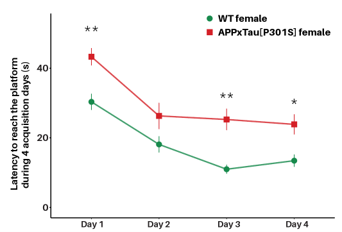
FIGURE 1. APP[V717I]xTau[P301S] mice show a learning deficit during MWM acquisition at 33 weeks of age. Compared with WT littermates, APP[V717I] xTau[P301S] females show a significantly increased latency to reach the platform across the 4-day acquisition phase.
In the probe trial, conducted after the acquisition phase and removal of the platform, female APP[V717I] xTau[P301S] mice spent significantly less time in the target quadrant where the platform was located compared with WT animals, indicating impaired retention of the platform location (Figure 2A). Swimming velocity during the probe trial was comparable between genotypes, confirming that the observed memory deficit is not confounded by differences in motor performance or motivation to swim (Figure 2B).
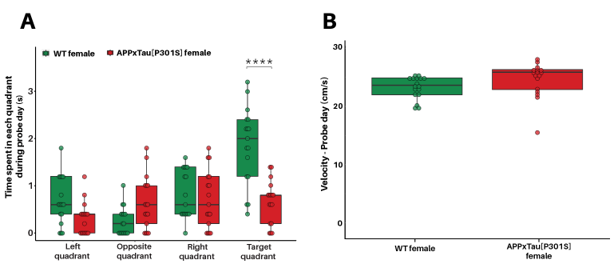
FIGURE 2. APP[V717I]xTau[P301S] mice show impaired spatial memory in the MWM probe trial, independent of motor function. (A) APP[V717I]xTau[P301S] mice spend less time in the target quadrant than WT controls, while WT mice show a clear preference for the target quadrant over the other three. (B) Swimming velocity during the probe trial is comparable between genotypes, supporting that the spatial memory deficit shown in panel A reflects a genuine cognitive impairment rather than a sensorimotor confound.
Among the probe trial parameters, cumulative time spent in the target quadrant offers a reliable measure of spatial memory, capturing sustained search behavior at the platform’s former location once mice have oriented to the spatial cues.
These results reproduce the spatial memory deficits previously described in this combined amyloid-tau model, now confirmed under InnoSer’s own study conditions, supporting the continued use of the MWM as a sensitive readout for this model in future efficacy studies.
Interested in studying amyloid- and tau-directed therapeutics in the APP[V717I] xTau[P301S] model? With this new cognitive dataset added to the model’s existing translational characterization, InnoSer is well positioned to support your AD-focused study design.
創薬は反復的な長期にわたるプロセスとなる場合がありますが、InnoSerはお客様の専任パートナーとして、連続した実験による迅速な対応を通じて、リード化合物の最適化を支援いたします。 医薬品開発分野におけるInnoSerの能力について、さらに詳しく知りたいとお考えですか?
前臨床研究を次のレベルへ引き上げる準備はできていますか?貴社の新規治療法が最適な臨床成果を達成できるよう、共に取り組んでいきましょう。