ページを選択

Clinically relevant biomarker panels for comprehensive efficacy studies in Alzheimer’s Disease mouse models.

May 5, 2026

InnoSer’s validated Alzheimer’s disease (AD) mouse models are equipped with translationally relevant biomarker readout panels — spanning amyloid-beta (Aβ) species, phosphorylated Tau isoforms, and the early, sensitive hallmark of neurodegeneration, neurofilament light chain (NfL) — supporting longitudinal follow-up across the disease course enabling a comprehensive, clinically anchored assessment of therapeutic efficacy within a single preclinical study.

Alzheimer’s Disease: The power of a multi-biomarker approach

To support a biologically grounded diagnosis and staging of Alzheimer’s disease (AD), the National Institute on Aging (NIA) and Alzheimer’s Association (AA) introduced the Amyloid/Tau/Neurodegeneration (AT(N)) research framework. This framework classifies AD biomarkers into three core pathological domains — amyloid-β plaque deposition (A), pathological tau accumulation (T), and neurodegeneration and inflammation (N) (Jack et al., 2018).

Recognizing the framework’s value for both diagnosis and longitudinal disease tracking, the field has since invested heavily in expanding the repertoire of measurable biomarkers across each domain. Recent advances in blood-based biomarkers have revolutionized the diagnosis of Alzheimer’s disease (AD) and Parkinson’s disease (PD), offering minimally invasive, cost-effective, and highly accurate tools that can detect pathology years before symptom onset and can follow up on disease progression.

These biomarkers are now widely adopted in clinical research and patient classification, and continue to gain importance for early AD and PD detection, longitudinal disease monitoring, and therapeutic development.

Importantly, the same biomarker classes are also measurable in transgenic mouse models of AD, where they have been shown to track disease progression and therapeutic response in ways that closely mirror human biomarker trajectories (Hansson et al., 2023). Incorporating these clinically established biomarker readouts into preclinical in vivo studies is therefore essential for generating robust, translationally relevant efficacy data.

These readouts span the core pathological processes of AD across the full (AT(N)) framework and can be measured in plasma, cerebrospinal fluid (CSF), and brain tissue, with biofluid selection tailored to the specific model and study design—enabling the simultaneous assessment of disease‑relevant biomarkers and peripheral pharmacodynamic responses within a single in vivo study.

Clinically relevant AD biomarkers available at InnoSer

Aβ42/40 ratio — Amyloid pathology

  • Amyloid-beta deposition is one of the earliest detectable hallmarks of AD (Verberk et al., 2018).
  • As Aβ42 aggregates into plaques, its free concentration in biofluids falls while Aβ40 remains relatively stable, producing a characteristic decrease in the Aβ42/40 ratio that can precede symptom onset (Andersson et al., 2023).
  • In humans, reduced CSF or plasma Aβ42/40 and positive amyloid PET are used to establish a biological diagnosis of AD and to triage patients for further confirmatory testing (Hansson et al., 2022).
Histopathology image showing differences in TDP-43 signal in nucleus and cytoplasm in mutant vs healthy TDP-43 mouse model

Figure 1. Plasma Aβ42/40 ratio declines with cortical Aβ plaque burden. (A) Plasma concentrations of Aβ42 and Aβ40 were measured using MSD-technology (kit K15200E) in APP x TauP301S transgenic mice. (B) A significant negative correlation was observed between the plasma Aβ42/40 ratio and cortical Aβ plaque burden, as assessed by immunohistochemistry. These findings support the use of the plasma Aβ42/40 ratio as a peripheral biomarker for cerebral Aβ pathology progression.

p-Tau181/Total Tau ratio — Tau pathology and phosphorylation

  • Tau is a microtubule-associated protein that, under pathological conditions, becomes hyperphosphorylated and aggregates into neurofibrillary tangles — a defining feature of AD neuropathology (Rawat et al., 2022).
  • Alongside amyloid biomarkers, CSF Total Tau is one of the core biomarkers used in clinical practice to support an AD diagnosis and assess disease severity (Hansson et al., 2023).
  • While total Tau reflects neuronal and synaptic damage and disease severity, pTau181 captures active, disease-specific Tau pathology and emerges earlier due to amyloid-β–driven, site-specific phosphorylation preceding advanced neurodegeneration (Janelidze et al., 2020).
  • Plasma p-Tau181 discriminates AD from other neurodegenerative diseases with high accuracy across multiple independent cohorts, rising early in the disease course and correlating strongly with amyloid and tau burden on PET imaging (Karikari et al., 2020).
Histopathology image showing differences in TDP-43 signal in nucleus and cytoplasm in mutant vs healthy TDP-43 mouse model

Figure 2. Plasma pTau181/total Tau ratio progressively increases over time in heterozygous Tau[P301S] mice. Plasma concentrations of total Tau and phosphorylated Tau at threonine 181 (pTau181) were measured by MSD technology (kits B2AGP and B2AGM) in heterozygous Tau[P301S] mice at 9.1, 11.0, end-stage clasping, and 13.2 months of age. End-stage clasping refers to the humane endpoint defined by severe Tau-induced motor impairment necessitating euthanasia.

Neurofilament light chain (NfL) — Neurodegeneration

  • NfL is a cytoskeletal structural protein only expressed in neurons and released into biofluids upon axonal injury or neuronal death.
  • It is consistently elevated across neurodegenerative diseases in humans and demonstrates strong cross-species translational validity, making it one of the most widely adopted biomarkers in clinical trials and preclinical research (Gaetani et al., 2019; Bergmann et al., 2026).
  • In the context of AD, NfL serves as a sensitive, quantitative readout of neurodegeneration and a robust measure of therapeutic efficacy and, therefore, has emerged as an valuable biomarker to assess neuronal injury.
  • For an in-depth characterization of NfL readouts across our specific Alzheimer’s disease mouse models, visit our website to read our previous NfL-related Newsletter.
Histopathology image showing differences in TDP-43 signal in nucleus and cytoplasm in mutant vs healthy TDP-43 mouse model

InnoSer’s Alzheimer’s disease mouse model portfolio: key highlights

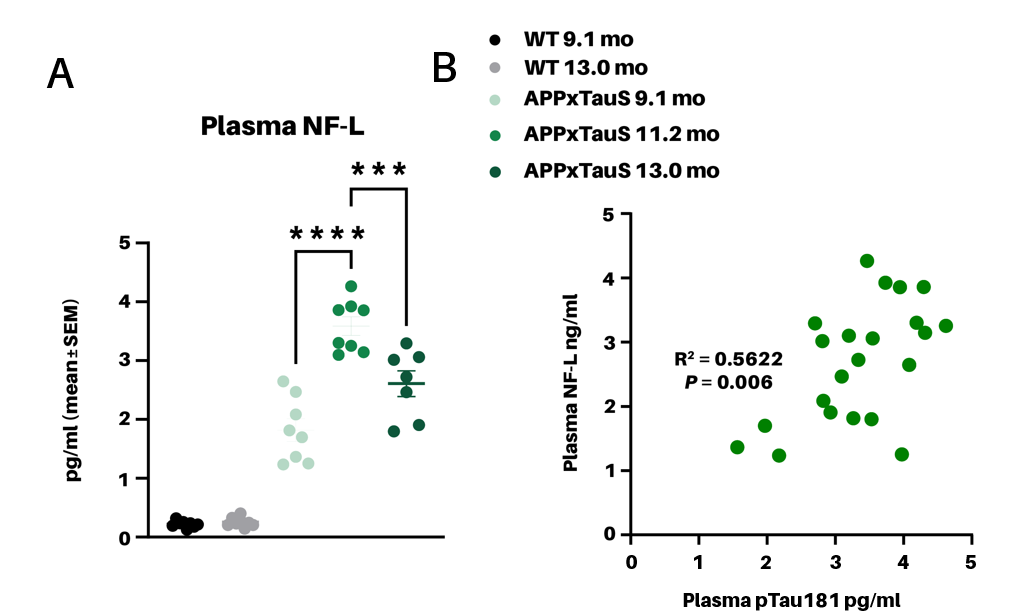
Figure 3. Increased plasma Neurofilament Light correlates with plasma pTau181. (A) Plasma concentrations of Neurofilament Light (NfL) were measured using MSD technology (kit K1517XR). (B) A significant positive correlation was observed between plasma NfL and pTau181 levels, suggesting a link between axonal damage and Tau-related neurodegeneration in APP[V717I] x Tau[P301S] mice. These findings support the utility of plasma NfL and pTau181 as complementary plasma biomarkers for disease progression. 

Across our broad portfolio of Alzheimer’s disease mouse models, biomarker readouts are fully integrated into our in vivo study designs. Each model is carefully selected for translational relevance and highly characterized, enabling your compound to be evaluated within a well‑defined pathological context, with meaningful, translational endpoints embedded from the earliest stages of the study.

  • Transgenic APP[V717I] × PS1[A246E] – A well-established amyloid model with progressive Aβ plaque deposition from ~6 months and cognitive deficits from 6–8 months of age. Disease progression is tracked using Aβ42/40 to assess amyloid pathology and NfL as a translational marker of neurodegeneration.


  • Transgenic Tau[P301S] – The homozygous model shows robust Tau pathology from 2.5–3 months, with cognitive impairment from ~3.5 months, enabling rapid evaluation of Tau-targeting approaches using Total Tau and pTau181, alongside NfL. A heterozygous variant is available for longer-term studies, with slower disease progression and onset around ~9 months.


  • Transgenic APP[V717I] × Tau[P301S] – A combined pathology model capturing both amyloid and tau hallmarks within a single system, with cognitive deficits from ~7 months of age. Integrated biomarker readouts include Total Tau, pTau181, and NfL, supporting comprehensive AD pathology studies.


  • Seed-and-spread models – A flexible Tau transmission model using human- or mouse-derived hTau seeds in a Tau[P301S] background, enabling rapid study initiation without breeding and a cost-effective approach to assess tau spread and therapeutic intervention.

Recent Articles

All Categories

いち早く情報を入手 – このニュースをメールボックスに直接お届けします

InnoSer provides a variety of validated in vitro and in vivo platforms for the efficient development of novel therapeutics. If you require additional information, feel free to reach out, and we will respond within a few days.

We provide a monthly update from our InnoSer labs containing scientific insights into our research services. To get news straight to your inbox please sign up here.

義務なし – 今すぐ始めよう

info@innoserlaboratories.com