
Delayed-type hypersensitivity (DTH) Mouse Model
The Delayed-type hypersensitivity (DTH) Mouse Model helps you quickly assess the efficacy of immunomodulatory or immunosuppressive compounds
DTH Mouse Model Key Characteristics
Delayed-type hypersensitivity (DTH) reactions, also known as type IV hypersensitivity reactions, are local inflammatory reactions mediated by cell-associated antigens involving CD4+ or CD8+ T-cell activation. During the afferent phase of DTH, mice are typically immunized by subcutaneous injection with a specific hapten or antigen emulsified with an adjuvant. The efferent phase is typically initiated 5-12 days after sensitization, via antigen challenge by subcutaneous footpad or intradermal ear injection.
The delayed-type hypersensitivity (DTH) mouse model represents a relatively quick and useful approach for evaluating the efficacy of potential immunomodulatory or immunosuppressive compounds to modulate the cellular immune response, primarily Th1 and Th17 type responses. By challenging the cell-mediated immune response, you can obtain valuable information such as whether your lead immunomodulatory compound can reduce DTH in mice. Hypersensitivity reactions can be categorized based on the delivery of the antigen through subcutaneous injection, topical administration or via the gut.
✓ DTH can be evaluated in wild-type (i.e., C57BL6) or humanized mice carrying human transgenes.
✓ DTH can be induced by antigen injection (OXA, KLH), skin absorption (DNFβ) following topical administration, or via the gut (DSS-induced colitis).
✓ Complementary in vitro immuno-assays, histopathology analyses, and PK/PD profiling services.

Developing new, safe, and efficacious therapies is an extremely intricate process. As a preclinical immunology contract research organization (CRO), InnoSer partners with you to help you navigate the complexities of this research area.
Nutzen Sie den kooperativen Ansatz von InnoSer, um das optimale Studiendesign zu entwickeln. Dank flexibler und schneller Studienstarttermine können Sie Ihre Forschung zügiger vorantreiben. Durch die Auslagerung Ihrer präklinischen Onkologiestudien an InnoSer erhalten Sie Zugang zu unserem Portfolio für die immunologische Arzneimittelentwicklung in vitro und in vivo.
DTH Mouse Model Sample Data

The delayed-type hypersensitivity (DTH) mouse model represents a relatively quick and useful approach for evaluating the efficacy of potential immunomodulatory or immunosuppressive compounds.
On day 0, mice were sensitized by a subcutaneous injection with KLH/CFA/IFA emulsion in the tail base. Six days later, following baseline measurements, mice were challenged with a KLH injection into one ear and PBS injection into the other ear as a within-subject control. Treatment with an anti-inflammatory drug (Rapidexon) was used as a positive control for KLH hypersensitivity.
We observed clear increases in ear thickness on the days after KLH challenge compared to baseline (day 6). Moreover, ear thickness of PBS control ears and KLH-injected ears of Rapidexon-treated animals showed reduced swelling throughout the whole study duration, confirming the suitability of this assay. Data is shown as mean±SEM.

The delayed-type hypersensitivity (DTH) mouse model represents a relatively quick and useful approach for evaluating the efficacy of potential immunomodulatory or immunosuppressive compounds.
Mice were sensitized with 0.5% DNFB on abdominal skin on day 0 and elicited on both ears with 0.5% DNFB on day 5. Ear thickness was measured daily from day 5 to day 10. The graph shows that treatment with Rapidexon (green) significantly reduced ear thickness compared to the PBS control (red), indicating the anti-inflammatory efficacy of Rapidexon in this contact dermatitis model. Data are presented as mean ± SEM.

The delayed-type hypersensitivity (DTH) mouse model represents a relatively quick and useful approach for evaluating the efficacy of potential immunomodulatory or immunosuppressive compounds.
All efficacy studies can be complemented with histopathology readouts with in-house expert pathologist evaluation. As an example, the H&E-stained digitalized whole-slide images below show (A) infiltration of immune cells consisting of mainly lymphocyte in the dermis. (B) Non-inflamed dermis.
DTH Mouse Model Readouts
Die Menschen hinter Ihrer Forschung

Dr. Céline Erens, Studie zur Immunologie Leiterin
Ein Expertenteam unter der Leitung unseres Direktors für Immunologiestudien ; Céline Erens arbeitet eng mit Ihnen zusammen, um Sie bei der Einrichtung optimale Studienkonzepte zu entwickeln. Die Begleitung der präklinischen Tests Ihrer Leitverbindungen mit fundiertem Fachwissen ist der Schlüssel zur Beschleunigung Ihrer Arzneimittelentwicklung.

Dr. Yanick Fanton, wissenschaftlicher Leiter
Als Chief Science Officer bei InnoSer ist Yanick für alle Kundenstudien bei InnoSer verantwortlich und kümmert sich um die wissenschaftliche und technische Koordination.
Häufig gestellte Fragen
What is the DTH model of inflammation?
The DTH model of inflammation is a well-established in vivo model used to study cell-mediated immune responses associated with Th1 reactivity. In the DTH mouse model, T-cell-mediated immune responses are triggered, leading to local inflammation at the site of antigen injection.
The DTH reaction is divided into the afferent and efferent phases. During the afferent phase of this model, mice are typically immunized by subcutaneous injection with a specific hapten or antigen in its chemically reactive state and emulsified with an adjuvant. The efferent phase is typically initiated 5-12 days after sensitization, whereby the previously sensitized mice are challenged by either subcutaneous footpad injection or intradermal ear injection. In addition, when studying contact dermatitis, these challenges will occur via topical administration. The DTH response is then evaluated 24 h post-challenge.
At InnoSer, this model is commonly used to study the efficacy of anti-inflammatory and immunomodulatory compounds in the setting of autoimmune conditions, allergic reactions, and chronic inflammation. At InnoSer, we offer DTH model evaluations in wild-type (e.g., C57BL/6) and humanized mice carrying human transgenes. Depending on your specific research objective, DTH can be induced through:
- Antigen injection (such as OXA or KLH)
- Skin absorption (e.g., DNFβ through topical administration)
- Gut-mediated induction (using the DSS-induced colitis IBD mouse model)
What is DTH immune response?
- Investigate the efficacy of compounds in autoimmune diseases like contact dermatitis
- Test efficacy of anti-inflammatory and immunomodulatory therapies
- Evaluate vaccine responses and allergic conditions
Contact InnoSer to explore how our DTH model can support your immunology research.
Which strains of mice are preferred to study the DTH model?
At InnoSer, commonly used strains for DTH studies include:
- C57BL/6: One of the most widely used strains, particularly for studies involving T-cell-mediated immune responses. It is ideal for autoimmune disease models and inflammatory disorders.
- BALB/c: This strain is commonly used for testing allergic responses and Th2-driven immune responses, making it suitable for evaluating hypersensitivity reactions.
- Humanized DTH mouse models carrying human transgenes can also be used to study DTH responses, providing enhanced translational value for your research.
How do you follow up the DTH response?
At InnoSer, following up on the DTH response involves several key methods to assess the immune reaction and inflammatory response over time:
- Localized ear swelling measurement: The most common method is to measure the size of the inflammatory lesion or swelling at the site of antigen injection (i.e., the ears in case of skin injections). This is usually done at 24, 48, and 72 hours post-exposure to evaluate the intensity of the immune response.
- Blood and/or serum collection: At InnoSer, we frequently perform immune cell profiling via flow cytometry and cytokine profiling (e.g., IFN-γ, TNF-α, and IL-1β)
- Histopathological Analysis: Tissue samples from the site of inflammation are assessed by an in-house veterinary pathologist to assess the presence and type of immune cells (e.g., T cells, macrophages) involved in the response and thus determine the efficacy of your compound.
Choose which readouts are the most suitable for your research together with our expert study team.
What are the typical positive controls to use in this model?
Using appropriate positive controls is essential to validate the immune response in the DTH mouse model, assess the efficacy of your new therapeutic compounds, and most importantly, to benchmark the therapeutic profile of your compounds against existing treatments. At InnoSer, common positive controls can include:
- Anti-inflammatory drugs: Rapidexon (or other corticosteroids) can be used as a positive control to demonstrate the ability of an anti-inflammatory drug to reduce inflammation and modulate the DTH response, helping you benchmark the efficacy of your novel compound.
- Phosphate-buffered saline (PBS) is injected into the ear as a negative control to ensure the response is due to the antigen and not other factors. It also serves as an internal control for the injected volume, allowing you to compare the inflammation in the ear caused by the antigen versus the PBS injection.
Including both positive and negative controls in your study ensures reliable data, allowing for the accurate interpretation of the DTH response and the efficacy of your novel therapeutic candidates. Reach out to our team to confirm the inclusion of the most appropriate positive and negative controls for your study.
Entdecken Sie weitere verwandte Mausmodelle aus dem Bereich der Immunologie


Bleiben Sie neugierig: Weitere Artikel zum Entdecken
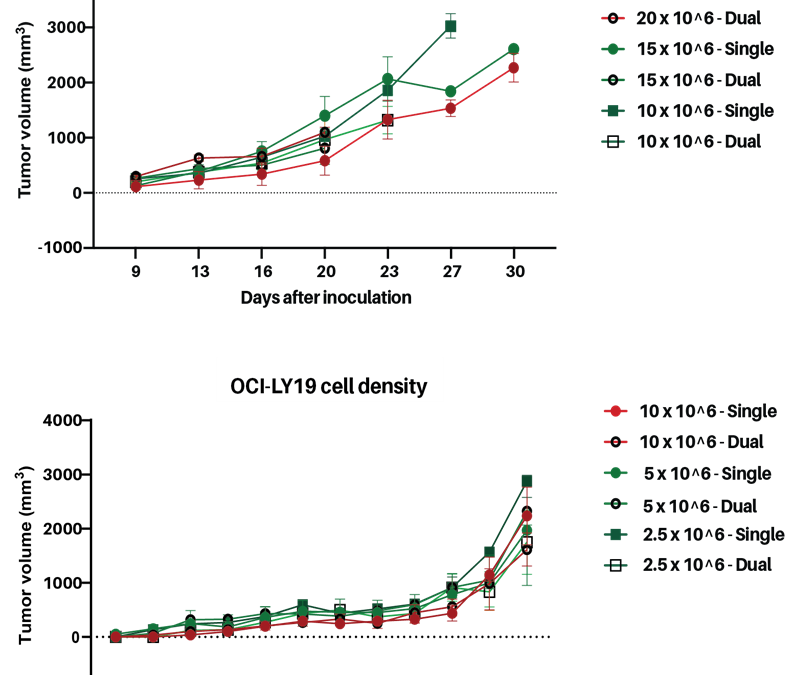
Individuell angepasste CDX-Mausmodelle für Lymphome in der präklinischen Onkologie
In aktuellen Studien haben wir zwei neue Xenotransplantatmodelle (CDX-Modelle) etabliert und validiert, die aus den Zelllinien OCI-Ly19 (diffuses großzelliges B-Zell-Lymphom, DLBCL) und REC-1 (Mantelzell-Lymphom) gewonnen wurden. Diese Modelle wurden im Rahmen einer strategischen...

Multiplex-Profiling von Zytokinen und Immunzellen in der immunonkologischen Forschung
Die Meso-Scale Discovery (MSD)-Plattform ist ein hochempfindliches Multiplex-Analysesystem zur Erstellung von Zytokinprofilen, mit dem Sie mehrere Zielzytokine, Chemokine, Antikörper und Wachstumsfaktoren aus winzigen Probenvolumina (bereits ab 1 µl) gleichzeitig quantifizieren können. Durch...

PDX-Modelle für Bauchspeicheldrüsenkrebs
Der vergangene Monat, der November, war der Monat der Aufklärung über Bauchspeicheldrüsenkrebs – eine Zeit, in der die Herausforderungen im Zusammenhang mit einer der aggressivsten und tödlichsten Krebsarten im Mittelpunkt stehen. Bauchspeicheldrüsenkrebs macht etwa 3 % aller in Europa diagnostizierten Krebserkrankungen aus, wobei Bauchspeicheldrüsenkrebs...

Einblick in die wichtigsten In-vitro-Dienstleistungen von InnoSer im Bereich der Onkologie: PD-1/PD-L1-Blockade-Assay
Immun-Checkpoint-Blockade in der onkologischen Wirkstoffforschung In den letzten Jahren hat sich die Immun-Checkpoint-Blockade als bahnbrechende therapeutische Strategie in der Immunonkologie etabliert. Der Programmierte-Zelltod-1-Rezeptor (PD-1) und sein Ligand, der Programmierte-Zelltod-Ligand 1 (PD-L1)...
AAALAC-Akkreditierung
InnoSer hat die AAALAC-Akkreditierung erhalten und damit sein Engagement für einen verantwortungsvollen Umgang mit Tieren unter Beweis gestellt. AAALAC International ist eine gemeinnützige Organisation, die sich durch freiwillige Akkreditierungs- und Bewertungsprogramme für den artgerechten Umgang mit Tieren in der Wissenschaft einsetzt. Die Einrichtungen von InnoSer in den Niederlanden und Belgien sind seit 2016 bzw. 2020 AAALAC-akkreditiert. Weitere Informationen zum AAALAC-Akkreditierungsprogramm finden Sie hier.

Tierschutz
Die 3Rs wirken sich auf alle Bereiche aus, von politischen und regulatorischen Veränderungen bis hin zur Entwicklung und Einführung neuer Technologien und Ansätze. Aus diesem Grund engagiert sich InnoSer kontinuierlich für diese Prozesse und überwacht sie. Die von uns umgesetzten Maßnahmen maximieren unsere Fähigkeit, den Einsatz von Tieren zu ersetzen, zu reduzieren und zu verfeinern, und unterstützen unser Bekenntnis zu diesen Grundsätzen in der Forschung und der Arzneimittelentwicklung.
info@innoserlaboratories.com