Autosomal dominant polycystic kidney disease (ADPKD) shows heterogeneous disease onset and progression in patients, demanding preclinical models that capture the full natural history of the condition. Presented at the 8th CKD Drug Development Summit in Boston (2026), this poster from our nephrology team presents comprehensive longitudinal characterization of an adult-onset ADPKD mouse model induced by Pkd1 knockout at postnatal day 40 (P40).
With an in-life phase of approximately 28 weeks, this model enables non-invasive monitoring of progressive kidney enlargement by ultrasound, renal dysfunction via blood urea nitrogen (BUN), and cystic disease progression by histopathology. Compared with established P10 and P18 induction models, the P40 model provides a substantially extended therapeutic window, making it well suited for disease prevention studies, biomarker identification, and long-duration efficacy assessment of novel ADPKD therapeutics.
| Conference | 8th CKD Drug Development Summit |
| Dates | March 16–18, 2026 |
| Location | Revere Hotel Boston Common, Boston, MA, USA |
| Authors | Laura Blockken, Stephanie Dhallé, Amandine Boeckx, Yanick Fanton |
| Affiliation | Nephrology research group, InnoSer Laboratories, Belgium |

Abstract
Autosomal dominant polycystic kidney disease (ADPKD) shows heterogeneous disease onset and progression in patients, necessitating preclinical models capturing this variability. While early postnatal Pkd1 inactivation models (PND10 and PND18) are widely used for efficacy studies due to rapid phenotype induction, adult-onset models with a more progressive disease course provide a complementary platform for biomarker identification and extended therapeutic evaluation before the onset of significant kidney function decline.
Pkd1 knockout was induced at PND40 (P40) in the Cre;Pkd1lox,lox mouse model. PKD progression was assessed at baseline (PND49), early (PND84), intermediate (PND119), late (PND146), and terminal (PND180) timepoints via kidney volume by ultrasound, blood urea nitrogen (BUN), and H&E histopathology.
Progressive renal enlargement was confirmed by longitudinal ultrasound, with strong correlation between kidney volume and kidney weight/body weight (R²=0.8551). BUN was consistently elevated in tamoxifen-induced Pkd1 cKO mice versus uninduced littermate controls, with BUN correlating with kidney weight/body weight (R²=0.7603). Histological analysis demonstrated progressive cyst formation from baseline through terminal stages, with proximal tubule involvement predominating in the P40 model.
The P40 ADPKD mouse model provides an extended in vivo phase of approximately 28 weeks, suitable for disease prevention studies, biomarker identification, longitudinal efficacy assessment, and evaluation of adverse effects. The InnoSer ADPKD platform — spanning P10, P18, and P40 induction variants — models the heterogeneous ADPKD patient population across different disease stages.
Stay Curious: More Research to Explore
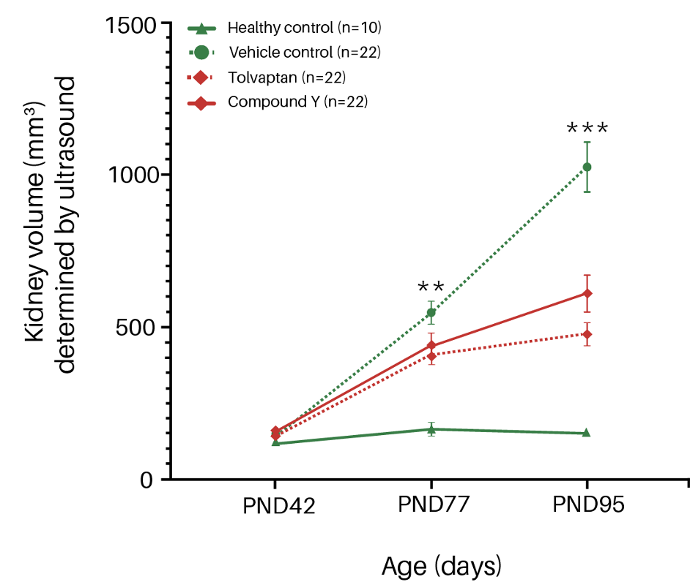
Total kidney volume (TKV) as a translationally relevant, non-invasive disease progression readout
In this month's newsletter, we invite you to explore how InnoSer's longitudinal total kidney volume (TKV) assessment via non-invasive ultrasound imaging in our ADPKD mouse model provides a clinically aligned structural readout that directly supports decision-making in...

Knocking out Pkd1 in the P40 mouse model enables extended dosing windows and long-term efficacy studies
It is well-established that ADPKD shows heterogeneous disease onset and progression in patients, necessitating preclinical models that capture the heterogeneous disease penetration observed in patients. Therefore, new datasets in our adult-onset (also referred to as...
![Proven Compound Susceptible Tau[P301S] Mouse Model for Preclinical Proof of Concept](https://www.innoserlaboratories.com/wp-content/uploads/2026/03/Proven-Compound-susceptible-TauP301S-mouse-model-for-preclinical-proof-of-concept--1080x675.png)
Proven Compound Susceptible Tau[P301S] Mouse Model for Preclinical Proof of Concept
The Tau[P301S] mouse remains one of the most established in vivo models for evaluating therapeutics targeting tauopathies including Alzheimer's disease and frontotemporal dementia (FTD). Presented at AD/PD 2025 in Vienna, this poster provides comprehensive...

InnoSer Presents New Data at the 8th CKD Summit 2026: Advancing Preclinical Models for ADPKD Research
Next week, the kidney research community will gather in Boston for the 8th CKD Summit 2026, a premier event that brings together clinicians, researchers, and industry experts to discuss the latest advances in chronic kidney disease (CKD) research and therapy...

Home-Cage Behavior Discriminates Neurodegeneration Models from Healthy Aging Mice
Distinguishing pathological neurodegeneration from normal biological aging is a fundamental challenge in preclinical neuroscience. Presented at AD/PD 2023 in Gothenburg, this poster — developed in collaboration with Sylics and VU University Amsterdam — establishes a...