Autosomal dominant polycystic kidney disease (ADPKD) shows heterogeneous disease onset and progression in patients, demanding preclinical models that capture the full natural history of the condition. Presented at the 8th CKD Drug Development Summit in Boston (2026), this poster from our nephrology team presents comprehensive longitudinal characterization of an adult-onset ADPKD mouse model induced by Pkd1 knockout at postnatal day 40 (P40).
Avec une durée de vie d'environ 28 semaines, ce modèle permet un suivi non invasif de l'hypertrophie rénale progressive par échographie, de la dysfonction rénale par le taux d'azote uréique sanguin (BUN) et de la progression de la maladie kystique par histopathologie. Par rapport aux modèles d'induction P10 et P18 déjà établis, le modèle P40 offre une fenêtre thérapeutique considérablement élargie, ce qui le rend particulièrement adapté aux études de prévention de la maladie, à l'identification de biomarqueurs et à l'évaluation de l'efficacité à long terme de nouveaux traitements contre la polykystose rénale autosomique dominante (ADPKD).
| Conference | 8th CKD Drug Development Summit |
| Dates | March 16–18, 2026 |
| Location | Revere Hotel Boston Common, Boston, MA, USA |
| Authors | Laura Blockken, Stephanie Dhallé, Amandine Boeckx, Yanick Fanton |
| Affiliation | Nephrology research group, InnoSer Laboratories, Belgium |

Résumé
Autosomal dominant polycystic kidney disease (ADPKD) shows heterogeneous disease onset and progression in patients, necessitating preclinical models capturing this variability. While early postnatal Pkd1 inactivation models (PND10 and PND18) are widely used for efficacy studies due to rapid phenotype induction, adult-onset models with a more progressive disease course provide a complementary platform for biomarker identification and extended therapeutic evaluation before the onset of significant kidney function decline.
Pkd1 knockout was induced at PND40 (P40) in the Cre;Pkd1lox,lox mouse model. PKD progression was assessed at baseline (PND49), early (PND84), intermediate (PND119), late (PND146), and terminal (PND180) timepoints via kidney volume by ultrasound, blood urea nitrogen (BUN), and H&E histopathology.
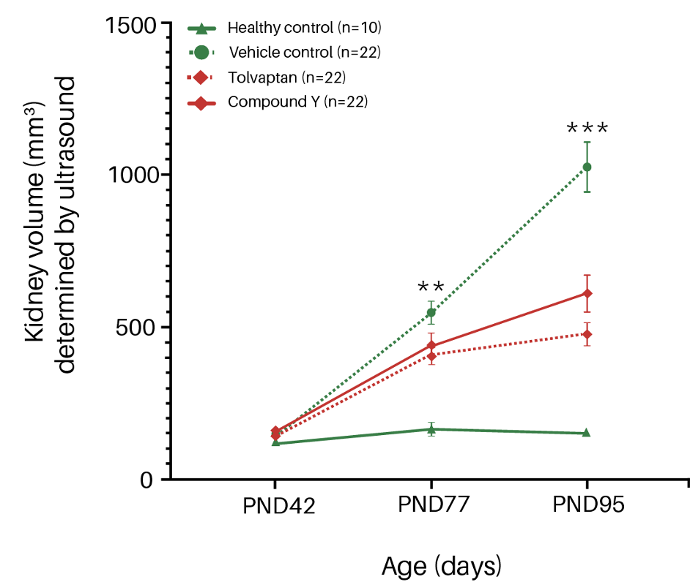
Progressive renal enlargement was confirmed by longitudinal ultrasound, with strong correlation between kidney volume and kidney weight/body weight (R²=0.8551). BUN was consistently elevated in tamoxifen-induced Pkd1 cKO mice versus uninduced littermate controls, with BUN correlating with kidney weight/body weight (R²=0.7603). Histological analysis demonstrated progressive cyst formation from baseline through terminal stages, with proximal tubule involvement predominating in the P40 model.
The P40 ADPKD mouse model provides an extended in vivo phase of approximately 28 weeks, suitable for disease prevention studies, biomarker identification, longitudinal efficacy assessment, and evaluation of adverse effects. The InnoSer ADPKD platform — spanning P10, P18, and P40 induction variants — models the heterogeneous ADPKD patient population across different disease stages.
Restez curieux : d'autres pistes de recherche à explorer
Le volume rénal total (TKV) : un indicateur non invasif de l'évolution de la maladie, pertinent sur le plan translationnel
Dans la newsletter de ce mois-ci, nous vous invitons à découvrir comment l'évaluation longitudinale du volume rénal total (TKV) réalisée par InnoSer à l'aide d'une imagerie échographique non invasive sur notre modèle murin de PKD autosomique dominante fournit des données structurelles en phase avec la pratique clinique, qui facilitent directement la prise de décision dans...

L'inactivation du gène Pkd1 dans le modèle murin P40 permet d'élargir les plages posologiques et de mener des études d'efficacité à long terme
Il est bien établi que la polykystose rénale autosomique dominante (ADPKD) se caractérise par une apparition et une évolution hétérogènes chez les patients, ce qui nécessite des modèles précliniques capables de refléter l'hétérogénéité de la pénétrance de la maladie observée chez les patients. Par conséquent, de nouveaux ensembles de données concernant notre forme à apparition à l'âge adulte (également appelée...
![Modèle murin Tau[P301S] dont la sensibilité au composé a été démontrée, destiné à la validation préclinique du concept](https://www.innoserlaboratories.com/wp-content/uploads/2026/03/Proven-Compound-susceptible-TauP301S-mouse-model-for-preclinical-proof-of-concept--1080x675.png)
Modèle murin Tau[P301S] dont la sensibilité au composé a été démontrée, destiné à la validation préclinique du concept
La souris Tau[P301S] reste l'un des modèles in vivo les plus reconnus pour l'évaluation de traitements ciblant les tauopathies, notamment la maladie d'Alzheimer et la démence frontotemporale (DFT). Présentée lors du congrès AD/PD 2025 à Vienne, cette affiche offre un aperçu complet...

InnoSer présente de nouvelles données lors du 8e Sommet CKD 2026 : faire progresser les modèles précliniques pour la recherche sur la polykystose rénale autosomique dominante (ADPKD)
La semaine prochaine, la communauté des chercheurs spécialisés dans les maladies rénales se réunira à Boston à l'occasion du 8e Sommet CKD 2026, un événement de premier plan qui rassemble des cliniciens, des chercheurs et des experts du secteur afin de discuter des dernières avancées en matière de recherche et de traitement de l'insuffisance rénale chronique (IRC)...

Le comportement dans la cage d'origine permet de distinguer les modèles de neurodégénérescence des souris vieillissant normalement
Distinguer la neurodégénérescence pathologique du vieillissement biologique normal constitue un enjeu fondamental en neurosciences précliniques. Présentée lors du congrès AD/PD 2023 à Göteborg, cette affiche — élaborée en collaboration avec Sylics et l’Université libre d’Amsterdam (VU) — établit une...