Earlier this year, we shared data from our phenotyping experiments showing TDP-43 mouse model pathophysiology, consistent with previously published findings in the same mouse model harboring the ALS-linked Q331K mutation in the TDP-43 gene (Watkins et al., 2021). Our results demonstrated that TDP-43 mice develop progressive motor deficits, reduced compound muscle action potentials (CMAP), and elevated plasma neurofilament light chain (NfL) levels (evaluated in mice aged 4-9 mo of age; click here to view the TDP-43 mouse model characterization datasets).
Building on these results, our team has recently extended the phenotyping experiments to examine early TDP-43 mouse model pathophysiology from 4 wk of age onwards. In line, we observed that TDP-43(Q331K) mice show reduced CMAP amplitude from 7 weeks (Figure 1), indicating early motor unit dysfunction, and elevated plasma NfL as early as 5 weeks (Figure 2), reflecting early neuronal injury; both occurring before the onset of robust motor deficits (Figure 3).
TDP-43(Q331K) mice show significant elevations in the neuronal injury biomarker, NfL, as early as 5 weeks of age
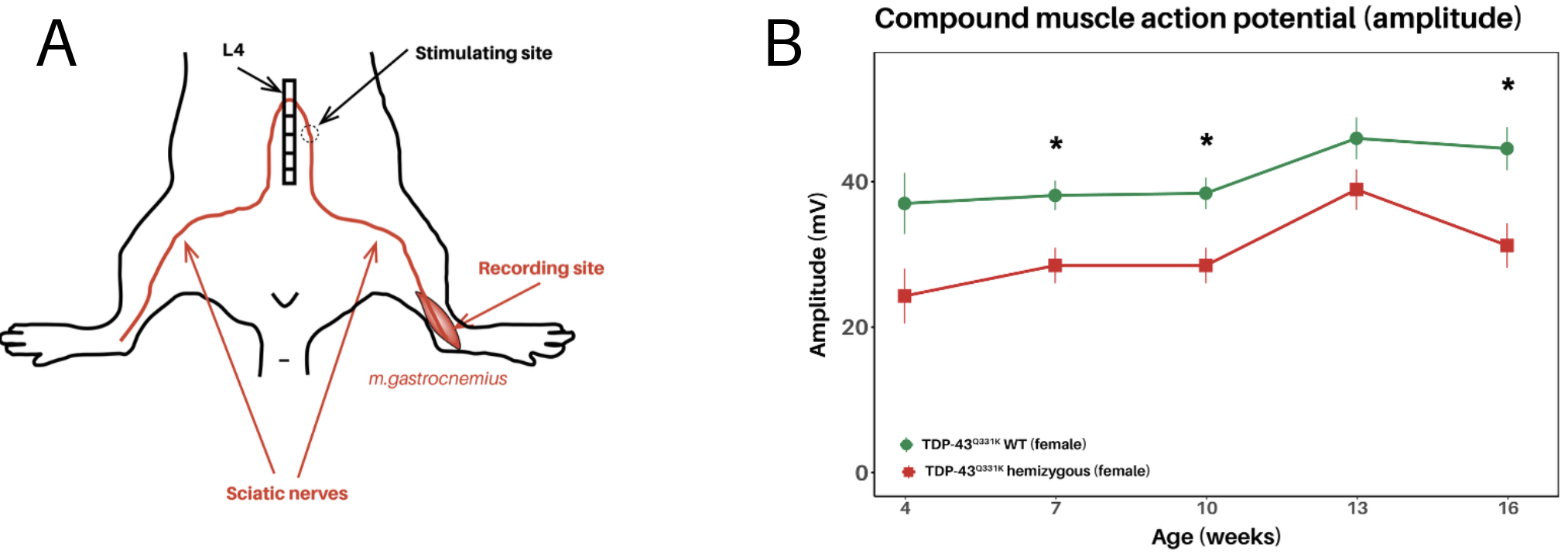
FIGURE 1. Electrophysiological readouts reveal a reduction in compound muscle action potential (CMAP) amplitude in TDP-43(Q331K) mice from 7 weeks of age. (A) Experimental set-up of sciatic nerve conduction recording. Nerve conduction study is an electrophysiological recording method that measures the speed (nerve conduction velocity) and the amplitude (compound muscle action potential) of an electrical impulse moving through the sciatic nerve. (B) Nerve conduction studies can be performed longitudinally in the same animal, enabling repeated measures of disease progression.
TDP-43(Q331K) mice show significant elevations in the neuronal injury biomarker, NfL, as early as 5 weeks of age

FIGURE 2. Neurofilament light chain (NfL) levels are significantly increased in TDP-43(Q331K) mice as early as 5 weeks of age. Longitudinal measurements of plasma NfL from 5 to 14 weeks of age show that female TDP-43(Q331K) mice exhibit significant elevations in plasma NfL compared to wild-type littermates, indicating an early-onset and progressive neuronal injury phenotype. Plasma NfL was assessed via MSD (Kit number # K1517XR).
TDP-43(Q331K) mice exhibit motor impairments

FIGURE 3. Motor function tests reveal early-stage, and progressive disease development in female TDP-43(Q331K) mice. Motor function phenotyping was performed in two separate experiments in young (4-16 weeks of age; “early disease stage” phenotyping) and old (16-24 weeks of age; “late disease stage” phenotyping) female mice. Female hemizygous TDP-43Q331K mice exhibit reduced (A) rotarod motor performance as well as reduced muscle strength assessed via (B) inverted grid tests (C) weightlifting test.
Evaluate the efficacy of your ALS and FTD therapeutics in a translationally validated TDP-43 mouse model. Characterized biomarker and early motor function endpoints support the evaluation of immunotherapies, autophagy activators, antisense oligonucleotides (ASOs), and small molecules targeting TDP-43 pathophysiology.
いち早く情報を入手 – このニュースをメールボックスに直接お届けします
InnoSerは、精神医学および神経学分野向けに、各種の検証済みin vitroおよびin vivoスクリーニング試験を提供しています。追加情報が必要な場合は、お気軽にお問い合わせください。数日以内にご返答いたします。
神経学研究所からの月次アップデートをお届けします。研究サービスに関する科学的知見を掲載しております。ニュースをメールで直接受け取るには、こちらからお申し込みください。