
A practical introduction to behavioural test battery selection when outsourcing your Alzheimer’s disease efficacy study to a specialist neurology CRO
When outsourcing a preclinical Alzheimer’s disease efficacy study, behavioral endpoint selection is one of the most consequential decisions you will make with your CRO. Disease-targeting therapies account for 73% of agents in the 2026 Alzheimer’s disease clinical trial pipeline, with cognition-enhancing symptom-targeted therapies contributing 18% (Cummings et al., 2026).
For preclinical sponsors in either category, behavioral and functional endpoints serve as evidence that your compound is reaching and rescuing cells in the brain regions relevant to your disease — hippocampus and cortex in the case of Alzheimer’s disease. Rather than a direct measure of cognitive translation to humans, a well-designed behavioral test battery confirms that pathology reduction in the right brain regions is sufficient to produce a measurable functional rescue in your model, a critical step in building confidence in your compound’s mechanism before entering the clinic.
A 2025 scoping review of 409 treatment evaluations in MAPT mouse models found that pathological tau reduction dominated as the primary readout across two decades of preclinical tauopathy research, with cognitive deficits assessed in 48% of evaluations and motor deficits in 36% (Langness et al., 2025).
In preclinical AD studies, pathological tau and/or amyloid reduction is typically the primary endpoint, demonstrating on-target mechanism. Behavioral and cognitive endpoints serve as secondary readouts, confirming that pathology modification translates into functional benefit in mouse models of Alzheimer’s disease.
Below, we outline the main behavioral tests frequently performed at InnoSer, along with representative validation datasets, illustrating their utility as functional efficacy markers across preclinical Alzheimer’s disease behavioral testing.
Cognitive or motor test battery? The behavioral phenotype depends on your model of choice
Alzheimer’s disease is characterised by two core pathological processes, amyloid plaque deposition and neurofibrillary tau tangle formation, that together drive the synaptic dysfunction, neuroinflammation, and neurodegeneration underlying cognitive decline.
Transgenic Alzheimer’s disease mouse models capture these processes selectively: amyloid mouse models such as APP[V717I] and/or APP[V717I] × PS1[A246E] develop progressive Aβ pathology and the associated cognitive deficits, but without the significant neurodegeneration and motor dysfunction.
Transgenic Tau mouse models such as the homozygous Tau[P301S] mouse model (also known as Tg2541), by contrast, develop both cognitive and motor phenotypes as neurofibrillary tangle pathology and neuronal loss progress.
Accordingly, combined transgenic amyloid and tau mouse models, such as the APP[V717I] × Tau[P301S] cross, combine progressive amyloid plaque deposition with neurofibrillary tau tangle pathology in a single model, producing a more complex phenotype than either single-transgenic line alone.
Understanding which phenotype your model actually expresses at your intended study timepoint is the starting point for selecting rodent behavioral tests that will produce interpretable efficacy data.
Transgenic tau mouse models develop progressive cognitive and motor phenotypes
In Tau[P301S] transgenic mice, hyperphosphorylated tau accumulates as neurofibrillary tangles in cortex, hippocampus, brainstem, and spinal cord, leading to dramatic loss of spinal motor neurons and the progressive motor impairment this produces alongside cognitive deficits.
The co-occurrence of cognitive and motor phenotypes in this model reflects the multi-domain functional decline seen in advanced AD and primary tauopathies and means that study design requires both cognitive and motor assays, whilst ensuring that motor deficits at advanced ages are not confounding the results of cognitive assays.
Rotarod, Clasping score and the CatWalk: quantifying the progressive motor decline of tauopathy mouse models
Rotarod performance, clasping score together and CatWalk gait analysis provide a comprehensive, multi-dimensional motor battery for preclinical efficacy tau mouse model studies.
Accelerating Rotarod performance quantifies motor coordination and balance; clasping score provides a rapid, repeatable index of neurological deficit severity and disease progression in the frequently used Tau[P301S] mouse model for preclinical efficacy studies at InnoSer (Figure 1).
CatWalkTM provides additional detailed motor deficits, namely changes in stride length, stance duration, base of support, and paw print parameters. Previously published results have shown that Tau[P301S] mice display early sign of motor impairment, presenting as smaller print area of forepaws, wider base of support between forepaws and narrower base support in hindpaws already at 2.5 months of age, with robust phenotypes at 3.5 months of age (Koivisto et al., 2019).
![Line graphs showing progressive clasping, body weight loss, rotarod deficits, and hyperactivity in the transgenic Tau[P301S] mouse model from 4 to 5.5 months, indicating neurodegenerative disease onset.](https://www.innoserlaboratories.com/wp-content/uploads/2026/08/preclinical-Alzheimers-disease-behavioral-testing-TauP301S-motor-dysfunction.png "preclinical Alzheimer’s disease behavioral testing TauP301S motor dysfunction")
FIGURE 1. The transgenic Tau[P301S] mouse model shows around 4 months of age the onset of a clasping phenotype, with a gradual increase until 5.5 months. This indicates the beginning of the neurodegenerative disease onset (N=18). (B) In addition, the body weight of this mouse model starts to gradually decrease around 4 months until 5.5 months (N=18). (C) Starting from 4 months, rotarod deficit is significantly measurable for the transgenic Tau[P301S] mice on the rod at 10 rpm, with almost full failure at 5 months (N=15). (D) Before the motoric deficit sets in, hyperactivity was consistently observed (N=20). Data is presented as mean ± SEM.
CognitionWall™ and Morris Water Maze: assessing cognitive deficits independently of motor status in transgenic tau mouse models
Because motor decline in Tau[P301S] mice can confound performance on locomotion-dependent cognitive assays such as the MWM, the CognitionWall™ may be better suited as a cognitive endpoint in this model; its automated home-cage, food-motivated format is less dependent on locomotor capacity than swim-based paradigms.
In Tau[P301S] transgenic mice, a sex-dependent discrimination learning deficit was observed in the CognitionWall™, before the onset of motor deficits (Figure 2).
![Graph showing increased entries required for female Tau[P301S] mice to reach the learning criterion compared with male Tau[P301S] mice and wildtype controls](https://www.innoserlaboratories.com/wp-content/uploads/2026/08/P301S_Exp1-.Survival.plot_.of_.entries.to_.80.criterion.Initial.Discrimination.Learning-2026-03-12-survivalplot-scaled.png "P301S_Exp1 .Survival.plot.of.entries.to.80.criterion.Initial.Discrimination.Learning 2026-03-12 survivalplot")
FIGURE 2. Female Tau[P301S] mice required significantly more entries to reach the learning criterion compared with male Tau[P301S] mice and wildtype controls, while male animals did not show significant impairment at the same timepoint.
![Graphs showing spatial memory deficits in female Tau[P301S] mice in the Morris Water Maze, including fewer platform-location crossings and reduced time in the target zone.](https://www.innoserlaboratories.com/wp-content/uploads/2026/08/Preclinical-behavioral-Alzheimers-disease-readouts-in-TauP301S.png "Preclinical behavioral Alzheimer's disease readouts in TauP301S")
FIGURE 3. Female Tau[P301S] mice display spatial memory deficits in the Morris Water Maze. (A) During training, both male and female mice showed increased latency to locate the hidden platform compared with WT controls. (B–C) In the probe trial, female Tau[P301S] mice showed reduced spatial memory performance compared with WT animals, evidenced by (B) fewer crossings of the former platform location and (C) reduced time spent in the target platform zone. (D) Swimming velocity during the probe trial was similar across groups, indicating that the observed differences are not explained by motor or swimming impairments.
Transgenic amyloid mouse models show primarily cognitive deficits
In APP transgenic models, Aβ42 overproduction drives progressive amyloid plaque deposition alongside early synaptic and network-level dysfunction that precedes overt pathology. This is reflected in cognitive deficits detectable before plaques are established, and is sensitive to pharmacological intervention targeting upstream amyloid processing.
Because significant neurodegeneration and motor dysfunction are absent in these models, the behavioral test battery can focus on cognitive readouts without the confounding effects of motor decline.
CognitionWall: detecting early cognitive decline in Alzheimer’s disease before plaques appear
The CognitionWall™ is a discrimination learning assay developed and validated at InnoSer, running within automated PhenoTyper™ home-cage systems overnight without experimenter handling or transfer to a novel environment. Mice are rewarded with food when they pass through a specific entrance of a three-choice wall, and the rate at which an animal develops a preference for the rewarded entrance serves as a measure of discrimination learning. (Remmelink et al., 2016).
The CognitionWall™ assesses discrimination learning in an automated home-cage setting where mice learn to earn food rewards, making it sensitive to subtle cognitive changes not yet detectable in more stressful, acute testing paradigms (Figure 4).
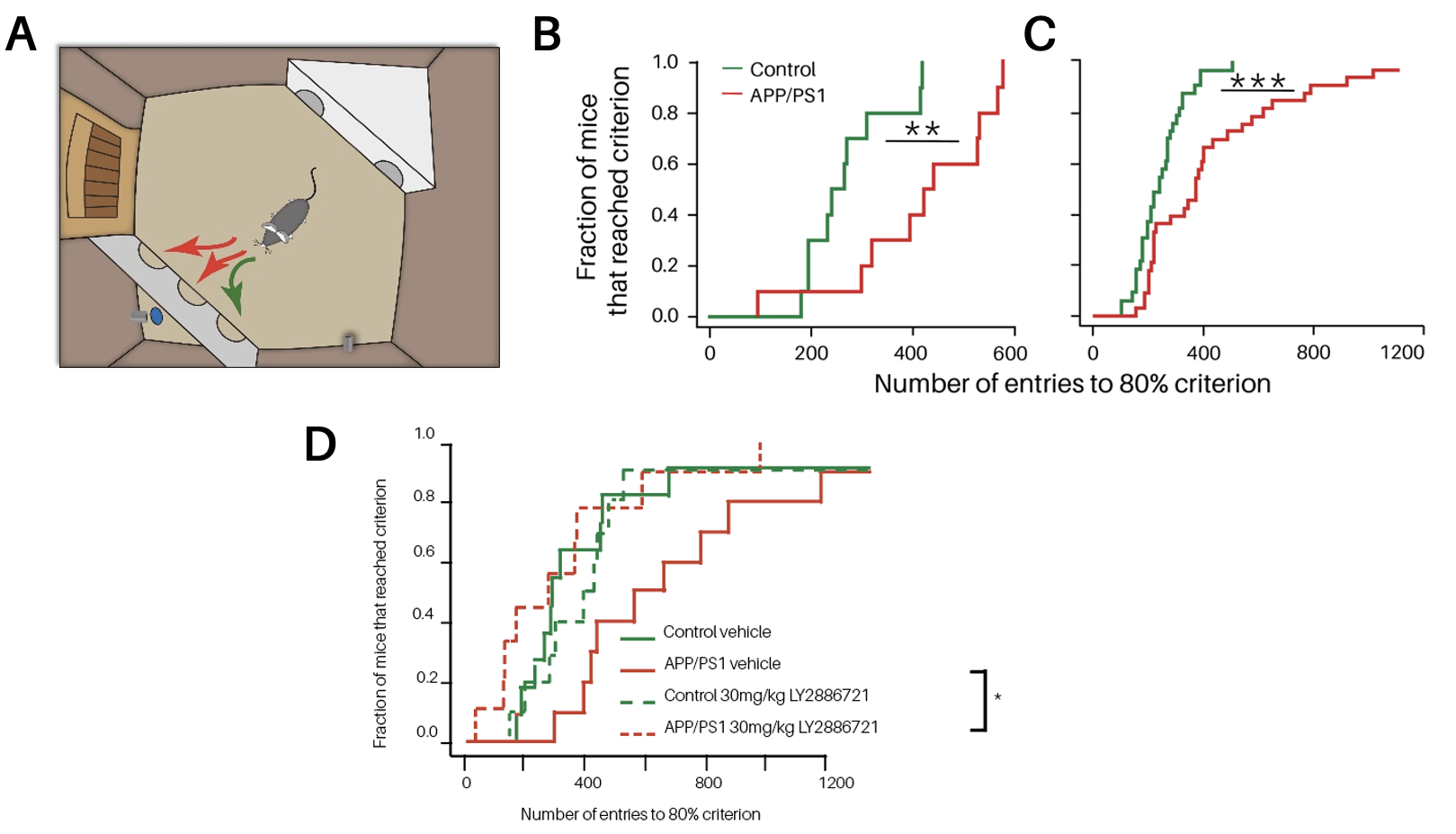
FIGURE 4. In APP × PS1 transgenic mice, discrimination learning deficits in the CognitionWall™ were already apparent at 12 weeks of age, before amyloid plaque detection at approximately 26 weeks. This suggests early synaptic or network-level dysfunction preceding overt amyloid pathology. At 16 weeks, this deficit was rescued by acute administration of the BACE1 inhibitor LY2886721, demonstrating the pharmacological sensitivity of the CognitionWall™ as an early efficacy endpoint in anti-amyloid programs.
Morris Water Maze: the most widely used spatial memory assay in preclinical Alzheimer’s disease research
The Morris Water Maze is one of the most widely used cognitive assays in preclinical Alzheimer’s disease research. Mice are trained across multiple days to locate a submerged platform using external spatial cues, and performance during training trials and a subsequent probe test, where the platform is removed, provides a readout of hippocampal-dependent spatial reference memory.
This memory domain is consistently impaired in early Alzheimer’s disease, making the MWM a highly relevant cognitive readout in mouse models of Alzheimer’s disease such as the APPxPS1 mouse model.
Published results in the APP[V717I] × PS1[A246E] transgenic mice, have shown that sub-chronic donepezil treatment produced a dose-dependent improvement in spatial reference memory during the MWM probe test, correlating directly with a dose-dependent reduction in cortical soluble Aβ42 levels.
These results illustrate both the sensitivity of the MWM as a relevant behavioral readout and the translational link between amyloid burden and cognitive performance in this model (Easton et al., 2013).
Combined amyloid and tau mouse models show both cognitive and motor phenotypes
The APP[V717I] × Tau[P301S] cross combines progressive amyloid plaque deposition with neurofibrillary tau tangle pathology in a single model, producing a more complex and clinically representative phenotype than either single-transgenic line alone.
Both cognitive deficits, reflecting the combined impact of amyloid and tau pathology on hippocampal circuit function, and motor dysfunction are present in this (double heterozygous) model, though the motor phenotype emerges later than in the single (homozygous) Tau[P301S] line, with clasping and rotarod deficits becoming apparent from approximately 9 months of age.
This later motor onset provides a wider window for cognitive endpoint assessment before motor decline begins to confound locomotion-dependent assays.
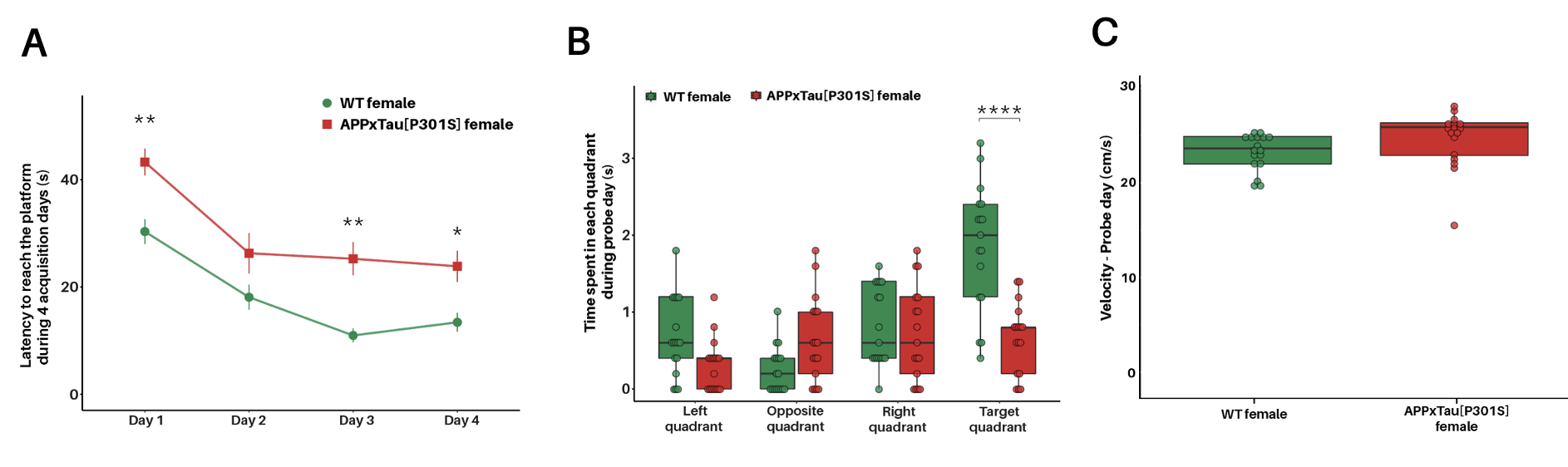
FIGURE 6. In female APP[V717I] × Tau[P301S] transgenic mice at 5.5 months of age, a significantly increased latency to reach the platform was observed across the 4-day acquisition phase compared to wildtype controls (N=17 per group; RM-ANOVA with Bonferroni-adjusted pairwise comparisons; *p<0.05 to ****p<0.0001), indicating impaired spatial learning. In the probe trial, APP[V717I] × Tau[P301S] mice spent significantly less time in the target quadrant than wildtype controls, which showed a clear preference for the target quadrant over the other three. Critically, swimming velocity during the probe trial was comparable between genotypes (one-way ANOVA), confirming that the spatial memory deficit reflects genuine cognitive impairment rather than a sensorimotor confound.
![Graphs showing progressive motor deficits in APP[V717I] × Tau[P301S] and heterozygous Tau[P301S] mice, with clasping and impaired rotarod performance from 9 months of age.](https://www.innoserlaboratories.com/wp-content/uploads/2026/08/Motoric-impairment-in-the-APPxTau-mouse-model-for-preclinical-efficacy-behavioral-testing.png "Motoric impairment in the APPxTau mouse model for preclinical efficacy behavioral testing")
FIGURE 7. Both APP[V717I] × Tau[P301S] and heterozygous Tau[P301S] transgenic mice develop motor deficits from approximately 9 months of age, evidenced by the clasping phenotype during tail suspension and impaired rotarod performance. At 9.5 months, rotarod performance is significantly reduced in transgenic mice compared to wild-type controls, indicating progressive motor dysfunction at advanced age. The rotarod performance keeps declining when age progresses (data not shown). The later onset of motor impairment in this combined model relative to the homozygous Tau[P301S] line — where motor deficits emerge from 3–4 months — reflects the influence of zygosity and genetic background on phenotype severity and is an important consideration when planning treatment windows and selecting endpoint timepoints.
Going beyond behavioral testing in preclinical Alzheimer’s disease studies: Long-term potentiation in ex vivo brain slices as a readout of synaptic plasticity
Long-term potentiation (LTP), the electrophysiological measure of activity-dependent synaptic strengthening in hippocampal slices, provides a direct ex vivo readout of synaptic plasticity independent of the motor and motivational confounds that can complicate in vivo behavioral interpretation.
Synaptic dysfunction strongly correlates with tau pathology and clinical manifestations and is thought to precede significant neuronal loss in AD (Langness et al., 2025), making LTP a potentially sensitive readout of treatment effect, particularly for programs where behavioral deficits may not yet be robust at the intended study timepoint, or where the compound’s mechanism specifically targets synaptic function.
As the most underassessed major endpoint in two decades of preclinical tauopathy research (Langness et al., 2024), synaptic plasticity readouts such as LTP may represent an opportunity to strengthen the value of your preclinical data package beyond what pathological and behavioral endpoints alone can provide. LTP data are available for select InnoSer Alzheimer’s disease models, reach out to our neurology team to discuss whether LTP endpoints are appropriate for your study design.
Contact our neurology team to discuss whether LTP endpoints are appropriate for your outsourced preclinical study.
From mouse model phenotype to functional readout: partnering with InnoSer for your preclinical Alzheimer’s disease behavioral testing
Cognitive decline is what Alzheimer’s disease looks like to a patient, a caregiver, and a clinical trial readout. A behavioral test battery that captures it convincingly, in the right model, at the right timepoint, with the right assays, is what makes a preclinical data package tell a coherent translational story.
At InnoSer, behavioral endpoint design is something our neurology study directors think about at the protocol stage, not after the study has started. Your preclinical Alzheimer’s disease program should generate data that translates.
A well-designed behavioral test battery does more than confirm that your model has a phenotype, it provides secondary evidence that pathological improvement translates into meaningful cognitive and functional benefit, which is what strengthens the translational argument of your preclinical data package.
The assays described in this post, CognitionWall™, Morris Water Maze, Phenotyper, Rotarod, CatWalk, clasping score, and LTP, have been validated across InnoSer’s AD model portfolio and can be tailored to your model’s phenotype, your compound’s mechanism, and your intended treatment window.
Planning your outsourced preclinical Alzheimer’s disease behavioral study? Contact our neurology study directors to discuss how InnoSer’s comprehensive behavioral test battery — spanning cognitive, motor, and synaptic plasticity endpoints — can be tailored to your model, your mechanism, and your clinical hypothesis.

