We will build upon our experience with mutant huntingtin (mHTT) in the extensively profiled zQ175 knock-in mouse model of Huntington’s Disease, and highlight a new point of interest for therapeutic intervention discussed in the literature: the HTT1a mRNA transcript, which produces the highly toxic HTTexon1 protein fragment in addition to the well-known mHTT protein (Hoschek, et al., 2024).
Huntington’s Disease is a severe neurodegenerative disorder caused by an expanded CAG repeat in exon 1 of the HTT gene, leading to protein misfolding, aggregation and progressive neuronal dysfunction. Although considerable attention has been directed toward the full-length mutant HTT protein (FL mHTT), emerging research highlights that smaller amino-terminal fragments containing expanded polyQ tracts can also form toxic aggregates and may substantially contribute to HD pathology.
Beyond full-length HTT: exploring HTT1a as a therapeutic opportunity
The exon 1 HTT protein fragment (HTTexon1) is among the most pathogenic of the small HTT protein fragments, exhibiting a strong propensity to aggregate and driving severe toxicity in Huntington’s disease mouse models (Neueder, et al., 2017). While proteolytic cleavage of full-length mutant HTT has long been recognized as a source of toxic fragments, recent studies show that HTTexon1 can also arise independently through aberrant splicing. Specifically, premature polyadenylation within intron 1 generates the HTT1a transcript, an RNA species containing exon 1 followed by a short intron 1 sequence that is directly translated into the aggregation-prone HTTexon1 protein (Sogorb-Gonzalez et al., 2024).
Importantly, this transcript has been detected in fibroblasts from juvenile HD patients and in the sensorimotor cortex, hippocampus, and cerebellum of post-mortem HD brains, supporting the relevance of this pathway in human disease (Neueder, et al., 2017). This mechanism highlights a potential opportunity to intervene at the RNA level before the toxic protein is formed.
Therapies such as antisense oligonucleotides (ASOs), RNA interference compounds, or splicing modulators could act on HTT1a to reduce the production of the aggregation-prone HTTexon1 protein, and when combined with strategies targeting full-length mHTT, may offer a more comprehensive approach to lowering toxic aggregates and slowing disease progression.
Translating these insights into preclinical research requires a model that reflects the human genetic context and allows HTT1a biology to be studied. The zQ175 knock-in model provides this context, enabling investigation of potential HTT1a production.
The zQ175 knock-in model for Huntington’s disease research
The zQ175 knock-in model available for preclinical studies at InnoSer carries the human HTT exon 1 sequence with a ~180 CAG repeat, replacing the native mouse Httexon1, thereby increasing the translational relevance of the model for therapies targeting human HTT. As a knock-in model, mutant HTT is expressed under the endogenous mouse Htt promoter, resulting in physiological expression levels and thereby avoiding the overexpression artefacts often observed in transgenic models, with the highest expression occurring in the brain.
In this model, we observe corresponding pathological, biochemical, motor and behavioural deficits, faithfully reflecting key features of Huntington’s disease. These disease-relevant phenotypes can be assessed using a range of translational readouts, including:
- Neuropathology: mutant huntingtin (mHTT) protein aggregation assessed by immunohistochemistry;
- Behavioral assessments: Open field test, grip strength, CatWalk™ gait analysis;
- Functional changes: electrophysiology (EEG, EPSCs) to assess synaptic dysfunction;
- Molecular analyses: qPCR of disease-relevant markers (e.g., DARPP-32, PDE10a, DRD2);
- Biomarkers: plasma or CSF analyses (e.g., neurofilament light chain via MSD/ELISA);
- Physiological parameters: body weight, brain weight, thermoregulation, and glucose homeostasis (OGTT, plasma insulin).
The zQ175 knock-in model: current translational value and opportunities to explore novel targets in Huntington’s disease
Through this comprehensive profiling of the zQ175 knock-in model, we show that InnoSer’s Huntington’s disease platform provides a robust tool for studying disease progression and evaluating potential therapeutics. By 6 months of age, heterozygous zQ175 mice exhibit pronounced accumulation of FL mHTT aggregates in the brain, reflecting the direct consequence of expanded CAG repeats and capturing a central molecular hallmark of the disease (Figure 1).

Figure 1. Progressive accumulation of mutant huntingtin (mHTT) aggregates in heterozygous zQ175 mice from 6 months of age. EM48 immunohistochemistry shows that heterozygous zQ175 mice (C57BL/6J background, JAX #029928) display mHTT aggregation starting at 6 months, which progressively increases over time as a direct consequence of the CAG expansion.
Behavioral changes appear early, with reduced locomotor activity detected in the open field test from 4.5 months in both heterozygous and homozygous mice (Figure 2), offering a clear readout of disease onset and progression.
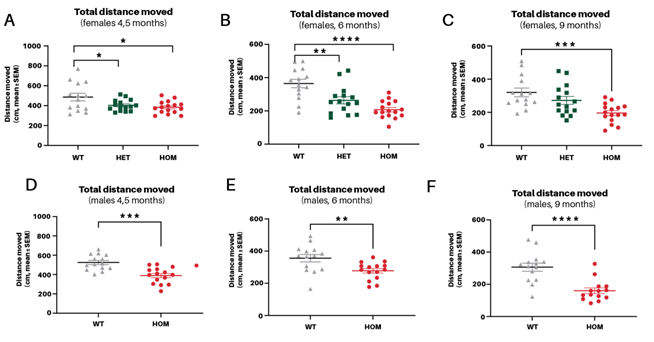
Figure 2. Behavioral deficits in the open field test manifest from 4.5 months of age in zQ175 mice (C57BL/6J background, JAX #029928). Panels A–C represent female cohorts, while panels D–F correspond to male cohorts. Reduced total distance traveled is evident in both heterozygous and homozygous zQ175 mice at 4.5 months (A, D), 6 months (B, E), and 9 months (C, F). Although earlier onset of deficits has been documented in homozygous zQ175 mice (Menalled et al., 2012), these earlier time points were not evaluated in the current study. Data are expressed as mean ± SEM; statistical analysis by t-test; N = 15 per genotype.
In support of these molecular and behavioral changes, CSF NfL levels were elevated from 7 months onward in heterozygous zQ175 mice (Figure 3), providing a sensitive biomarker readout of emerging neuro‑axonal damage and progressive disease pathology.
Together, these complementary readouts underscore the translational relevance of the zQ175 model for preclinical Huntington’s disease research.

Figure 3. Neurofilament light chain (NfL) levels are elevated in the cerebrospinal fluid (CSF), measured using the Meso Scale Discovery platform, of zQ175 mice (C57BL/6J background, JAX #029928) from 7 months of age onward. Increased NfL is a biomarker of neuronal damage and neurodegeneration, reflecting progressive pathology in this Huntington’s disease model.
Future directions for expanding translational opportunities in the zQ175 knock in model
Recent studies indicate that the comparative merits of targeting FL mHTT versus HTT1a—and whether one or both transcripts should be lowered—remain under-explored (Smith, et al., 2023). This knowledge gap highlights the potential value of investigating these questions in preclinical in vivo models of Huntington’s disease, such as the zQ175 knock-in model.
To understand where HTT1a fits within the zQ175 model, researchers have leveraged the QuantiGene branched-DNA assay — a highly sensitive, hybridisation-based technique capable of detecting and quantifying low-abundance or incompletely spliced transcripts that would otherwise go unnoticed with standard gene expression methods. Evidence for the presence of the HTT1a transcript in the zQ175 model has been reported by Papadopoulou et al. (2019), who employed multiplex QuantiGene assays and qPCR analysis of HTT transcripts across multiple brain regions in heterozygous zQ175 mice.
Using probe sets specifically designed to target intron 1 — the genomic region retained in incompletely spliced HTT transcripts — HTT1a was detected across multiple brain regions with both QuantiGene and qPCR, with the two methods corroborating each other.
In Figures 3a–e of Papadopoulou et al. (2019), QuantiGene 10-plex measurements show consistently elevated intronic HTT sequence signals in zQ175 heterozygous mice compared to wildtype across all five brain regions examined — striatum, cortex, hippocampus, cerebellum, and brainstem. Figures 3k–o of the same study confirm these findings by qPCR, reproducing the same pattern of elevated HTT1a transcript levels in zQ175 heterozygous mice across regions, again most strongly in the striatum and cortex.
Because HTT1a is the direct RNA precursor to the aggregation-prone HTTexon1 protein, its consistent detection across brain regions by two independent methods points to where the upstream source of HTTexon1 pathology originates — and underscores the potential value of targeting this transcript therapeutically.
In line with our dedication to maximizing the translational value of the zQ175 knock-in model, we are eager to investigate the presence, dynamics, and functional impact of HTT1a and HTTexon1 protein.