
Polycystic Kidney Disease – ADPKD Mouse Model (Pkd1 cKO)
Use the gold-standard research ADPKD mouse model to test the efficacy of your novel therapeutics for Polycystic Kidney Disease
ADPKD Mouse Model Key Characteristics
Autosomal dominant polycystic kidney disease (ADPKD) is characterized by the development of renal fluid-filled cysts, eventually leading to kidney failure. With a prevalence of 4 in 10.000, ADPKD is a relatively common genetic disorder. Mutations in the Pkd1 gene are associated with approximately 85% of ADPKD cases.
To support the preclinical development of new drugs and therapies for ADPKD, InnoSer offers a well-established, conditional, renal-specific Pkd1 knock-out (KO) ADPKD mouse model.
InnoSer’s ADPKD expert team possesses relevant experience in working with multiple therapy types ranging from small molecules, biologics (antibodies, peptides, enzymes), and gene therapy (viral vectors – e.g.. AAVs).
✓ The ADPKD mouse model is an inducible, conditional, kidney-specific Cre (lox,lox)-Pkd1 knock-out (cKO) model.
✓ cKO of the Pkd1 gene at specific time points results in three different models (P10, P18 & P40) with different stages of disease progression.
✓ ADPKD mice show age-dependent, reproducible cyst formation and epithelial cell proliferation, similar to ADPKD patients.
✓ InnoSer offers multiple validated reference compounds in the ADPKD mouse model (Everolimus, Tolvaptan, Mozavaptan, Rapamycin, Salsalate).
✓ InnoSer maintains a continuous stock of ADPKD mouse colonies, supporting quick study initiation timelines.

Take advantage of InnoSer’s expertise, flexibility and collaborative approach for your research. We support our clients in identifying new drugs or applications, characterizing their pharmacological properties, and conducting safety and efficacy testing with state-of-the-art readout capabilities and histopathological analysis.
ADPKD Mouse Model Options
InnoSer offers different ADPKD mouse models by specifically timed Tamoxifen-induced Pkd1 knockout. There are three models available depending on which post-natal (P) day Tamoxifen is administered:
The P10 model is widely used as a first screening platform as it offers quick and robust results with renal cyst formation, while the P18 and P40 models show a slower progression even closer to clinical phenotypes.
For all your nephrology projects, we support custom in vivo models for kidney injury and toxicological studies.
| Model | Cyst characteristics |
| P10 | Quick progression of cyst formation in the distal segment of the nephron |
| P18 | Slow progression with cysts in all segments of the nephron |
| P40 | Slow and reproducible cyst formation in the proximal part of the nephron |
Timelines using ADPKD Mouse Model
Conditional Pkd1 knockout at different time points (P10, P18, P40) allows the establishment of multiple mouse models, with different disease progressions and phenotypes to meet your specific requirements in terms of study duration, outcome measures and clinical translatability.

Your ADPKD Research Starts with InnoSer.
Access detailed study timelines, essential readouts, robust ADPKD mouse model validation data, and benchmark your ADPKD drug candidate against existing treatments.

ADPKD Mouse Model Sample Data

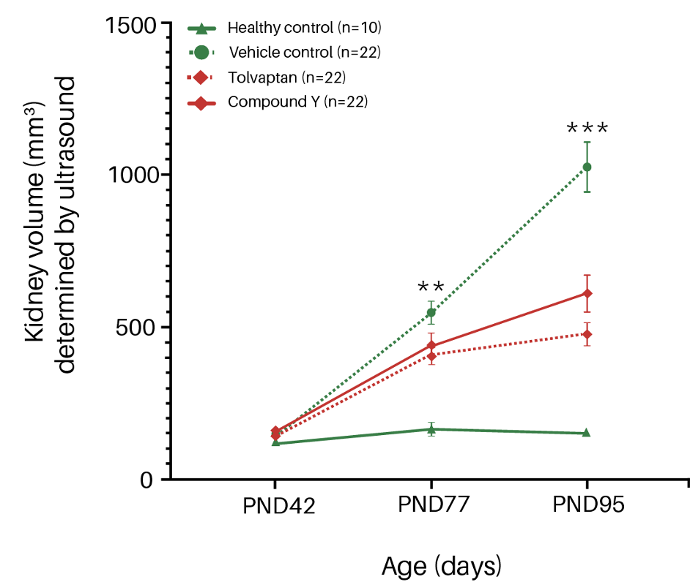
ADPKD mice show a progressive increase in kidney volume, assessed non-invasively by ultrasound.
Compared to wild-type, the kidney volume of P18 Pkd1 cKO mice is significantly increased over time, indicating a decline in renal health. Upon treatment with Tolvaptan, right kidney volume significantly decreases compared to untreated P18 Pkd1 cKO mice. Data is shown as M ± SEM. Ultrasound arises as a valuable tool to provide non-invasive, real-time assessment of kidney size and function, allowing for continuous monitoring without the need for in-study sacrifices and therefore reduces the amount of mice needed per study. Learn more about other suitable methods to assess disease progression and drug efficacy in the ADPKD mouse model here.

ADPKD mice show a progressive decrease in kidney function marked by a decrease in GFR.
Over time, we observe a significant decrease in the GFR of the ADPKD group in comparison to the healthy control group, confirming the loss of renal function in PKD mice and the suitability of this method in efficacy studies in this preclinical mouse model of ADPKD. Read more about including transdermal GFR in your nephrology studies here.

Cystic index enables the end-stage efficacy assessment of your test compound on renal health.
(A) P10 Pkd1 cKO mice exhibit a high cystic index which significantly decreases after Everolimus treatment (****P<0.0001). (B) Compared to healthy controls, P18 Pkd1 cKO mice show a significant increase (****P<0.0001) in cystic index which is significantly decreased following Tolvaptan treatment (*P<0.05). Cystic index is a valuable metric for quantifying cyst burden and assessing disease severity, enabling the evaluation of therapeutic efficacy. Read more about how the application of cystic index in the ADPKD mouse model here.

Salsalate treatment (0.25% in food) reduces cystic index (%) in the ADPKD mouse model.
(A) Compared to Pkd1 KO mice administered with vehicle (food pellets), Salsalate-administered Pkd1 KO mice show a significant decrease in cystic index (P=0.0001), indicative of improvement of the pathophysiological kidney disease. (B) Representative histological image of kidney obtained from healthy mouse. (C) Representative histological image of kidney obtained from Pkd1 KO vehicle-treated mouse. (D) Representative histological image of kidney obtained from Pkd1 KO Salsalate-treated animal. In comparison to vehicle-treated animals, Salsalate-treated mouse have smaller cysts with lower distribution (arrows). View more validation data of Salsalate on cystic index and survival probability in the ADPKD mouse model. View validation data of Salsalate on total kidney to body weight ratio and blood urea levels in. the ADPKD mouse model here.
ADPKD Mouse Model Readouts
Histopathology readouts
Histopathology assessments performed by certified veterinary pathologists:
- H&E staining for assessment of cystic index (view example data of Cystic Index application here) and associated pathological lesions (e.g., tubular dilation and/or glomerular atrophy, view example data here)
- Special stainings and immunohistochemistry for specific markers of interest
Key Publications Using the InnoSer’s ADPKD Mouse Model
- Dagorn, P. G., Buchholz, B., Kraus, A., Batchuluun, B., Bange, H., Blockken, L., Steinberg, G. R., Moller, D. E., & Hallakou-Bozec, S. (2023). A novel direct adenosine monophosphate kinase activator ameliorates disease progression in preclinical models of Autosomal Dominant Polycystic Kidney Disease. Kidney International, 103(5), 917–929. https://doi.org/10.1016/j.kint.2023.01.026
- Brownjohn, P. W., Zoufir, A., O’Donovan, D. J., Sudhahar, S., Syme, A., Huckvale, R., Porter, J. R., Bange, H., Brennan, J., & Thompson, N. T. (2024). Computational drug discovery approaches identify mebendazole as a candidate treatment for autosomal dominant polycystic kidney disease. Frontiers in pharmacology, 15, 1397864. https://doi.org/10.3389/fphar.2024.1397864

Your ADPKD Research Starts Here.
This poster from our nephrology team presents comprehensive longitudinal characterization of an adult-onset ADPKD mouse model induced by Pkd1 knockout at postnatal day 40 (P40).
Your Nephrology Research with InnoSer

Powered by ultrasound
In vivo imaging has become a valuable tool for collecting mid study data particularly in long term animal studies. These non-invasive methods can be applied with high sensitivity and in real time. With InnoSer’s imaging capabilities, track your lead compound effects on cyst growth easily. Read more >>

Intelligente pathologische Beurteilung
Histopathological assessments are standard parts of our ADPKD model readouts. Thanks to smart algorithms being trained to identify cysts in an automated manner, these can be offered in an efficient way, also with possibilities of long term and secure cloud storage of the images. Read more >>

Scientific experts to guide you
An expert team of scientists with vast experience in our ADPKD model helps you choose the right model options and set up optimal study designs for your nephrology projects. Curating the preclinical testing of your lead compounds with a deep understanding in the field is your solution to accelarating your drug development.
Die Menschen hinter Ihrer Forschung

The ADPKD Mouse Model was Developed by Prof. Dr. Dorien Peters of the LUMC
Dr. Peters from Leiden University Medical Center (LUMC) focuses on insights into the genetic, pathophysiologic, and functional mechanisms of inherited disorders.

Laura Blockken, Nephrology Principal Scientist
An expert team of scientists with vast experience in our ADPKD mouse model help you choose the right model and set up your optimal study design. We provide the solution to accelerating your drug development.
Häufig gestellte Fragen
What is the mouse model of ADPKD?
The mouse model of ADPKD is a genetically engineered research tool used to study Autosomal Dominant Polycystic Kidney Disease (ADPKD). InnoSer’s inducible kidney-specific Cre(lox,lox)–Pkd1 knockout (KO) mouse model is the gold standard model for evaluating the efficacy of novel therapeutics for ADPKD in preclinical research. Discover how this model has been used in research. View the publication list here.
What reference compounds are used in the ADPKD mouse model?
Reference controls in the ADPKD mouse models include known compounds that predictably influence cyst formation. Including reference controls in a study is essential to establish a comparison for evaluating the efficacy of novel therapeutic compounds. At InnoSer, we have validated a multitude of reference controls: – mTOR inhibitors (Everolimus, Rapamycin) – Vasopressin receptor antagonists (Mozavaptan, Tolvaptan; only approved ADPKD treatment), – AMPK activators (Salsalate; view validation data in our previous blog posts here and here). The selection of a reference control depends on your test item’s mechanism of action. For example, Salsalate may be used as comparator for therapies targeting AMPK-involved pathways. Contact our team to identify the right reference controls for your ADPKD study.
How do your models replicate the cyst formation seen in ADPKD patients?
InnoSer’s Pkd1 knockout mouse models of ADPKD highlight different aspects of cyst formation observed in human ADPKD patients by conditionally disrupting the Pkd1 gene expression. The inducible feature of this model allows a disruption of Pkd1 gene expression at specifically chosen time points, both in juvenile and adult mice. This not only allows a well-controlled evaluation of ADPKD pathogenesis, but also the creation of different ADPKD progression models (P10, P18, and P40), thanks to the characteristic age-dependent cyst formation observed in these animals. This allows the evaluation of different aspects of disease progression and how they can be influenced by a therapeutic test item depending on the mode of action. The different models all replicate hallmark features of human ADPKD, including progressive kidney enlargement, cyst formation, and impaired kidney function. Learn more about our P10, P18, and P40 models in our blog post here.
Are InnoSer's ADPKD mice readily available for studies?
Yes, InnoSer maintains a continuous stock of ADPKD mouse colonies, meaning that they do not have to be sourced from other laboratories, supporting quick study starts, whilst helping you avoid high costs associated with animal purchases as well as timeline delays due to quarantining periods. At InnoSer, we can accommodate studies with up to 8 treatment groups and handle >100 animals per study, ensuring flexibility for even the most complex study designs. Request a tailored study quote from our team today.
Does InnoSer have capability to run other studies in other nephrology-related models?
- Systemic Lupus Erythematosus (SLE).
- Diabetic Kidney Disease.
- Kidney ischemia-reperfusion injury.
- Glomerular nephritis models.
Entdecken Sie weitere relevante Modelle seltener genetischer Erkrankungen


Entdecken Sie die neuesten Forschungsergebnisse von InnoSer
Das Gesamtnierenvolumen (TKV) als translational relevanter, nicht-invasiver Indikator für den Krankheitsverlauf
In unserem Newsletter dieses Monats laden wir Sie ein, zu erfahren, wie die von InnoSer mittels nicht-invasiver Ultraschallbildgebung durchgeführte Langzeitbeurteilung des gesamten Nierenvolumens (TKV) in unserem ADPKD-Mausmodell einen klinisch relevanten strukturellen Messwert liefert, der die Entscheidungsfindung in … direkt unterstützt.

Die Ausschaltung von Pkd1 im P40-Mausmodell ermöglicht erweiterte Dosierungsfenster und Studien zur Langzeitwirksamkeit
Es ist allgemein anerkannt, dass ADPKD bei Patienten einen heterogenen Krankheitsbeginn und -verlauf aufweist, was präklinische Modelle erforderlich macht, die die bei Patienten beobachtete heterogene Ausprägung der Erkrankung abbilden. Daher sind neue Datensätze zu unserer Form mit Beginn im Erwachsenenalter (auch bezeichnet als...

InnoSer präsentiert neue Daten auf dem 8. CKD-Gipfel 2026: Weiterentwicklung präklinischer Modelle für die ADPKD-Forschung
Nächste Woche trifft sich die Nierenforschungsgemeinschaft in Boston zum 8. CKD-Gipfel 2026, einer hochkarätigen Veranstaltung, bei der Kliniker, Forscher und Branchenexperten zusammenkommen, um die neuesten Fortschritte in der Forschung und Therapie chronischer Nierenerkrankungen (CKD) zu erörtern...
Vollständige phänotypische Charakterisierung eines ADPKD-Mausmodells mit im Erwachsenenalter einsetzender Erkrankung zur langfristigen Überwachung der Wirksamkeit neuartiger ADPKD-Therapeutika
Die autosomal-dominante polyzystische Nierenerkrankung (ADPKD) zeigt bei den Patienten ein heterogenes Krankheitsbild hinsichtlich Ausbruch und Verlauf, was präklinische Modelle erfordert, die den gesamten natürlichen Krankheitsverlauf der Erkrankung abbilden. Vorgestellt auf dem 8. CKD Drug Development Summit in Boston (2026),...
AAALAC-Akkreditierung
InnoSer hat die AAALAC-Akkreditierung erhalten und damit sein Engagement für einen verantwortungsvollen Umgang mit Tieren unter Beweis gestellt. AAALAC International ist eine gemeinnützige Organisation, die sich durch freiwillige Akkreditierungs- und Bewertungsprogramme für den artgerechten Umgang mit Tieren in der Wissenschaft einsetzt. Die Einrichtungen von InnoSer in den Niederlanden und Belgien sind seit 2016 bzw. 2020 AAALAC-akkreditiert. Weitere Informationen zum AAALAC-Akkreditierungsprogramm finden Sie hier.

Tierschutz
Die 3Rs wirken sich auf alle Bereiche aus, von politischen und regulatorischen Veränderungen bis hin zur Entwicklung und Einführung neuer Technologien und Ansätze. Aus diesem Grund engagiert sich InnoSer kontinuierlich für diese Prozesse und überwacht sie. Die von uns umgesetzten Maßnahmen maximieren unsere Fähigkeit, den Einsatz von Tieren zu ersetzen, zu reduzieren und zu verfeinern, und unterstützen unser Bekenntnis zu diesen Grundsätzen in der Forschung und der Arzneimittelentwicklung.
info@innoserlaboratories.com