
Psoriasis Mouse Model (IL-23 Induced)
Perform quick efficacy tests to evaluate your novel psoriasis treatment strategies using the acute psoriasis mouse model
Psoriasis Mouse Model Key Characteristics
Preclinical psoriasis mouse models are essential tools for understanding the pathogenesis of psoriasis and evaluating the efficacy of novel therapeutic approaches ranging from topical to systemic treatments. Acute models, such as the IL-23 and Imiquimod-induced models, rapidly induce psoriasis-like symptoms, while chronic models mimic the long-term progression of the disease.
The acute psoriasis model, created by intradermal ear injections of recombinant IL-23, leads to acute skin inflammation. IL-23, a key cytokine, promotes pathogenic lymphocytes that drive keratinocyte differentiation and inflammation, hallmarks of psoriasis. This model mimics human psoriasis features, such as inflammatory cell infiltration, epidermal hyperplasia, and activation of inflammatory pathways.
✓ Rapid induction of psoriasis-like symptoms.
✓ Phenotype exhibits key psoriasis hallmarks, including inflammatory cell infiltration and epidermal hyperplasia.
✓ Suitable for testing IL-23 inhibitors and other modulators of the IL-23-induced inflammation pathway.

As a preclinical immunology CRO, InnoSer offers relevant expertise to support various skin inflammation studies including psoriasis, atopic dermatitis, contact dermatitis, and scleroderma research. In accordance, our dermatological platform allows us to investigate the efficacy of your novel investigational compound(s) in similar models, including Imiquimod-induced psoriasis, Ovalbumin or Oxazole-induced atopic dermatitis, and the Bleomycin-induced scleroderma model.
Take advantage of InnoSer’s collaborative approach to develop the most optimal study design. With flexible and fast study start times you can perform your research at an accelerated pace. By outsourcing your preclinical oncology studies to InnoSer, you gain access to our in vitro and in vivo immunology drug development portfolio.
Psoriasis Mouse Model Sample Data

The IL-23 induced psoriasis mouse model represents a translationally relevant model of psoriasis, while allowing you to obtain quick efficacy data.
8-weeks old C57BL6/J mice were injected with recombinant IL-23 in right ear and with PBS (serving as within-subject control) in left ear every two days for a total of 8 days. Mice were dosed with vehicle, test treatment and positive control twice daily via oral gavage. Ear thickness increased in the IL-23 control (vehicle) group following IL-23 injection. A slight decrease in ear thickness was observed on days 4 and 6 in the positive control-treated group.

The IL-23 induced psoriasis mouse model represents a translationally relevant model of psoriasis, while allowing you to obtain quick efficacy data.
Scoring of psoriasis-like lesions following histopathology assessment reveals increase in inflammatory cell infiltration and hypergranulosis in response to IL-23 treatment. Score 0 indicates presence of such features in normal limits, while scores 2 and 3 indicate slight to moderate presence of psoriasis-like features in the tissue. Bars represent M ± SD.

The IL-23 induced psoriasis mouse model represents a translationally relevant model of psoriasis, while allowing you to obtain quick efficacy data.
H&E-stained sections of ear skin confirm psoriasis-like lesions in the IL-23 induced psoriasis mouse model. Vehicle-treated ear sections show spongiosis.
Key IL-23 Induced Mouse Model Readouts
Die Menschen hinter Ihrer Forschung

Dr. Céline Erens, Studie zur Immunologie Leiterin
Ein Expertenteam unter der Leitung unseres Direktors für Immunologiestudien ; Céline Erens arbeitet eng mit Ihnen zusammen, um Sie bei der Einrichtung optimale Studienkonzepte zu entwickeln. Die Begleitung der präklinischen Tests Ihrer Leitverbindungen mit fundiertem Fachwissen ist der Schlüssel zur Beschleunigung Ihrer Arzneimittelentwicklung.

Dr. Yanick Fanton, wissenschaftlicher Leiter
Als Chief Science Officer bei InnoSer ist Yanick für alle Kundenstudien bei InnoSer verantwortlich und kümmert sich um die wissenschaftliche und technische Koordination.
Häufig gestellte Fragen
What is the IL-23 psoriasis mouse model?
The IL-23 psoriasis mouse model is a widely used preclinical model for studying psoriasis pathogenesis and treatment efficacy. It mimics the chronic inflammation and skin lesions seen in human psoriasis by leveraging the role of IL-23, a key cytokine in driving disease progression. Intradermal injection of IL-23 (into the ear) induces a psoriasis-like inflammatory response. IL-23 promotes Th17 cell activation, leading to increased IL-17 and IL-22 production, which drives keratinocyte proliferation and skin thickening. The model exhibits hallmark psoriasis symptoms, including epidermal hyperplasia, erythema, scaling, and immune cell infiltration.
What is the role of IL-23 in the treatment of psoriasis?
Can this model be used to study both early and chronic stages of psoriasis?
What are the timelines and deliverables for studies using this model?
- Day -3 to 0: Acclimatization, baseline measurements (ear thickness, weight, images).
- Days 0-8: Intradermal IL-23 injection (right ear, every 2 days), PBS control (left ear). Monitor inflammation (swelling, redness, scaling).
- Days 9-10: Final assessments, tissue collection.
Entdecken Sie weitere verwandte Mausmodelle aus dem Bereich der Immunologie


Bleiben Sie neugierig: Weitere Artikel zum Entdecken
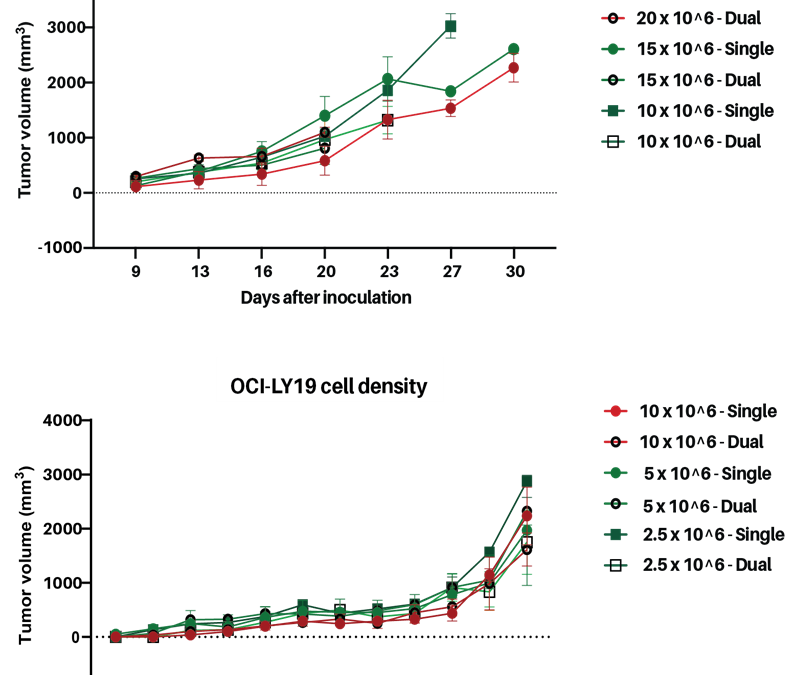
Individuell angepasste CDX-Mausmodelle für Lymphome in der präklinischen Onkologie
In aktuellen Studien haben wir zwei neue Xenotransplantatmodelle (CDX-Modelle) etabliert und validiert, die aus den Zelllinien OCI-Ly19 (diffuses großzelliges B-Zell-Lymphom, DLBCL) und REC-1 (Mantelzell-Lymphom) gewonnen wurden. Diese Modelle wurden im Rahmen einer strategischen...

Multiplex-Profiling von Zytokinen und Immunzellen in der immunonkologischen Forschung
Die Meso-Scale Discovery (MSD)-Plattform ist ein hochempfindliches Multiplex-Analysesystem zur Erstellung von Zytokinprofilen, mit dem Sie mehrere Zielzytokine, Chemokine, Antikörper und Wachstumsfaktoren aus winzigen Probenvolumina (bereits ab 1 µl) gleichzeitig quantifizieren können. Durch...

PDX-Modelle für Bauchspeicheldrüsenkrebs
Der vergangene Monat, der November, war der Monat der Aufklärung über Bauchspeicheldrüsenkrebs – eine Zeit, in der die Herausforderungen im Zusammenhang mit einer der aggressivsten und tödlichsten Krebsarten im Mittelpunkt stehen. Bauchspeicheldrüsenkrebs macht etwa 3 % aller in Europa diagnostizierten Krebserkrankungen aus, wobei Bauchspeicheldrüsenkrebs...

Einblick in die wichtigsten In-vitro-Dienstleistungen von InnoSer im Bereich der Onkologie: PD-1/PD-L1-Blockade-Assay
Immun-Checkpoint-Blockade in der onkologischen Wirkstoffforschung In den letzten Jahren hat sich die Immun-Checkpoint-Blockade als bahnbrechende therapeutische Strategie in der Immunonkologie etabliert. Der Programmierte-Zelltod-1-Rezeptor (PD-1) und sein Ligand, der Programmierte-Zelltod-Ligand 1 (PD-L1)...
AAALAC-Akkreditierung
InnoSer hat die AAALAC-Akkreditierung erhalten und damit sein Engagement für einen verantwortungsvollen Umgang mit Tieren unter Beweis gestellt. AAALAC International ist eine gemeinnützige Organisation, die sich durch freiwillige Akkreditierungs- und Bewertungsprogramme für den artgerechten Umgang mit Tieren in der Wissenschaft einsetzt. Die Einrichtungen von InnoSer in den Niederlanden und Belgien sind seit 2016 bzw. 2020 AAALAC-akkreditiert. Weitere Informationen zum AAALAC-Akkreditierungsprogramm finden Sie hier.

Tierschutz
Die 3Rs wirken sich auf alle Bereiche aus, von politischen und regulatorischen Veränderungen bis hin zur Entwicklung und Einführung neuer Technologien und Ansätze. Aus diesem Grund engagiert sich InnoSer kontinuierlich für diese Prozesse und überwacht sie. Die von uns umgesetzten Maßnahmen maximieren unsere Fähigkeit, den Einsatz von Tieren zu ersetzen, zu reduzieren und zu verfeinern, und unterstützen unser Bekenntnis zu diesen Grundsätzen in der Forschung und der Arzneimittelentwicklung.
info@innoserlaboratories.com