
Psoriasis Mouse Model (IL-23 Induced)
Perform quick efficacy tests to evaluate your novel psoriasis treatment strategies using the acute psoriasis mouse model
Psoriasis Mouse Model Key Characteristics
Preclinical psoriasis mouse models are essential tools for understanding the pathogenesis of psoriasis and evaluating the efficacy of novel therapeutic approaches ranging from topical to systemic treatments. Acute models, such as the IL-23 and Imiquimod-induced models, rapidly induce psoriasis-like symptoms, while chronic models mimic the long-term progression of the disease.
The acute psoriasis model, created by intradermal ear injections of recombinant IL-23, leads to acute skin inflammation. IL-23, a key cytokine, promotes pathogenic lymphocytes that drive keratinocyte differentiation and inflammation, hallmarks of psoriasis. This model mimics human psoriasis features, such as inflammatory cell infiltration, epidermal hyperplasia, and activation of inflammatory pathways.
✓ Rapid induction of psoriasis-like symptoms.
✓ Phenotype exhibits key psoriasis hallmarks, including inflammatory cell infiltration and epidermal hyperplasia.
✓ Suitable for testing IL-23 inhibitors and other modulators of the IL-23-induced inflammation pathway.

As a preclinical immunology CRO, InnoSer offers relevant expertise to support various skin inflammation studies including psoriasis, atopic dermatitis, contact dermatitis, and scleroderma research. In accordance, our dermatological platform allows us to investigate the efficacy of your novel investigational compound(s) in similar models, including Imiquimod-induced psoriasis, Ovalbumin or Oxazole-induced atopic dermatitis, and the Bleomycin-induced scleroderma model.
Take advantage of InnoSer’s collaborative approach to develop the most optimal study design. With flexible and fast study start times you can perform your research at an accelerated pace. By outsourcing your preclinical oncology studies to InnoSer, you gain access to our in vitro and in vivo immunology drug development portfolio.
Psoriasis Mouse Model Sample Data

The IL-23 induced psoriasis mouse model represents a translationally relevant model of psoriasis, while allowing you to obtain quick efficacy data.
8-weeks old C57BL6/J mice were injected with recombinant IL-23 in right ear and with PBS (serving as within-subject control) in left ear every two days for a total of 8 days. Mice were dosed with vehicle, test treatment and positive control twice daily via oral gavage. Ear thickness increased in the IL-23 control (vehicle) group following IL-23 injection. A slight decrease in ear thickness was observed on days 4 and 6 in the positive control-treated group.

The IL-23 induced psoriasis mouse model represents a translationally relevant model of psoriasis, while allowing you to obtain quick efficacy data.
Scoring of psoriasis-like lesions following histopathology assessment reveals increase in inflammatory cell infiltration and hypergranulosis in response to IL-23 treatment. Score 0 indicates presence of such features in normal limits, while scores 2 and 3 indicate slight to moderate presence of psoriasis-like features in the tissue. Bars represent M ± SD.

The IL-23 induced psoriasis mouse model represents a translationally relevant model of psoriasis, while allowing you to obtain quick efficacy data.
H&E-stained sections of ear skin confirm psoriasis-like lesions in the IL-23 induced psoriasis mouse model. Vehicle-treated ear sections show spongiosis.
Key IL-23 Induced Mouse Model Readouts
Les personnes qui travaillent sur vos recherches

Céline Erens, docteure en immunologie, étude Directrice
Une équipe d'experts dirigée par notre ; Céline Erens, travaille à vos côtés pour vous aider à mettre en place des . La gestion des essais précliniques de vos composés phares, fondée sur une connaissance approfondie du domaine, est la solution qui vous permettra d’accélérer le développement de vos médicaments.

Yanick Fanton, docteur, directeur scientifique
En tant que directeur scientifique chez InnoSer, Yanick est responsable de toutes les études menées pour le compte des clients de l'entreprise et assure la coordination scientifique et technique.
Foire aux questions
What is the IL-23 psoriasis mouse model?
The IL-23 psoriasis mouse model is a widely used preclinical model for studying psoriasis pathogenesis and treatment efficacy. It mimics the chronic inflammation and skin lesions seen in human psoriasis by leveraging the role of IL-23, a key cytokine in driving disease progression. Intradermal injection of IL-23 (into the ear) induces a psoriasis-like inflammatory response. IL-23 promotes Th17 cell activation, leading to increased IL-17 and IL-22 production, which drives keratinocyte proliferation and skin thickening. The model exhibits hallmark psoriasis symptoms, including epidermal hyperplasia, erythema, scaling, and immune cell infiltration.
What is the role of IL-23 in the treatment of psoriasis?
Can this model be used to study both early and chronic stages of psoriasis?
What are the timelines and deliverables for studies using this model?
- Day -3 to 0: Acclimatization, baseline measurements (ear thickness, weight, images).
- Days 0-8: Intradermal IL-23 injection (right ear, every 2 days), PBS control (left ear). Monitor inflammation (swelling, redness, scaling).
- Days 9-10: Final assessments, tissue collection.
Découvrez d'autres modèles murins liés à l'immunologie


Restez curieux : d'autres articles à découvrir
Modèles murins CDX personnalisés de lymphome pour la recherche préclinique en oncologie
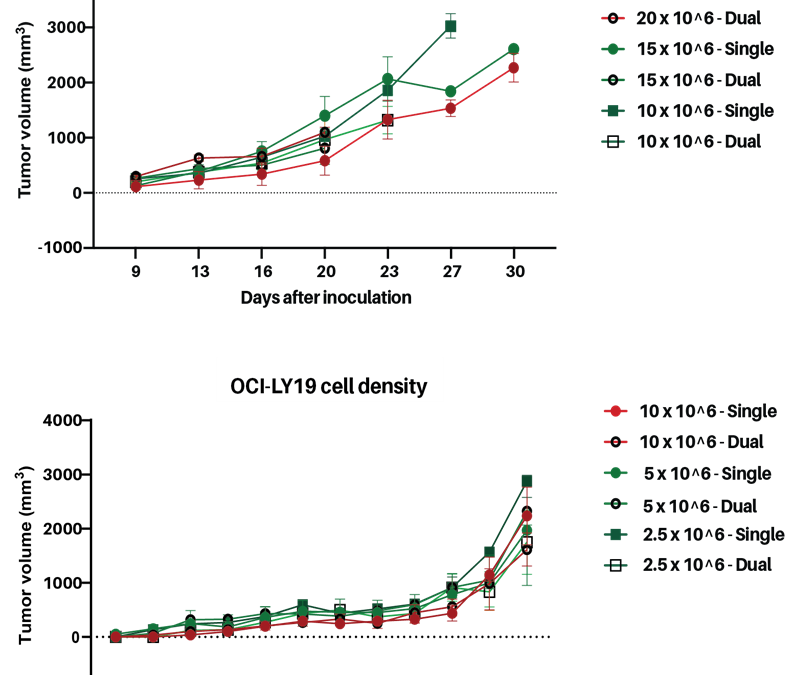
Dans le cadre d’études récentes, nous avons mis au point et validé deux nouveaux modèles de xénogreffes dérivées de lignées cellulaires de lymphomes humains (CDX), issus des lignées cellulaires OCI-Ly19 (lymphome diffus à grandes cellules B, DLBCL) et REC-1 (lymphome à cellules du manteau). Ces modèles ont été développés dans le cadre d’une stratégie...

Profilage multiplexe des cytokines et des cellules immunitaires dans la recherche en immuno-oncologie
La plateforme Meso-Scale Discovery (MSD) est un système d'analyse de profilage multiplexe des cytokines à haute sensibilité, qui vous permet de quantifier simultanément plusieurs cytokines, chimiokines, anticorps et facteurs de croissance cibles à partir de volumes d'échantillons infimes (à partir de 1 µL). En...

Modèles PDX du cancer du pancréas
Le mois dernier, novembre, était le Mois de la sensibilisation au cancer du pancréas ; l'occasion de mettre l'accent sur les défis posés par l'un des types de cancer les plus agressifs et les plus mortels. Le cancer du pancréas représente environ 3 % de l'ensemble des cancers diagnostiqués en Europe, avec le cancer du pancréas...

Découverte des principaux services d'oncologie in vitro d'InnoSer : test de blocage PD-1/PD-L1
Le blocage des points de contrôle immunitaires dans la recherche sur les médicaments oncologiques Ces dernières années, le blocage des points de contrôle immunitaires s'est imposé comme une stratégie thérapeutique révolutionnaire en immuno-oncologie. Le récepteur de la mort cellulaire programmée 1 (PD-1) et son ligand, le ligand de la mort cellulaire programmée 1 (PD-L1)...
Accréditation AAALAC
InnoSer a obtenu l'accréditation AAALAC, ce qui témoigne de notre engagement en faveur d'une prise en charge et d'une utilisation responsables des animaux. AAALAC International est une organisation à but non lucratif qui promeut le traitement sans cruauté des animaux dans le domaine scientifique par le biais de programmes volontaires d'accréditation et d'évaluation. Les sites d'InnoSer aux Pays-Bas et en Belgique sont accrédités par l'AAALAC depuis 2016 et 2020, respectivement. Pour en savoir plus sur le programme d'accréditation de l'AAALAC, cliquez ici.

Bien-être animal
Les « 3R » ont une incidence sur tous les domaines, depuis les changements politiques et réglementaires jusqu’au développement et à l’adoption de nouvelles technologies et approches. C’est pourquoi InnoSer s’engage en permanence à suivre ces processus. Les mesures que nous mettons en œuvre optimisent notre capacité à remplacer, réduire et perfectionner l’utilisation des animaux et facilitent notre engagement envers ces principes dans le cadre de la recherche et du développement de médicaments.
info@innoserlaboratories.com
Liens rapides