
IND Enabling Studies – Nonclinical GLP Safety Assessments
GLP/GMP-certified preclinical safety studies for your IND submission
Performing GLP Studies with InnoSer’s Support
Good Laboratory Practice (GLP) defines the quality standards required to ensure that your nonclinical safety studies are reliable, traceable and suitable for regulatory submission. However, GLP guidelines do not determine which studies should be performed. The appropriate study design depends on the therapeutic modality, mechanism of action, intended clinical use and regulatory requirements.
As a specialist preclinical CRO, InnoSer supports sponsors in designing and executing GLP toxicology programmes tailored to their specific development needs. By combining expertise in exploratory pharmacology, translational models, immunotoxicology and GLP toxicology, we help you identify the most relevant test systems and endpoints to generate meaningful safety data.
Our GLP capabilities support a wide range of therapeutic modalities, including small molecules, biologics, RNA therapeutics, cell and gene therapies. Study designs may include repeated-dose toxicity, safety pharmacology, immunotoxicity assessment, immunogenicity testing, biodistribution studies and other modality-specific non-clinical safety evaluations.
✓ GLP-certified since 2004: GLP toxicology studies and immunotoxicology/immunogenicity assessments
✓ GMP certified since 2007: in vivo adventitious virus testing & potency testing of recombinant vaccines
✓ 25 years of preclinical safety expertise: founded 2001 · EU-based · Gronau, Germany
✓ OECD · ICH S6 · ICH S8 · ISO 10993 · EMA/FDA aligned
✓ 2 GxP archives · full audit trail · client audit rights
Generate GLP-compliant nonclinical safety data to your IND needs — without the guesswork
Every molecule is different. Your GLP strategy should be too.
Our study directors work with you from the first conversation — integrating your existing pharmacology data, translational insights, and regulatory requirements into a safety programme that is designed for your molecule specifically/
The result: reliable, submission-ready GLP data generated efficiently, with no unnecessary studies and no surprises in your timeline.


Collaborative scientific guidance
Work directly with experienced toxicologists and study directors throughout planning, execution, and reporting.
Tailored study design
No one-size-fits-all approach — study strategies are adapted to your molecule, mechanism of action, and development stage.
Agile support from exploratory to GLP
Integrate existing pharmacology data and translational insights to build efficient safety packages and avoid unnecessary studies.
What studies does InnoSer offer under GLP/GMP?
Chemical testing in accordance with OECD guidelines
- OECD 417 – Toxicokinetic
- OECD 420 – Acute Oral Toxicity – Fixed Dose Procedure
- OECD 423 – Acute Oral toxicity – Acute Toxic Class Method
- OECD 425– Acute Oral toxicity – Up and Down Procedure
- OECD 407 – Repeated Dose 28-day Oral Toxicity Study in Rodents
- OECD 408 – Repeated Dose 90-Day Oral Toxicity Study in Rodents
- OECD 452 – Chronic Toxicity Studies
- OECD 453 – Combined Chronic Toxicity/Carcinogenicity Studies
- OECD 451 – Carcinogenicity Studies
- OECD 414 – Prenatal Development Toxicity Study
- OECD 416 – Two-Generation Reproduction Toxicity
- OECD 421 – Reproduction/Developmental Toxicity Screening Test
- OECD 422 – Combined Repeated Dose Toxicity Study with the Reproduction/Developmental Toxicity Screening Test
- OECD 443- Extended One-Generation Reproductive Toxicity Study
- OECD 442 B – Skin Sensitization
- OECD 474: Mammalian Erythrocyte Micronucleus Test
Medical Device testing in accordance with ISO10993 guidelines
- ISO10993-1 Requirements and general principles for the evaluation of biological safety within a risk management process
- ISO 10993-11: Systemic toxicity
- ISO 10993-6: Tests for local effects after implantation
- ISO10993-2: Animal welfare requirements
- ISO10993-12: Sample preparation and reference materials.
- Under consideration of ISO10993-17: Toxicological risk assessment of medical device constituents
- ISO10993-18: Chemical characterization of medical device materials within a risk management process
- ISO/TR10993-19: Nano-technologies – Considerations for performing toxicokinetic studies with nanomaterials, etc.
Food testing in accordance with EFSA guidelines for novel foods and ingredients, food additives and flavourings, food contact materials
- Toxicology testing in accordance with EFSA and OECD guidance documents
- Repeated dose administrations via oral gavage or feed
(Bio)Pharmaceuticals (EMA) - Testings in accordance with ICH M3 (R2) and ICH S6 (Biotechnological Products)
- Local tolerance
- Carcinogenicity (S1)
- Toxicokinetics & Pharmacokinetics (S3)
- Toxicity testing (S4), Repeated Dose Toxicity
- Reprotoxicity (S5)
- Immunotoxicology Studies (S8)
- Non-clinical Biodistribution considerations for Gene therapy products (S12)
- Immunology assays: in vivo, TDAR assay (KLH), Delayed type hypersensitivity, Sensitization (mLLNA)
- Autoimmunity studies
- Tumorigenicity/ oncogenicity
- Vaccine studies
- Potency assays/ efficacy studies
- Histopathology of Immune organs
- Differential blood counts
- ex-vivo/ in vitro Immunophenotyping (FC) of leucocytes and lymphocytes, Cytokine release (FC, CBA), NK-activity ex vivo and following in vitro stimulation
- Antigen dependent T-cell proliferation (ELISPOT)
- Mitogen dependent proliferation (BrdU)
- Phagocytosis of macrophages from peritoneal exudates
- Complement activation (MAC, CARPA, ELISA)
- Serological quantification of antibody concentrations/ isotype distribution
- Pharmacological in vitro studies
- Pharmacokinetics of biologicals (direct / biomarkers)
- Anti-drug antibody assays (screening / confirmatory ADA)
- Immunohistological analytics
- Detection of specific antigens in selected tissues
- Enzyme-linked detection systems
- Semi-quantitative analysis and analytics of IHC
- in vivo analysis for adventitious viruses in accordance with European Pharmacopoeia 2.6.16 (Ph.Eur.), ICH guideline Q5A (CPMP/ICH/295/95) Points to Consider PTC (1993)
Your Nonclinical Safety Programme Starts Here.
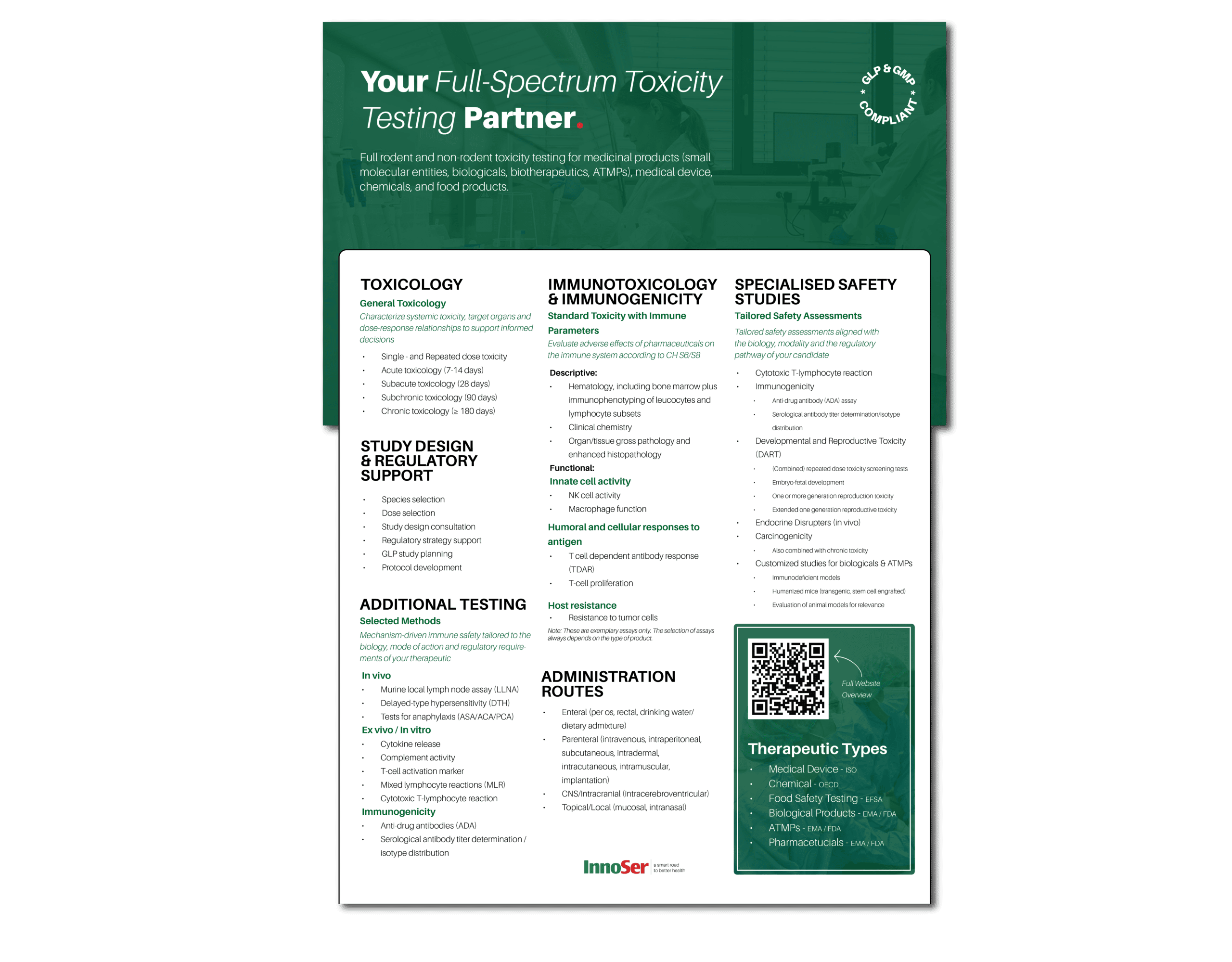
Explore InnoSer’s GLP Toxicology Capabilities at a Glance
Practical insights from our scientists that shape the path to GLP safety assessment

Your compound has shown efficacy in a preclinical disease model – now what? Moving from exploratory studies to GLP toxicology studies
Not every preclinical study requires GLP compliance. Understanding when to transition from exploratory non-GLP research to regulatory GLP toxicology studies can save valuable time, budget, and prevent delays when preparing your IND or CTA submission. Read more >>

When does an immune-safety concern warrant additional immunotoxicity testing?
Every molecule is different. Your GLP strategy should be too.
Arbeiten Sie mit unserem Team zusammen, um Ihr Medikament und Ihr Zielmolekül im Hinblick auf therapeutische Wirkungen präzise und fachkundig zu bewerten.
Die Menschen hinter Ihrer Forschung

Dr. Marion Hecht, PhD
Director of Operations, InnoSer Deutschland
Dr. Marion Hecht has been with the GLP/GMP-certified safety testing facility (formerly Vivo Science) in Gronau for 15 years, spanning its integration into InnoSer in 2026. Starting as a Project Manager, she went on to lead Quality Assurance before becoming Test Facility Manager and COO in 2024. She oversees GLP/GMP operations, quality systems, and regulatory compliance, and serves as InnoSer’s primary regulatory interface with German inspection authorities.
Entdecken Sie die neuesten Forschungsergebnisse von InnoSer
Neurodevelopmental disorder mouse models at InnoSer — TSC, Rett & STXBP1
in this month's update, we invite you to explore recent developments in rare neurodevelopmental disorders associated with epilepsy and seizure phenotypes. We highlight emerging therapeutic approaches, discuss the importance of selecting translationally relevant...

Plasma NfL, p-tau217, or Aβ42/40: Which Alzheimer’s disease biomarkers should you include in your preclinical efficacy study?
A practical guide to preclinical Alzheimer’s disease biomarkers panel selection when you’re considering outsourcing to a specialist neurology CRO Biomarkers have transformed Alzheimer's disease clinical trials, enabling diagnosis confirmation for trial eligibility,...

Transgenic Amyloid, Tau, Seeding, or combined Amyloid/Tau pathology mouse models — which is the right one for your drug development program?
A practical guide to model selection when outsourcing your Alzheimer's disease efficacy study to a specialist neurology CRO Choosing the right Alzheimer's disease mouse model is one of the most consequential early decisions in a preclinical drug development program....

Morris Water Maze, Rotarod and beyond: How do you build a comprehensive behavioral test battery when outsourcing your preclinical Alzheimer’s disease efficacy study?
A practical introduction to behavioural test battery selection when outsourcing your Alzheimer's disease efficacy study to a specialist neurology CRO When outsourcing a preclinical Alzheimer's disease efficacy study, behavioral endpoint selection is one of the most...

Die Pipeline der Arzneimittelentwicklung im Überblick
AAALAC-Akkreditierung
InnoSer hat die AAALAC-Akkreditierung erhalten und damit sein Engagement für einen verantwortungsvollen Umgang mit Tieren unter Beweis gestellt. AAALAC International ist eine gemeinnützige Organisation, die sich durch freiwillige Akkreditierungs- und Bewertungsprogramme für den artgerechten Umgang mit Tieren in der Wissenschaft einsetzt. Die Einrichtungen von InnoSer in den Niederlanden und Belgien sind seit 2016 bzw. 2020 AAALAC-akkreditiert. Weitere Informationen zum AAALAC-Akkreditierungsprogramm finden Sie hier.

Tierschutz
Die 3Rs wirken sich auf alle Bereiche aus, von politischen und regulatorischen Veränderungen bis hin zur Entwicklung und Einführung neuer Technologien und Ansätze. Aus diesem Grund engagiert sich InnoSer kontinuierlich für diese Prozesse und überwacht sie. Die von uns umgesetzten Maßnahmen maximieren unsere Fähigkeit, den Einsatz von Tieren zu ersetzen, zu reduzieren und zu verfeinern, und unterstützen unser Bekenntnis zu diesen Grundsätzen in der Forschung und der Arzneimittelentwicklung.
info@innoserlaboratories.com