
Modèle murin du diabète de type 1s – Modèle murin NOD (Nonobese Diabetic)dudiabète sucré de type 1
Testez votre composé immunomodulateur sur le modèle murin NOD du diabète de type 1 auto-immun
Caractéristiques principales du modèle murin NOD du diabète de type 1
Le modèle murin NOD est l’un des modèles précliniques les plus reconnus et les plus largement utilisés (décrit à l’origine par Makino et al., 1980)pour étudier l’efficacité de nouveaux traitements contre le diabète de type 1 (DT1). En raison d'un patrimoine génétique polygénique favorisant une dérégulation immunitaire, une perte d'autotolérance et la destruction des cellules bêta pancréatiques par les lymphocytes T, les souris NOD développent spontanément un DT1.
Conformément à la littérature publiée et aux données de référence fournies par les fournisseurs, les études de validation menées en interne par InnoSer ont montré que les souris NOD femelles développent spontanément un DT1, caractérisé par une glycémie supérieure à 250 mg/dL, avec une incidence médiane à l’âge de 19 semaines. En accord avec le phénotype publié pour ce modèle, nos données confirment l’évolution progressive de la maladie, qui se caractérise par une insulite et une atrophie des cellules bêta productrices d’insuline.
Par conséquent, le modèle murin NOD constitue un modèle murin pertinent pour obtenir des ensembles de données d’efficacité pertinents sur le plan translationnel, adaptés à l’évaluation des thérapies immunomodulatrices, des composés protecteurs des cellules bêta, des stratégies de prévention et des interventions modificatrices de la maladie.
✓ InnoSer propose des solutions entièrement validés flux de travail internes pour les études NOD, comprenant la surveillance longitudinale de la glycémie, le suivi de l’incidence du diabète, et des évaluations histopathologiques réalisées par un pathologiste vétérinaire certifié
✓ Les deux protocoles de dosage prophylactiques que thérapeutiques sont disponibles, permettant une intervention avant l’apparition du diabète ou un traitement après confirmation de l’ hyperglycémie
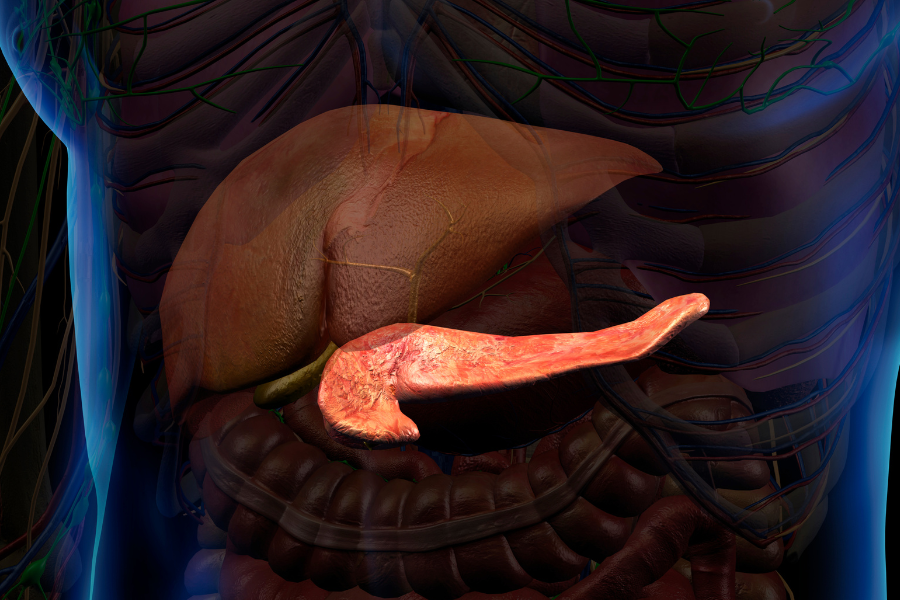
InnoSer propose des services de recherche préclinique utilisant trois modèles murins distincts du DT1 : le modèle auto-immun spontané NOD, le modèle induit par le STZ et le modèle induit par l'alloxane, chacun reflétant un aspect particulier de la physiopathologie du DT1. Toutefois, chaque modèle présentant des caractéristiques qui lui sont propres et des fenêtres d'intervention optimales, nous vous recommandons de définir le protocole de votre étude en étroite collaboration avec nos experts.
InnoSer’s vdonnées de validation de le modèle murin NOD
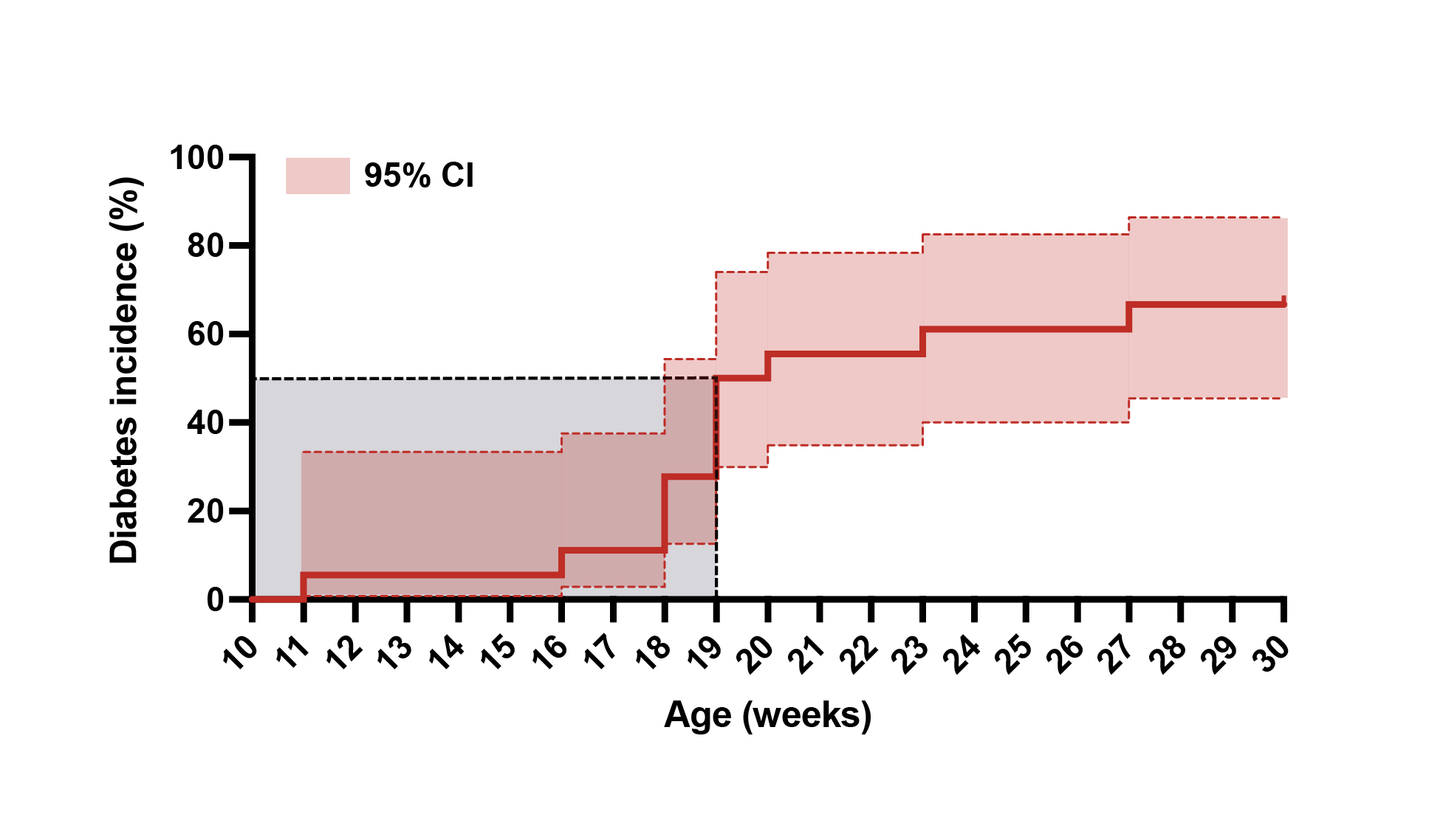
Les souris NOD femelles reproduisent de manière fiable l'évolution du diabète spontané, avec une incidence du diabète atteignant 50 % à l'âge de 19 semaines.
Femme Des (n = 18) ont été recrutées à l'âge de 12 semaines et suivies longitudinalement de manière longitudinale jusqu’à l’âge de 30 semaines. La glycémie à jeun a été mesurée chaque semaine par prélèvement sanguin dans la veine caudale, de 11 à 30 semaines, afin de surveiller l'apparition et la progression du diabète. Le diabète de type 1 a été confirmé lorsque la glycémie dépassait 250 mg/dL lors de deux mesures consécutives. La variabilité de l'apparition et de la gravité du diabète chez les souris NOD reflète celle observée dans l'évolution de la maladie chez l'homme. Conformément à la littérature, certains animaux n’ont pas développer jusqu’à une hyperglycémie manifeste, bien que l’analyse histologique a néanmoins a révélé des degrés variables d’insulite (inflammation des îlots ) (Ehall et al., 2026).
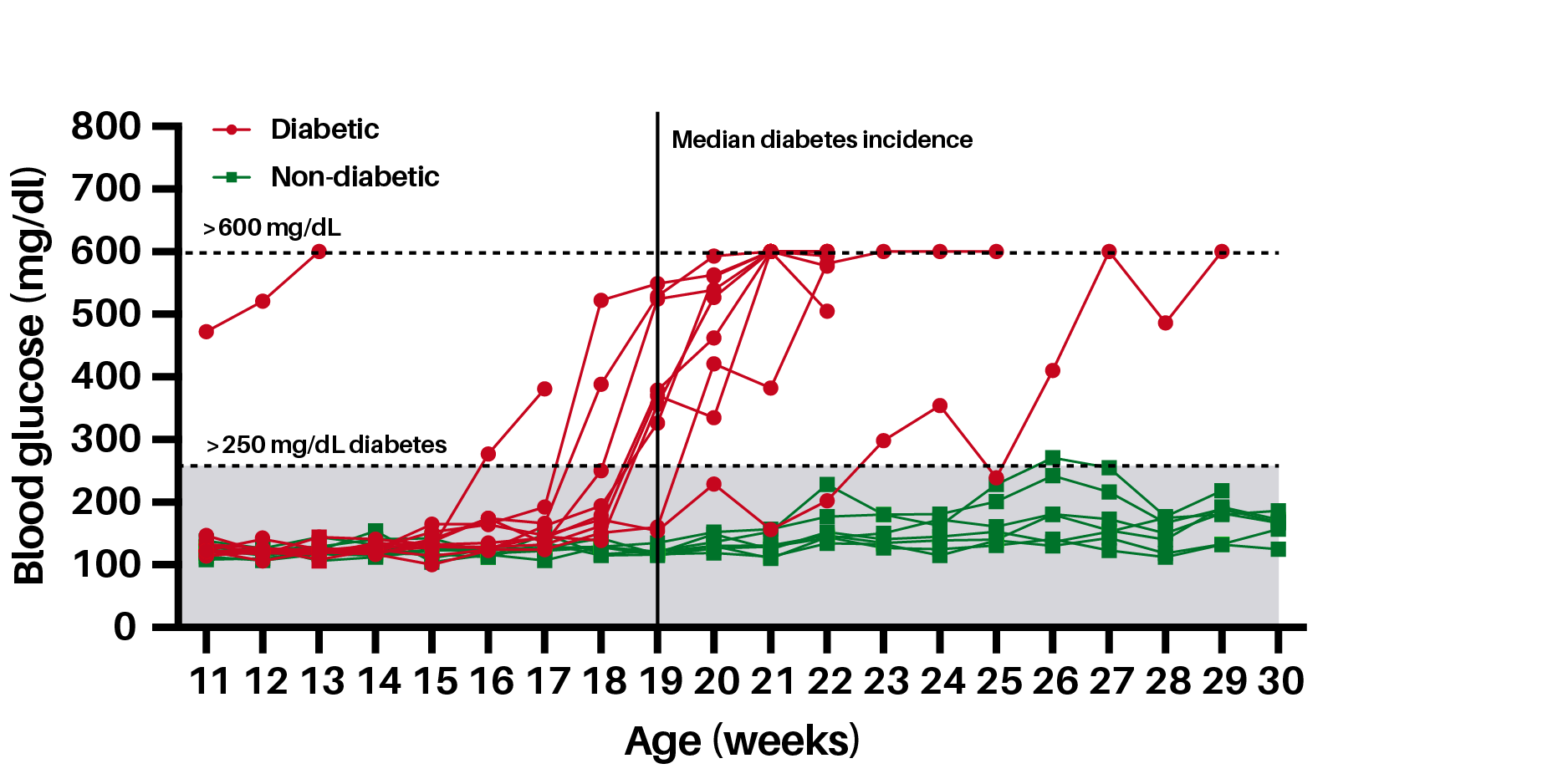
Les souris NOD femelles développent une hyperglycémie progressive à la suite de l'apparition spontanée d'un diabète de type 1
Des souris NOD femelles (n = 18) ont été suivies de manière longitudinale de 11 à 30 semaines à l’aide de mesures hebdomadaires de la glycémie à jeun, obtenues par prélèvement dans la veine caudale. Les souris ayant développé un diabète (n = 11) présentaient des élévations persistantes de leur glycémie au-delà du seuil diagnostique (> 250 mg/dL), tandis que les animaux non diabétiques (n = 7) conservaient des profils normoglycémiques tout au long de l’étude. Les animaux ayant atteint une hyperglycémie sévère (>600 mg/dL) ont été euthanasiés conformément aux critères d’arrêt prédéfinis de l’étude. La variabilité concernant l’apparition du diabète et la gravité de la maladie observée chez les souris NOD reflète fidèlement la progression hétérogène du diabète de type 1 chez les patients, ce qui corrobore l’e pertinence de ce modèle pour les essais d’efficacité et les interventions modificatrices de la maladie. Conformément à la littérature, certains animaux n’ont pas développé d’ hyperglycémie manifeste, bien que l’analyse histologique ait tout de même révélé des degrés variables d’insulite (inflammation des îlots pancréatiques) (Ehall et al., 2026)
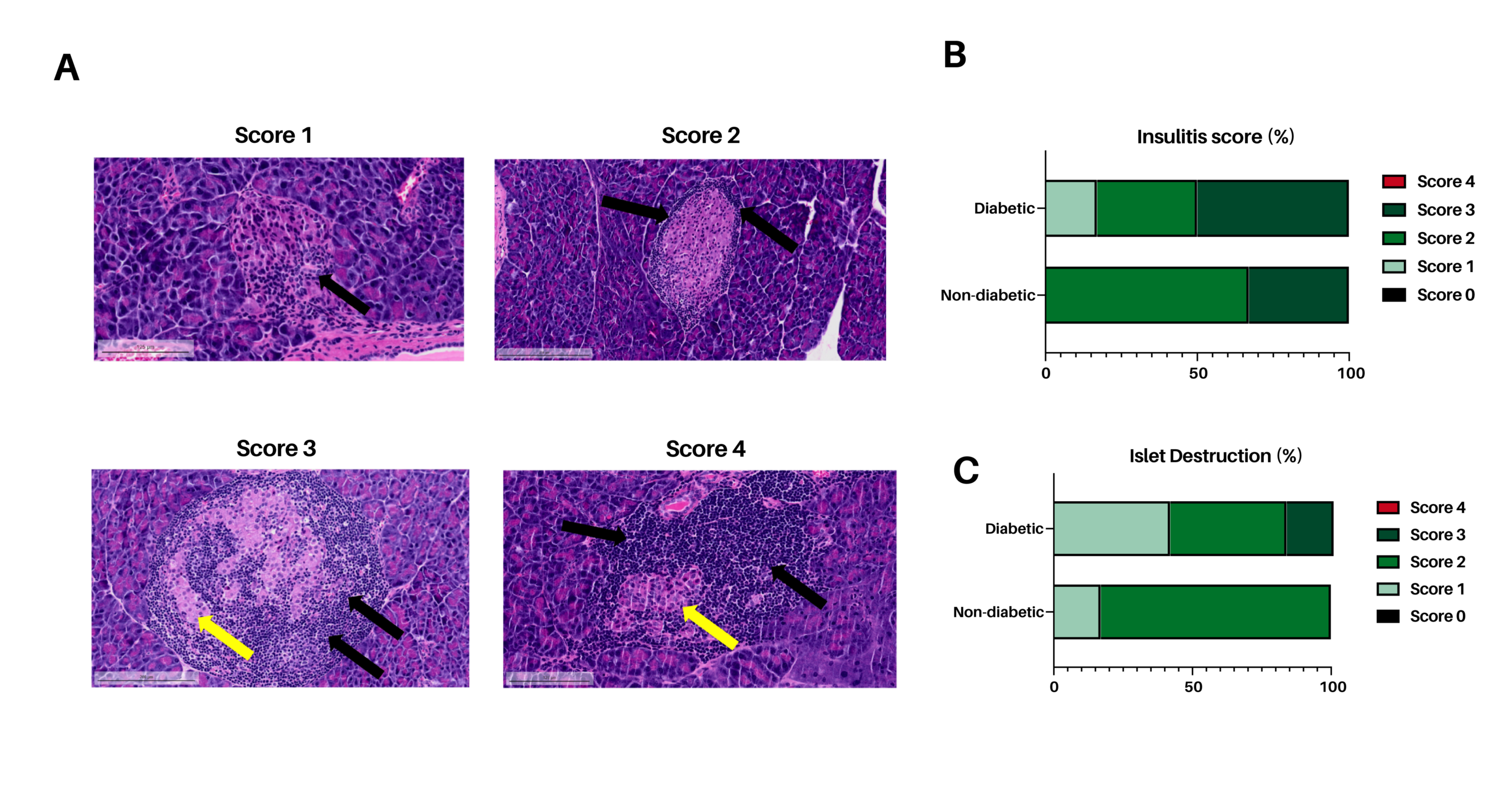
Les souris NOD femelles développent une insulite progressive et une destruction des îlots pancréatiques, reproduisant ainsi la pathologie auto-immune à l'origine du diabète de type 1
Les coupes pancréatiques ont été évaluées à l'aide d'un système de notation semi-quantitative de l'insulite allant d'une infiltration inflammatoire péri-îlotique (grade 1) à une infiltration étendue de cellules mononucléaires accompagnée d'une destruction sévère des cellules bêta et d'une perte d'îlots (grade 4). Pratiquement toutes les souris NOD femelles présentaient un certain degré d’insulite, y compris les animaux normoglycémiques, ce qui reflète le fait que l’infiltration auto-immune des îlots pancréatiques précède l’apparition manifeste du diabète. Alors que la plupart souris évoluent vers une destruction étendue des cellules bêta et une une hyperglycémie, un petit sous-groupe restents dans un état d’insulite légère ou non progressive, reflétant l’hétérogénéité observée lors du développement du diabète de type 1 chez l’homme.
Principaux résultats obtenus dans le modèle murin NOD
Les personnes qui travaillent sur vos recherches

Yanick Fanton, docteur, directeur scientifique
En tant que directeur scientifique chez InnoSer, Yanick est responsable de toutes les études menées pour le compte des clients de l'entreprise et assure la coordination scientifique et technique.

Lisa Claes, directrice d'étude
Lisa vous aide à choisir les bons outils et à mettre en place des protocoles d'étude optimaux. La gestion des essais précliniques de vos composés phares, fondée sur une connaissance approfondie du domaine, est la solution qui vous permettra d'accélérer le développement de vos médicaments.

Laboratoire de diabétologie de Louvain
InnoSer travaille en étroite collaboration avec le laboratoire du Prof. Dr Chantal Mathieu, en intégrant ses technologie de pointe expertise en matière de diabète de type 1 en matière de diabète de type 1 afin d’ aider nos clients à à concevoir deset pertinents sur le plan translationnel études précliniques, afin, à terme, accélérerle le développement de nouvelles thérapies.
Foire aux questions
Comment la fin de l'étude est-elle déterminée dans le modèle murin NOD chez InnoSer ?
La glycémie des souris est contrôlée régulièrement ; l'apparition du diabète est définie par deux mesures consécutives supérieures à 250 mg/dL. Une fois l'apparition du diabète confirmée, les animaux font l'objet d'une surveillance accrue et sont sacrifiés dès qu'ils atteignent une hyperglycémie sévère, définie par deux mesures consécutives de glycémie supérieures à 600 mg/dL.
Conformément aux recommandations en matière de bien-être animal, il est généralement admis de se baser sur une hyperglycémie persistante (> 600 mg/dL), associée à des signes cliniques et à l’état physique des animaux, pour déterminer à quel moment les souris atteignent les critères d’euthanasie, en intervenant avant l’apparition de souffrances graves. Cette approche reflète à la fois les pratiques établies dans la littérature consacrée au modèle NOD et l’engagement d’InnoSer en faveur des « 3R » de la recherche animale.
Contactez notre équipe pour discuter des critères d'évaluation et du calendrier de votre programme.
Pourquoi utilise-t-on principalement des souris NOD femelles dans les études d'efficacité ?
InnoSer applique systématiquement les directives réglementaires visant à inclure à la fois des rongeurs mâles et femelles dans les études précliniques, afin de mieux comprendre les différences entre les sexes en matière de manifestation des maladies et de réponse aux traitements. Cependant, le modèle murin NOD présente, selon la littérature scientifique, une différence marquée et bien documentée entre les sexes quant à l'incidence du diabète spontané (Rosmalen et al., 2001). En conséquence, des recherches ont montré que, tandis que 60 à 80 % des femelles développent un diabète, chez les souris NOD mâles, la prévalence n’est que de 20 à 30 %.
Cela a donc d'importantes implications pratiques pour la conception des études d'efficacité précliniques, dans la mesure où il faut moins d'animaux pour obtenir des effectifs suffisants et, par conséquent, la puissance statistique nécessaire pour détecter des résultats significatifs.
En quoi le modèle murin NOD du diabète de type 1 diffère-t-il des modèles murins de diabète induit ?
La distinction fondamentale entre le modèle murin NOD et un modèle murin induit chimiquement réside dans le mécanisme de perte des cellules bêta. Le modèle murin NOD se caractérise par l'apparition spontanée d'un diabète due à un fond génétique polygénique favorisant une dérégulation immunitaire, une perte d'autotolérance et une destruction des cellules bêta pancréatiques médiée par les lymphocytes T. Chez la souris NOD, les lymphocytes T autoréactifs commencent à infiltrer les îlots pancréatiques vers l’âge de 3 à 4 semaines, détruisant progressivement les cellules bêta productrices d’insuline au cours d’un processus immunitaire par étapes qui reflète la séquence immunologique de l’apparition du diabète de type 1 chez l’homme.
En revanche, le modèle murin de diabète induit par le STZ repose sur la cytotoxicité des cellules bêta plutôt que sur une destruction auto-immune, et ne parvient donc pas à reproduire la phase préclinique d’auto-anticorps observée chez l’homme. Il s’agit toutefois d’un modèle murin préclinique de diabète rapide et hautement reproductible, particulièrement adapté à l’évaluation de l’efficacité précoce des stratégies de substitution insulinique, des composés hypoglycémiants et des approches de régénération des cellules bêta.
De même, le modèle murin de diabète induit par le STZ et le modèle murin de diabète induit par l’alloxane entraînent une hyperglycémie rapide d’origine chimique, sans composante auto-immune. L’alloxane est un dérivé de l’urée qui induit une nécrose sélective des cellules bêta des îlots pancréatiques en générant des radicaux hydroxyles hautement réactifs responsables de la fragmentation de l’ADN.
Par conséquent, pour les programmes ciblant les mécanismes auto-immuns du DT1, le modèle NOD constitue le choix le plus approprié. Pour une ablation rapide et reproductible des cellules bêta, indépendante des mécanismes immunitaires, le STZ ou l'alloxane constituent les plateformes les plus pratiques et s'avèrent souvent les plus utiles pour évaluer l'efficacité à un stade précoce.
Quelles sont les fenêtres d'intervention disponibles chez InnoSer avec le modèle murin NOD ?
InnoSer prend en charge trois paradigmes d'intervention distincts dans le modèle murin NOD, chacun étant conçu pour répondre à une hypothèse thérapeutique et à un stade de la maladie différents :
- Études de prévention (fenêtre prédiabétique) : Les études de prévention menées sur le modèle murin NOD sont lancées avant l'apparition de l'insulite et l'installation de la maladie manifeste, ce qui correspond à la fenêtre la plus précoce et la plus permissive sur le plan immunologique. Ce protocole est particulièrement adapté aux approches visant à induire une tolérance immunitaire et aux stratégies d'immunothérapie prophylactique.
- Études de prévention (phase précoce de l'apparition de la maladie) : Des études de prévention peuvent être menées sur le modèle murin NOD pendant la phase précoce de l'apparition de la maladie, qui constitue un point de contrôle critique marquant le passage d'une péri-insulite non destructive à une intra-insulite destructive. À l'instar des études de prévention menées pendant la phase prédiabétique, ce protocole de recherche est particulièrement adapté aux approches immunologiques.
- Études d'intervention thérapeutique (l'administration du traitement commence une fois la maladie établie) : Le diabète de type 1 dans le modèle murin NOD est défini par une glycémie confirmée supérieure à 250 mg/dL lors de deux mesures consécutives, ce qui signifie que l’administration du traitement commence généralement vers l’âge de 20 semaines (l’âge médian d’apparition du diabète dans le modèle murin NOD chez InnoSer Labs était de 19 semaines, voir les figures dans la section ci-dessus). Ces protocoles s'adressent à la population de patients la plus pertinente sur le plan clinique : les individus qui présentent déjà un DT1 manifeste et qui ont besoin d'une modification de l'évolution de la maladie ou d'une préservation des cellules bêta plutôt que d'une prévention. Par rapport aux études de prévention, les études d'intervention thérapeutique sont les plus adaptées à l'évaluation de l'efficacité des stratégies combinées axées sur la modulation immunitaire ainsi que des traitements favorisant la régénération des cellules bêta.
Il est important de noter que tous les calendriers de l'étude et les périodes d'intervention font l'objet de discussions approfondies avec l'équipe scientifique d'InnoSer, en fonction du mécanisme d'action de votre molécule, des exigences posologiques et des critères d'évaluation cibles.
Découvrez d'autres modèles murins liés aux maladies métaboliques


Découvrez d'autres modèles murins liés à l'immunologie


Restez curieux : d'autres articles à découvrir
Modèles murins CDX personnalisés de lymphome pour la recherche préclinique en oncologie
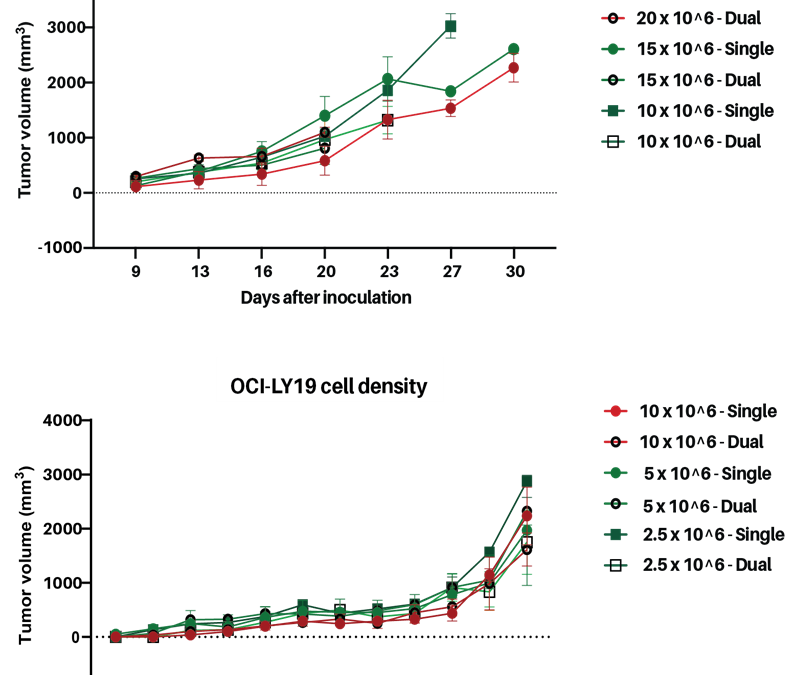
Dans le cadre d’études récentes, nous avons mis au point et validé deux nouveaux modèles de xénogreffes dérivées de lignées cellulaires de lymphomes humains (CDX), issus des lignées cellulaires OCI-Ly19 (lymphome diffus à grandes cellules B, DLBCL) et REC-1 (lymphome à cellules du manteau). Ces modèles ont été développés dans le cadre d’une stratégie...

Profilage multiplexe des cytokines et des cellules immunitaires dans la recherche en immuno-oncologie
La plateforme Meso-Scale Discovery (MSD) est un système d'analyse de profilage multiplexe des cytokines à haute sensibilité, qui vous permet de quantifier simultanément plusieurs cytokines, chimiokines, anticorps et facteurs de croissance cibles à partir de volumes d'échantillons infimes (à partir de 1 µL). En...

Modèles PDX du cancer du pancréas
Le mois dernier, novembre, était le Mois de la sensibilisation au cancer du pancréas ; l'occasion de mettre l'accent sur les défis posés par l'un des types de cancer les plus agressifs et les plus mortels. Le cancer du pancréas représente environ 3 % de l'ensemble des cancers diagnostiqués en Europe, avec le cancer du pancréas...

Découverte des principaux services d'oncologie in vitro d'InnoSer : test de blocage PD-1/PD-L1
Le blocage des points de contrôle immunitaires dans la recherche sur les médicaments oncologiques Ces dernières années, le blocage des points de contrôle immunitaires s'est imposé comme une stratégie thérapeutique révolutionnaire en immuno-oncologie. Le récepteur de la mort cellulaire programmée 1 (PD-1) et son ligand, le ligand de la mort cellulaire programmée 1 (PD-L1)...
Accréditation AAALAC
InnoSer a obtenu l'accréditation AAALAC, ce qui témoigne de notre engagement en faveur d'une prise en charge et d'une utilisation responsables des animaux. AAALAC International est une organisation à but non lucratif qui promeut le traitement sans cruauté des animaux dans le domaine scientifique par le biais de programmes volontaires d'accréditation et d'évaluation. Les sites d'InnoSer aux Pays-Bas et en Belgique sont accrédités par l'AAALAC depuis 2016 et 2020, respectivement. Pour en savoir plus sur le programme d'accréditation de l'AAALAC, cliquez ici.

Bien-être animal
Les « 3R » ont une incidence sur tous les domaines, depuis les changements politiques et réglementaires jusqu’au développement et à l’adoption de nouvelles technologies et approches. C’est pourquoi InnoSer s’engage en permanence à suivre ces processus. Les mesures que nous mettons en œuvre optimisent notre capacité à remplacer, réduire et perfectionner l’utilisation des animaux et facilitent notre engagement envers ces principes dans le cadre de la recherche et du développement de médicaments.
info@innoserlaboratories.com
Liens rapides